However, many new 4WD drivers are unsure when to select high range or low range. Using the wrong setting can make driving more difficult, increase wheelspin and place additional stress on drivetrain components.
This guide explains how 4H and 4L work, when to use each setting, how they differ across common Australian off-road conditions and which mistakes drivers should avoid.
Quick Answer: When Should You Use 4H vs 4L?
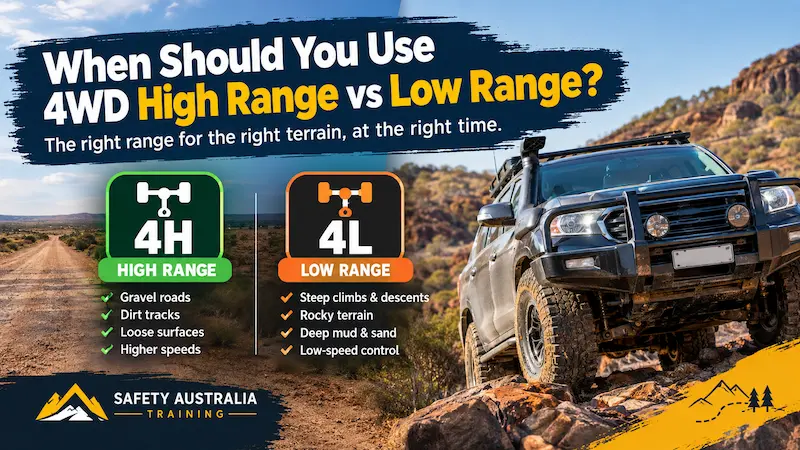
Use 4WD High Range (4H) when you need additional traction while maintaining normal or moderate driving speeds. It is commonly used on gravel roads, sandy tracks and slippery surfaces, subject to the vehicle manufacturer’s instructions.
Use 4WD Low Range (4L) when driving slowly through demanding terrain that requires greater torque and precise vehicle control, such as steep climbs, rocky tracks, deep mud or controlled descents.
Explore 4WD Training in Australia
What Is the Difference Between 4WD High Range and Low Range?
High range and low range are two different gear ratios available in many four-wheel-drive vehicles equipped with a dual-range transfer case. Both settings can send engine power to all four wheels, but they are designed for different driving conditions.
The main difference is how the transfer case changes the relationship between engine speed and wheel speed.
Four-Wheel Drive High Range
Provides four-wheel-drive traction while retaining higher gearing for normal or moderate off-road speeds. Suitable for many loose or slippery surfaces where the vehicle manufacturer’s instructions permit its use.
Four-Wheel Drive Low Range
Uses lower gearing to multiply torque at the wheels and provide greater control at low speeds. Designed for challenging terrain, steep gradients and technical off-road driving.
In simple terms, 4H is generally for maintaining momentum, while 4L is for controlled movement when the terrain becomes more demanding. Neither setting automatically makes a vehicle safer; correct selection depends on the surface, conditions, vehicle design and driving technique.
What Is 4WD High Range (4H)?
Four-wheel-drive high range allows a vehicle to distribute power to all four wheels while using the transfer case’s normal or higher gear ratio. It is useful when you need extra traction but do not require the slow-speed torque multiplication provided by low range.
For many part-time 4WD vehicles, selecting 4H engages the front and rear drivetrains together. This can improve traction on loose or slippery surfaces, but it also means the vehicle cannot freely accommodate differences in front and rear axle speeds when turning on high-grip surfaces.
When Should You Use 4H?
Depending on your vehicle’s drivetrain and manufacturer recommendations, 4H may be appropriate for:
- Gravel roads: Loose gravel can reduce tyre grip, making additional traction useful.
- Sand tracks: 4H is commonly used on suitable beach and sandy tracks where maintaining controlled momentum is important.
- Wet or slippery tracks: Muddy or rain-affected surfaces may require additional traction, depending on their condition.
- Loose dirt roads: Four-wheel-drive traction can help maintain control when the surface is uneven or unstable.
- Moderate off-road trails: 4H can be suitable when the route does not require the extra torque multiplication of low range.
Do not assume that 4H is suitable for every road. On dry, sealed, high-traction surfaces, many part-time 4WD vehicles should remain in 2H. Check your owner’s manual because full-time 4WD and selectable 4WD systems operate differently.
What Is 4WD Low Range (4L)?
Four-wheel-drive low range uses a lower transfer-case gear ratio to reduce wheel speed while increasing torque multiplication. This allows the vehicle to move more slowly and with greater control when negotiating difficult terrain.
Unlike high range, low range is not designed for normal road speeds. It is intended for situations where controlled power delivery and slow movement are more important than travelling quickly.
When Should You Use 4L?
Low range is particularly useful in demanding off-road conditions, including:
- Steep uphill climbs: Helps provide controlled torque when climbing difficult gradients.
- Steep downhill sections: Supports controlled low-speed descent and allows the driver to make better use of engine braking.
- Rock crawling: Provides slow, precise movement when negotiating rocks, ledges and uneven obstacles.
- Deep mud: Can help maintain controlled power delivery where slow movement is required.
- Deep sand or difficult soft terrain: May be useful where the terrain or vehicle conditions require additional torque and controlled movement.
- Vehicle recovery: Can assist with controlled movement during certain recovery situations, provided the recovery method is appropriate and safe.
Low range does not guarantee that a vehicle will get through difficult terrain. Tyre selection, ground clearance, vehicle weight, traction, driver experience and terrain assessment remain important.
4H vs 4L: Key Differences Explained
The following comparison summarises the main differences between 4WD high range and low range.
| Feature | 4WD High Range (4H) | 4WD Low Range (4L) |
|---|---|---|
| Gear ratio | Higher gearing | Lower gearing |
| Wheel speed | Suitable for higher speeds within vehicle limits | Designed for controlled low-speed movement |
| Torque multiplication | Normal transfer-case gearing | Greater torque multiplication |
| Best suited for | Loose gravel, sand and moderate slippery tracks | Rocky tracks, steep gradients and difficult terrain |
| Driving style | Controlled momentum | Slow and precise driving |
| Typical use | Moderate off-road conditions | Technical off-road conditions |
Which 4WD Range Should You Use on Different Australian Terrains?
Australia offers a wide range of off-road driving conditions. From coastal beaches and outback tracks to steep mountain trails, each environment presents different challenges.
Choosing between 4H and 4L requires you to assess the terrain, vehicle capability and driving conditions rather than relying on a fixed rule.
1. Driving on Sand and Beaches
Driving on sand requires careful tyre pressure management, smooth acceleration and consistent momentum. In many suitable sandy conditions, 4H is commonly used to maintain traction without needing the extra torque multiplication of low range.
However, very soft sand, steep sandy climbs or difficult recovery situations may require a different approach. Some vehicles and conditions may benefit from low range.
Before driving on beaches, check local access rules, tides, weather and environmental restrictions. Reduce tyre pressures only in accordance with suitable guidance for your vehicle and reinflate them before returning to normal road speeds.
2. Driving on Rocky Tracks
Rocky terrain often requires slow, controlled driving. Large obstacles, uneven surfaces and sudden changes in elevation can challenge vehicle clearance and traction.
4L is generally the preferred range for technical rock crawling because it allows the driver to move slowly while benefiting from greater torque multiplication.
Choose a suitable line through the obstacles, avoid sudden acceleration and check that the vehicle has adequate clearance before proceeding.
3. Driving Through Mud
Muddy tracks can become unpredictable, particularly after heavy rainfall. The correct range depends on mud depth, surface consistency, vehicle weight and the amount of traction available.
4H may be suitable for moderate muddy tracks where maintaining controlled momentum is important. For deeper or more challenging sections that require slow, controlled movement, 4L may be more appropriate.
Avoid excessive wheelspin. Spinning tyres can dig the vehicle deeper into soft ground and make recovery more difficult.
4. Climbing Steep Hills
Steep climbs require careful gear selection, traction management and an understanding of the vehicle’s limitations. Low range can provide the torque multiplication needed for controlled climbing at low speeds.
Before attempting a steep climb, assess the surface, gradient, available traction and the consequences of losing momentum. Never attempt an obstacle that exceeds your vehicle’s capability or your level of experience.
5. Descending Steep Slopes
Low range can be particularly useful when descending steep slopes because it supports slow movement and helps the driver use engine braking. This can reduce the need for continuous heavy braking.
Select an appropriate low gear before starting the descent, follow the vehicle manufacturer’s guidance and avoid abrupt steering or braking inputs. Never rely on low range alone to control a descent.
Common Mistakes When Using 4WD High and Low Range
Even experienced drivers can make mistakes when selecting a transfer-case range. Understanding these common problems can help improve off-road safety and protect your vehicle.
Using 4H on Dry Sealed Roads
Engaging 4H on high-grip surfaces in a part-time 4WD vehicle can cause drivetrain wind-up and mechanical stress.
Driving Too Fast in 4L
Low range is designed for controlled low-speed driving. Excessive speed can place unnecessary stress on the drivetrain.
Selecting the Wrong Range
Using high range for a technical obstacle or low range when normal gearing is more appropriate can make vehicle control harder.
Ignoring Vehicle Instructions
Transfer-case engagement procedures differ between vehicles. Incorrect shifting can damage components or prevent engagement.
How to Change from 4H to 4L Safely
Changing between high range and low range requires following the correct procedure for your particular 4WD. Some vehicles allow electronic selection, while others require a manual transfer-case lever.
Many vehicles require the driver to stop completely, select neutral and then engage low range. Other models have different procedures. Always consult the owner’s manual before changing ranges.
General Steps to Follow
- Find a safe location: Avoid changing ranges while negotiating a difficult obstacle or in an unsafe traffic position.
- Check the manufacturer’s procedure: Confirm whether the vehicle must be stationary and whether the transmission should be in neutral.
- Select the correct transfer-case setting: Use the vehicle’s approved selector or electronic control.
- Confirm engagement: Check the dashboard indicator or other confirmation method specified by the manufacturer.
- Drive appropriately: Use low speeds and controlled inputs when operating in low range.
Safety warning: The steps above are general guidance, not a universal shifting procedure. Never force the transfer-case selector. Follow the specific instructions for your vehicle, including any speed restrictions or neutral requirements.
Improve Your 4WD Driving Skills with Professional Training
Understanding the difference between 4H and 4L is only one part of safe four-wheel-driving. Drivers also need to understand terrain assessment, vehicle positioning, tyre pressures, traction management, recovery equipment and safe driving techniques.
Professional 4WD training can help drivers develop practical skills and make better decisions when travelling on challenging Australian tracks.
For more practical advice, read our guides:
- The Hidden Techniques Professional 4WD Drivers Use on Aussie Tracks – learn more about the driving techniques used to handle challenging off-road conditions.
- How to Recover a Stuck 4WD Vehicle: Essential Techniques Every Driver Should Know – understand important recovery considerations when a vehicle becomes bogged or stuck.
Ready to Become a More Confident 4WD Driver?
Learn how to assess terrain, select the right driving techniques and handle challenging off-road conditions. Explore professional 4WD training and develop practical skills for safer four-wheel driving.
Frequently Asked Questions About 4WD High Range and Low Range
1. What is the difference between 4H and 4L in a 4WD?
4H (high range) provides four-wheel-drive traction with higher gearing for normal or moderate off-road speeds. 4L (low range) uses lower gearing to multiply torque and provide greater control at low speeds, making it suitable for challenging terrain.
2. When should I use low range in a 4WD?
Use low range when you need slow, controlled movement and greater torque multiplication. Common situations include steep climbs, rocky tracks, technical obstacles, difficult muddy sections and controlled downhill descents.
3. Should I use 4H or 4L on sand?
4H is commonly used for many sandy tracks because it helps maintain traction and momentum. However, very soft sand or difficult sandy climbs may require low range depending on the vehicle and conditions. Follow the manufacturer’s recommendations and use appropriate tyre pressures.
4. Should I use 4L when driving downhill?
Low range can help control a steep descent by allowing slow movement and making use of engine braking. Select the appropriate gear before beginning the descent and follow the vehicle manufacturer’s guidance.
5. Can I drive on normal roads in 4H?
It depends on the vehicle and drivetrain system. Many part-time 4WD vehicles should not be driven in 4H on dry, sealed roads because the front and rear axles cannot accommodate different rotational speeds during turns. Some full-time 4WD systems are designed for sealed-road use. Always check your owner’s manual.
6. Does 4L give a 4WD more power?
Low range does not increase the engine’s power output. Instead, it changes the transfer-case gearing to provide greater torque multiplication at the wheels while reducing vehicle speed. This helps the vehicle move through difficult terrain with better low-speed control.
7. Can I switch from 4H to 4L while driving?
The correct procedure depends on the vehicle. Some models permit shifting within specified speed limits, while others require the vehicle to be stationary and the transmission in neutral. Always follow the owner’s manual and never force the selector.
8. Is low range better than high range for off-road driving?
Neither range is universally better. High range is suitable for many moderate off-road conditions where maintaining momentum is important. Low range is better suited to technical terrain that requires slow movement and greater torque multiplication.
9. Does every 4WD vehicle have low range?
No. Some four-wheel-drive vehicles have a dual-range transfer case with 4H and 4L, while others use full-time or electronically controlled systems without a traditional selectable low-range setting. Check your vehicle specifications before planning off-road driving.