🚨 Learn All 9 Dangerous Goods Classes Online
Understand dangerous goods classes, hazard labels, class diamonds, safe handling, storage and emergency procedures.
Quick Answer: What Are the 9 Dangerous Goods Classes?
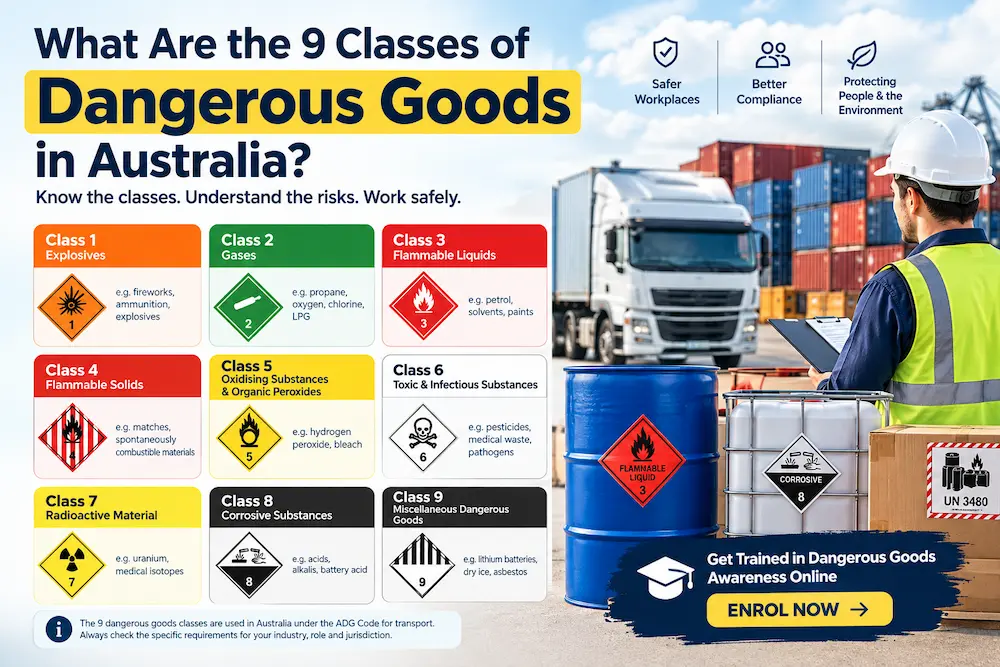
The nine dangerous goods classes in Australia are:
- Class 1 – Explosives
- Class 2 – Gases
- Class 3 – Flammable Liquids
- Class 4 – Flammable Solids and Other Flammable Substances
- Class 5 – Oxidising Substances and Organic Peroxides
- Class 6 – Toxic and Infectious Substances
- Class 7 – Radioactive Material
- Class 8 – Corrosive Substances
- Class 9 – Miscellaneous Dangerous Substances and Articles
Some classes are divided into divisions because materials within the same class can present different types or levels of hazard.
Dangerous Goods Classes at a Glance
| Class | Dangerous Goods Category | Common Examples | Main Hazard |
|---|---|---|---|
| 1 | Explosives | Fireworks, ammunition, explosives | Explosion, blast, projection or fire |
| 2 | Gases | Propane, butane, oxygen, chlorine | Fire, pressure or toxicity |
| 3 | Flammable liquids | Petrol, some solvents, flammable liquids | Fire and vapour ignition |
| 4 | Flammable solids and related substances | Flammable solids, spontaneously combustible materials, dangerous-when-wet substances | Fire or hazardous reaction with water |
| 5 | Oxidising substances and organic peroxides | Oxidising chemicals, organic peroxides | May cause or intensify fire |
| 6 | Toxic and infectious substances | Toxic chemicals, infectious substances | Poisoning or infection |
| 7 | Radioactive material | Radioactive materials and sources | Ionising radiation |
| 8 | Corrosive substances | Strong acids and alkalis | Severe burns and corrosion |
| 9 | Miscellaneous dangerous substances and articles | Lithium batteries, dry ice and other regulated articles | Various hazards not covered by Classes 1–8 |
Class 1 – Explosives
Class 1 covers explosives and articles that can create an explosion, blast, fire or projection hazard.
This class can include materials and articles such as:
- Explosive substances
- Fireworks
- Ammunition
- Detonating articles
- Other explosive articles
Class 1 is divided into several divisions according to the type and severity of the hazard, including mass explosion hazards, projection hazards and fire hazards.
Because explosives are highly regulated, general dangerous goods awareness should not be considered a substitute for any specialist explosives training, licence or authorisation required for a particular activity.
Class 2 – Gases
Class 2 includes gases transported under pressure, including flammable, non-flammable and toxic gases.
Common examples include:
- Propane
- Butane
- Oxygen
- Carbon dioxide
- Chlorine
- Hydrogen sulphide
What are the Class 2 divisions?
| Division | Description | Examples |
|---|---|---|
| 2.1 | Flammable gases | Propane, butane |
| 2.2 | Non-flammable, non-toxic gases | Oxygen and other gases depending on classification |
| 2.3 | Toxic gases | Chlorine, hydrogen sulphide |
Gas cylinders and other gas containers can also present pressure-related hazards, so correct storage, handling and transport procedures are important.
Class 3 – Flammable Liquids
Class 3 covers flammable liquids that can produce ignitable vapours.
Examples can include:
- Petrol
- Some fuels
- Flammable solvents
- Some paints and coatings
- Other liquids classified as dangerous goods in Class 3
The major concern is ignition of the liquid or its vapour. A spill, leaking container or poor storage arrangement can therefore create a serious fire hazard.
Class 4 – Flammable Solids and Other Reactive Substances
Class 4 covers several groups of substances that can present fire or reactive hazards.
| Division | Description | General Hazard |
|---|---|---|
| 4.1 | Flammable solids | Can readily ignite |
| 4.2 | Substances liable to spontaneous combustion | May heat up and ignite without an external ignition source |
| 4.3 | Substances which emit flammable gas when in contact with water | Can react with water and release flammable gas |
The correct handling method depends on the specific substance and its classification. In particular, Class 4.3 materials require careful control around moisture and water.
Class 5 – Oxidising Substances and Organic Peroxides
Class 5 contains materials that can contribute to combustion or create serious fire and reaction hazards.
It has two divisions:
- Class 5.1 – Oxidising substances: substances that can cause or intensify the combustion of other materials.
- Class 5.2 – Organic peroxides: reactive substances that can present fire, decomposition and other hazards.
These substances are particularly important in environments where incompatible chemicals are stored together. Correct segregation and storage procedures are essential.
Class 6 – Toxic and Infectious Substances
Class 6 includes substances that can cause poisoning or present an infectious risk.
| Division | Description | Examples |
|---|---|---|
| 6.1 | Toxic substances | Certain toxic chemicals and poisons |
| 6.2 | Infectious substances | Materials containing pathogens or substances capable of causing infection |
Class 6 can be relevant in chemical manufacturing, laboratories, healthcare, veterinary services, waste management and transport operations.
Workers need to understand the specific hazards associated with the material and follow workplace procedures for containment, handling, storage and emergency response.
Class 7 – Radioactive Material
Class 7 covers radioactive material that can present a radiation hazard.
Radioactive materials require specialised controls covering packaging, handling, transport, storage and emergency procedures.
Because radioactive material is subject to specialised regulatory requirements, workers involved in these activities may require specific radiation safety training and authorisation in addition to general dangerous goods awareness.
Class 8 – Corrosive Substances
Class 8 covers substances that can cause severe damage to skin, eyes, metals or other materials through corrosive action.
Typical examples can include:
- Strong acids
- Strong alkalis
- Battery acid
- Some industrial cleaning chemicals
- Other corrosive chemicals
Important safety considerations include correct containers, compatible storage, appropriate personal protective equipment and procedures for dealing with leaks or spills.
Class 9 – Miscellaneous Dangerous Substances and Articles
Class 9 is used for dangerous substances and articles that present a hazard during transport but do not fit into Classes 1 to 8.
Examples can include certain:
- Lithium batteries
- Dry ice
- Environmentally hazardous substances
- Other miscellaneous dangerous substances and articles
Class 9 is particularly relevant today because batteries and battery-powered equipment are widely used in transport, warehousing, electronics, logistics and industrial workplaces.
What Are Dangerous Goods Class Diamonds?
Dangerous goods class diamonds are hazard labels used to communicate the dangerous goods class of a package, vehicle, container or load.
These labels generally use distinctive colours, symbols and class numbers to help identify the primary transport hazard.
For example:
- Class 3: flame symbol for flammable liquids
- Class 8: corrosion symbol for corrosive substances
- Class 2.1: flame symbol for flammable gases
- Class 6.1: toxic substance symbol
- Class 9: miscellaneous dangerous goods symbol
It is important not to confuse ADG dangerous goods labels with GHS workplace chemical pictograms. Australia uses GHS 7 for workplace hazardous chemical classification and labelling, while the ADG Code provides the transport classification system. In some situations the systems can appear together or be used in combination, but they serve different purposes.
Why Do Dangerous Goods Have Different Classes?
The classification system makes it easier to identify the main hazard associated with a substance or article.
Classification helps with decisions involving:
- Packaging
- Labelling
- Transport
- Storage
- Segregation
- Emergency response
- Risk management
The ADG Code assigns dangerous goods to one of nine classes according to their hazard or predominant hazard, with some classes divided into specific divisions.
Why Is It Important to Understand the 9 Dangerous Goods Classes?
Knowing the class of a dangerous good helps workers recognise what type of hazard they are dealing with before handling, storing or moving the material.
For example, a worker dealing with a Class 3 flammable liquid needs to understand fire and ignition risks, while someone dealing with a Class 8 corrosive substance needs to understand the potential for severe burns and material corrosion.
Correct identification also supports communication between workers, supervisors, warehouse teams, transport operators and emergency personnel.
Do the 9 Classes Apply to Every Dangerous Chemical?
No. Dangerous goods classification and hazardous chemical classification are related but are not the same system.
For transport, the ADG Code uses the nine dangerous goods classes. For workplace hazardous chemicals, Australia uses the Globally Harmonized System (GHS) to classify and communicate chemical hazards through labels and Safety Data Sheets.
A chemical may therefore have information under both systems, depending on how it is being used, stored, supplied or transported.
Who Should Learn About Dangerous Goods Classes?
Understanding dangerous goods can be useful for workers in many industries, including:
- Warehousing and distribution
- Transport and logistics
- Manufacturing
- Construction
- Mining
- Engineering
- Healthcare and veterinary services
- Laboratories
- Emergency services
- Industrial operations
The relevance of training depends on the worker’s actual duties, the substances involved and the applicable workplace or transport requirements.
Read more: Which Industries Require Dangerous Goods Training in Australia?
Does Dangerous Goods Awareness Training Cover All 9 Classes?
Yes. The Safety Australia Training Dangerous Goods Awareness Online Course provides an overview of all nine dangerous goods classes and their divisions.
The course also introduces dangerous goods regulations, class diamonds and other labels, safe handling and storage, and emergency procedures. It is delivered entirely online and includes a theory assessment. Successful learners receive a Certificate of Completion from Safety Australia Training. The provider currently states that the course is not nationally accredited.
✅ Learn the 9 Dangerous Goods Classes Online
Build a practical foundation in dangerous goods classification, labels, safe handling, storage and emergency procedures.
Quick Reference: The 9 Dangerous Goods Classes
| Class | What It Means |
|---|---|
| Class 1 | Explosives |
| Class 2 | Gases |
| Class 3 | Flammable liquids |
| Class 4 | Flammable solids, spontaneously combustible substances and dangerous-when-wet substances |
| Class 5 | Oxidising substances and organic peroxides |
| Class 6 | Toxic and infectious substances |
| Class 7 | Radioactive material |
| Class 8 | Corrosive substances |
| Class 9 | Miscellaneous dangerous substances and articles |
Dangerous Goods Safety: More Than Just Knowing the Class
Knowing whether a product is Class 3, Class 6 or Class 8 is only the first step. Workers must also understand the product’s specific hazards, workplace procedures, labels, Safety Data Sheets and applicable storage or transport requirements.
Businesses may have additional obligations depending on the materials and quantities involved. Safe Work Australia provides guidance covering hazardous chemical classification, labelling, Safety Data Sheets and workplace controls.
Read more: The Cost of Ignorance: Penalties for Non-Compliance with Dangerous Goods Laws.
Frequently Asked Questions About the 9 Dangerous Goods Classes
How many classes of dangerous goods are there in Australia?
There are nine main classes of dangerous goods under the ADG classification system used for dangerous goods transport in Australia. Some classes are divided into additional divisions based on the specific hazard.
What is Class 1 dangerous goods?
Class 1 covers explosives. It includes explosive substances and articles that can present explosion, blast, fire or projection hazards.
What is Class 2 dangerous goods?
Class 2 covers gases and includes divisions for flammable gases, non-flammable non-toxic gases and toxic gases.
What is Class 3 dangerous goods?
Class 3 covers flammable liquids. Petrol and various flammable solvents are examples of materials that may fall into this class depending on their classification.
What are Class 4 dangerous goods?
Class 4 includes flammable solids, substances liable to spontaneous combustion and substances that emit flammable gas when in contact with water.
What is Class 5 dangerous goods?
Class 5 includes oxidising substances and organic peroxides. These materials can create or intensify fire and may have other reactive hazards.
What is Class 6 dangerous goods?
Class 6 covers toxic and infectious substances. Division 6.1 covers toxic substances, while Division 6.2 covers infectious substances.
What is Class 7 dangerous goods?
Class 7 covers radioactive material and is subject to specialised requirements for handling and transport.
What is Class 8 dangerous goods?
Class 8 covers corrosive substances that can cause severe damage to people, materials or metals.
What is Class 9 dangerous goods?
Class 9 covers miscellaneous dangerous substances and articles that present transport hazards but do not fit into Classes 1 to 8. Certain lithium batteries are an example.
Are dangerous goods classes the same as GHS hazard classes?
No. The ADG dangerous goods classification system is primarily used for dangerous goods transport, while Australia’s workplace hazardous chemical system uses the GHS for classification and labelling. They are related systems but should not be treated as identical.
Can I learn the 9 dangerous goods classes online?
Yes. Safety Australia Training offers an online Dangerous Goods Awareness course that provides an overview of all nine classes and their divisions, along with dangerous goods labels, safe handling, storage and emergency procedures.
Does Dangerous Goods Awareness Training replace a licence?
Not necessarily. General awareness training does not automatically replace a specific licence, permit, competency or specialist training requirement that may apply to a particular dangerous goods activity. Always check the requirements for your specific role and jurisdiction.
Conclusion
The 9 classes of dangerous goods in Australia provide a practical way to identify and communicate the main hazards associated with dangerous substances and articles. From explosives and gases to flammable liquids, corrosives and lithium batteries, each class represents a different type of risk.
For workers, understanding these classes can make it easier to recognise dangerous goods, interpret labels and follow the correct workplace procedures. For businesses, dangerous goods classification forms an important part of safe handling, storage and transport practices.
Remember that general awareness is different from specialised or legally required training. Your exact requirements depend on your role, the dangerous goods involved and the work being performed.
🎓 Want to Understand Dangerous Goods With Confidence?
Learn the 9 dangerous goods classes, divisions, class diamonds, labels, safe handling, storage and emergency procedures through online training.