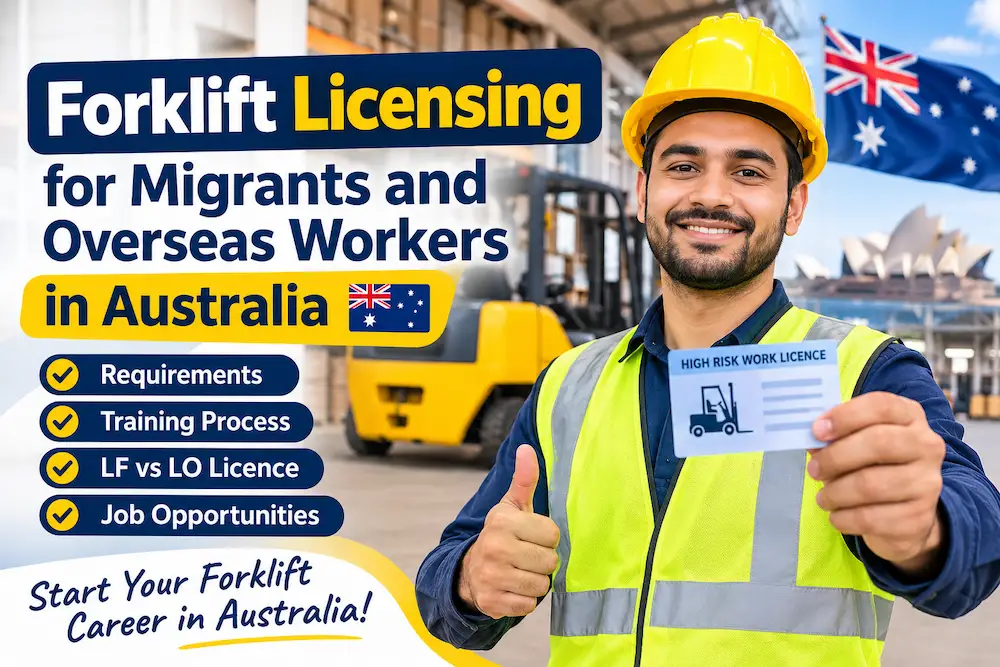
Australia offers employment opportunities for skilled forklift operators across warehouses, distribution centres, manufacturing facilities, construction sites and logistics businesses.
Quick Answer: Can Migrants Use an Overseas Forklift Licence in Australia?
An overseas forklift licence or certificate is not automatically accepted as an Australian High Risk Work (HRW) licence. If you want to operate a forklift professionally in Australia, you generally need the appropriate Australian HRW licence, such as an LF or LO class licence.
Even if you have several years of forklift operating experience overseas, you may need to complete Australian training and pass an assessment through an appropriately registered training organisation (RTO) and accredited assessor before applying for your Australian licence.
Can Migrants Work as Forklift Operators in Australia?
Australia offers employment opportunities for skilled forklift operators across warehouses, distribution centres, manufacturing facilities, construction sites and logistics businesses.
For migrants and overseas workers, previous forklift operating experience can be a valuable advantage when applying for these positions. However, having experience or a forklift certificate from another country does not automatically give you permission to operate a forklift in an Australian workplace.
Under Australia’s Work Health and Safety (WHS) requirements, workers must hold the appropriate High Risk Work Licence before undertaking forklift operations that require licensing.
The most common forklift licence classes are:
- LF Licence: Required for operating standard forklift trucks, including counterbalance forklifts and reach trucks.
- LO Licence: Required for operating order-picking forklift trucks.
The correct licence depends on the type of forklift you intend to operate, not simply your previous experience.
If you are new to Australia’s licensing system, read our guide explaining the difference between a forklift ticket and a forklift licence before choosing a training course.
Ready to Start Your Forklift Training in Australia?
Build the practical skills and knowledge needed to work safely as a forklift operator. Explore the forklift training options at Safety Australia Training.
Does an Overseas Forklift Licence Count in Australia?
One of the most common questions among migrants is whether a forklift licence issued in another country can be used to operate machinery in Australia.
In most cases, an overseas forklift certificate is not a substitute for an Australian HRW licence.
For example, you might have:
- A forklift operator certificate issued in the United Kingdom.
- A forklift training card from New Zealand.
- A forklift operating qualification from India, Nepal or the Philippines.
- Several years of documented forklift experience in an overseas warehouse.
Although these qualifications may demonstrate your previous training and experience, they do not automatically replace the Australian licensing process.
Australia has its own national competency requirements and licensing framework. Overseas workers should check their qualifications with an appropriate Australian RTO and the relevant state or territory WHS regulator.
Your previous experience may help you understand the training and assessment requirements, but you should not assume that it provides an exemption from Australian licensing requirements.
Australian Forklift Licence Requirements for Migrants and Overseas Workers
The requirements for obtaining a forklift licence are generally based on competency, eligibility and safety standards rather than simply whether you were born in Australia.
The following table outlines the main requirements for overseas applicants.
| Requirement | What You Need to Know |
|---|---|
| Minimum Age | You must generally be at least 18 years old. |
| Identification | You need acceptable identity documents for the licensing application. |
| English Proficiency | You must have sufficient English skills to understand training, assessment instructions and operate safely. |
| Training | Complete the required training with an appropriately registered RTO. |
| Assessment | Demonstrate the required knowledge and practical operating skills to an accredited assessor. |
| HRW Licence Application | Apply to the relevant state or territory regulator after successfully completing the assessment. |
It is important to understand that immigration status, training eligibility and workplace licensing are separate matters. Check your individual training and work rights with the relevant authorities before enrolling or accepting employment.
Do You Need to Speak English to Get a Forklift Licence in Australia?
English communication is an important part of forklift training and workplace safety in Australia.
Operators must understand safety instructions, warning signs, workplace procedures, load information and communication from other workers.
During training and assessment, you may need to:
- Understand the trainer’s instructions and safety explanations.
- Read and interpret forklift operating information and safety signs.
- Communicate effectively with supervisors and other workers.
- Answer questions about forklift operation and workplace hazards.
- Demonstrate safe operating procedures during the practical assessment.
You do not necessarily need perfect English or an IELTS certificate to undertake forklift training. However, you must demonstrate sufficient English language ability to complete the training and assessment safely.
For example, applicants in NSW must be able to use English at a level that enables them to carry out high risk work safely.
If English is not your first language, consider improving your workplace safety vocabulary before attending the course.
How to Get an Australian Forklift Licence as a Migrant
Getting an Australian forklift licence involves several steps. Even if you have worked as a forklift operator overseas, you should understand the Australian training and assessment process before starting work.
Step 1: Choose the Correct Forklift Licence Class
First, determine which forklift licence class matches the equipment you want to operate.
- LF: Forklift truck licence.
- LO: Order-picking forklift truck licence.
Most applicants seeking general warehouse forklift positions will investigate the LF class first.
Step 2: Find an Appropriate Australian Training Provider
Choose a Registered Training Organisation (RTO) that is authorised to deliver the relevant high risk work training and assessment.
Before enrolling, confirm the course includes the appropriate licence class, training arrangements, assessment requirements and any support you may need as an overseas applicant.
Step 3: Complete Forklift Training
During training, you will learn how to operate a forklift safely and understand the responsibilities of a licensed operator.
Training generally covers:
- Forklift controls and operating procedures.
- Load handling and stability.
- Workplace hazard identification.
- Pre-start inspections.
- Safe manoeuvring and load transportation.
- Parking and shutdown procedures.
Step 4: Pass the Theory and Practical Assessment
You must demonstrate that you understand forklift safety requirements and can operate the equipment competently.
The assessment involves knowledge questions and practical tasks based on the applicable national assessment requirements.
Step 5: Apply for Your Australian High Risk Work Licence
After successfully completing the assessment, you receive the relevant assessment documentation, such as a Notice of Satisfactory Assessment (NSA), depending on the regulator’s process.
You must then apply to the relevant state or territory licensing regulator within the required timeframe. Under the national model WHS framework, this is generally 60 days from receiving your statement of attainment or equivalent.
Ready to Start Your Forklift Training in Australia?
Build the practical skills and knowledge needed to work safely as a forklift operator. Explore the forklift training options at Safety Australia Training.
Can Your Overseas Forklift Experience Help You Pass the Australian Assessment?
Yes. Previous forklift operating experience can give you a useful foundation when preparing for Australian training and assessment.
If you have already worked in a warehouse, distribution centre, manufacturing facility or logistics operation, you may be familiar with many practical aspects of forklift operation.
However, Australian assessments focus on demonstrating competency against the applicable Australian requirements.
You may need to adapt to differences in:
- Australian workplace health and safety legislation.
- Forklift inspection and reporting procedures.
- Load handling and stability requirements.
- Pedestrian separation and workplace traffic management.
- Australian safety terminology and communication procedures.
- Operating procedures and assessment expectations.
Previous experience is an advantage, but it does not guarantee that you will pass the Australian assessment.
Preparation is still essential. Read our guide on the most common reasons people fail their forklift licence assessment to understand the mistakes you should avoid.
LF vs LO: Which Forklift Licence Should Overseas Workers Get?
Choosing the correct licence class is important because different forklift types require different licensing arrangements.
The two main classes are LF and LO.
| Feature | LF Licence | LO Licence |
|---|---|---|
| Licence Class | Forklift Truck | Order-Picking Forklift Truck |
| Typical Equipment | Counterbalance and reach forklifts | Order-picking forklifts |
| Typical Workplaces | Warehouses, manufacturing and distribution centres | High-bay warehouses and order-picking operations |
| Licence Requirement | Required for applicable LF-class work | Required for applicable LO-class work |
If you have only operated counterbalance forklifts overseas, an LF licence may be the appropriate starting point. If your intended job involves operating order-picking forklifts, you should investigate the LO requirements.
You can learn more in our detailed guide to Australian forklift tickets and licences.
Can Migrants Find Forklift Operator Jobs in Australia?
Once you have the appropriate Australian forklift licence and the right to work, you can explore employment opportunities across several industries.
Some common employment areas include:
1. Warehousing and Distribution
Warehouse operators use forklifts to move pallets, load goods, organise inventory and support daily distribution operations.
2. Transport and Logistics
Forklift operators help load and unload freight, manage storage areas and support transport operations.
3. Manufacturing
Manufacturing businesses use forklifts to transport raw materials, move finished products and supply production lines.
4. Construction and Building Supplies
Forklift operators may work in construction supply yards and material distribution facilities, moving building products and equipment.
5. Wholesale and Retail Distribution
Large retailers and wholesale businesses use forklift operators to manage stock movement, warehouse storage and delivery preparation.
Having an Australian forklift licence can help demonstrate that you meet an important workplace licensing requirement. However, employment also depends on your work rights, experience, communication skills and the employer’s requirements.
What Should Migrants Check Before Enrolling in a Forklift Course?
Before choosing a forklift training provider, take the time to check the following points:
- RTO registration: Confirm that the organisation is registered and authorised to deliver the relevant training and assessment.
- Licence class: Make sure the course covers the LF or LO class you need.
- Assessment arrangements: Understand what practical and theoretical assessments involve.
- English support: Ask about available learning support if English is not your first language. Support does not remove the requirement to demonstrate safe understanding.
- Course fees: Check what is included in the advertised price and whether additional assessment or licensing fees apply.
- Licensing process: Confirm how assessment documents are issued and how to apply for the HRW licence in your state or territory.
Choosing a suitable training provider can make the process clearer and help you prepare for your future responsibilities as a forklift operator.
Take the Next Step Towards Your Forklift Career in Australia
Whether you are new to Australia or already have international forklift operating experience, the right training can help you work towards meeting Australian forklift licensing requirements.
Contact Safety Australia Training to discuss course requirements and available training options.
Frequently Asked Questions About Forklift Licensing for Migrants in Australia
1. Can I use my forklift licence from another country in Australia?
Generally, an overseas forklift certificate does not automatically replace an Australian High Risk Work Licence. You will usually need to complete the applicable Australian training and assessment requirements before applying for an Australian licence.
2. Do I need an Australian driver’s licence to get a forklift licence?
An ordinary Australian car driver’s licence is not generally a prerequisite for obtaining an LF or LO High Risk Work Licence. However, you must meet the identity and licensing requirements of the relevant regulator. Driving a forklift on public roads may involve additional requirements.
3. Can international students get a forklift licence in Australia?
International students may be able to undertake forklift training if they meet the applicable licensing and training eligibility requirements. They should also check their visa conditions and work rights before accepting employment.
4. Is English compulsory for forklift licence training?
You need sufficient English communication skills to understand training materials, follow safety instructions and demonstrate competency. The exact assessment arrangements should be confirmed with your training provider and relevant regulator.
5. How long does it take to get a forklift licence in Australia?
Training and assessment duration depends on the course, your previous experience and your ability to demonstrate competency. After passing, you must also complete the relevant licensing application process. In NSW, applicants generally need to apply within 60 days of receiving their Notice of Satisfactory Assessment.
6. Is an Australian forklift licence valid in other states?
Under the national high risk work licensing framework, an Australian HRW licence is generally recognised across states and territories. However, you should check with the regulator in the state or territory where you intend to work.
7. Do I need to repeat forklift training if I have years of overseas experience?
Previous experience may help you prepare, but it does not automatically exempt you from Australian training and assessment requirements. You should discuss your background with an appropriately registered RTO.
8. What is the difference between an LF and LO forklift licence?
An LF licence covers forklift trucks, including counterbalance forklifts, while an LO licence covers order-picking forklift trucks. You must hold the correct class for the equipment you operate.
9. How long is an Australian forklift licence valid?
A High Risk Work Licence is generally valid for five years. You must renew it according to the requirements of the relevant state or territory regulator.
10. Can I work as a forklift operator immediately after passing my assessment?
Passing your assessment is not the same as receiving your HRW licence. The licensing application must be completed within the required timeframe. The applicable rules for working while an application is being processed should be checked with your local regulator.
Start Your Forklift Training Journey with Safety Australia Training
For migrants and overseas workers, obtaining an Australian forklift licence is an important step towards meeting workplace licensing requirements and accessing opportunities in the warehousing, logistics and manufacturing industries.
Your previous experience can provide a useful foundation, but understanding Australian safety standards, completing the required training and demonstrating practical competency are essential parts of the process.
If you are ready to develop your forklift operating skills and work towards an Australian High Risk Work Licence, explore the available training options at Safety Australia Training’s Forklift Licence course.
Take the next step towards your forklift career in Australia.