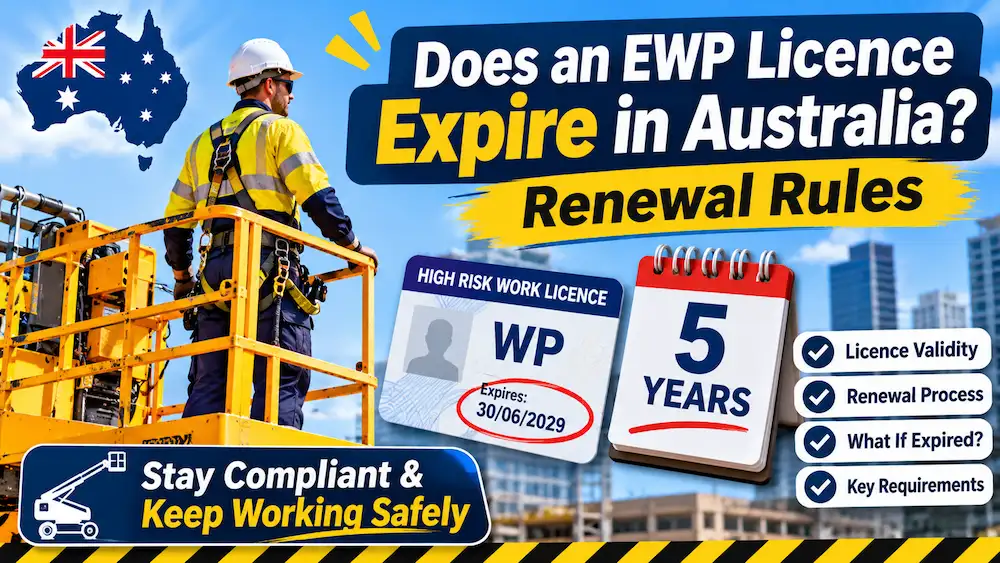
If you operate an elevating work platform (EWP) in Australia, it is important to know whether your licence has an expiry date and what you need to do to keep it valid. A WP high-risk work licence is generally valid for five years, meaning eligible operators must renew it before expiry to continue performing work that requires this licence.
Quick Answer: Does an EWP Licence Expire in Australia?
Yes. An Australian WP high-risk work licence generally expires after five years. It must be renewed through the relevant state or territory regulator if you want to continue operating a boom-type elevating work platform with a boom length over 11 metres.
Under the model WHS framework, eligible licence holders can generally renew within 12 months after expiry. However, you cannot perform work requiring a WP licence while your licence is expired. If you miss the permitted renewal period, you will generally need to complete the relevant training and assessment again.
EWP Training in Australia
Need to Obtain or Renew Your EWP Licence?
Explore EWP over 11 metres training and learn about the skills and assessment involved in operating boom-type elevating work platforms safely.
1. How Long Does an EWP Licence Last in Australia?
The WP class High Risk Work Licence is generally valid for five years from its issue date. It authorises the holder to perform the relevant high-risk work involving a boom-type elevating work platform with a boom length over 11 metres.
Your licence card or digital licence should display its expiry date. It is important to check this date rather than relying solely on a reminder from your regulator or employer.
| Licence detail | What you need to know |
|---|---|
| Licence class | WP – Boom-type Elevating Work Platform |
| Validity period | Generally five years |
| Renewal authority | Relevant state or territory regulator |
| Renewal deadline | Before the expiry date is recommended |
| After expiry | You cannot perform work requiring the WP licence while it is expired |
| Late renewal | Generally possible within 12 months under the model WHS framework, subject to local requirements |
Important: The five-year validity period relates to the WP high-risk work licence. It does not mean every EWP training certificate, equipment familiarisation record or workplace competency document has the same expiry period.
2. Which EWP Operators Need to Renew Their Licence?
Not every elevating work platform operator in Australia needs a WP high-risk work licence. The WP class applies to operating a boom-type elevating work platform with a boom length over 11 metres.
Examples of relevant boom-type equipment can include:
- Truck-mounted boom lifts.
- Self-propelled boom lifts.
- Telescopic boom lifts.
- Articulated boom lifts.
- Other boom-type platforms with a boom length exceeding 11 metres.
Operators of other types of elevating work platforms, such as scissor lifts, do not generally need a WP high-risk work licence solely to operate that equipment. However, employers must still ensure operators receive suitable training, information, instruction and supervision for the equipment and the work involved.
Understand EWP Licence Requirements
Not sure which EWP operations require a WP high-risk work licence? Read our detailed guide to understand the licence requirements, equipment categories and operator responsibilities in Australia.
3. When Should You Renew Your EWP Licence?
The safest approach is to check your renewal requirements well before your licence expires. Some regulators send renewal notifications by email or SMS, but it remains your responsibility to ensure your licence stays current.
2–3 MONTHS BEFORE
Check your details
Confirm your licence expiry date and contact information.
BEFORE EXPIRY
Submit renewal
Follow your regulator’s renewal instructions and submit the application.
AFTER SUBMISSION
Check the status
Keep your confirmation and verify the renewed licence details.
For example, SafeWork NSW sends renewal reminders approximately 60 days before expiry, while WorkSafe Queensland generally sends a renewal notice four to six weeks beforehand. Notification arrangements can change, so check directly with your regulator.
4. How to Renew an EWP Licence in Australia
The renewal process depends on the state or territory where your high-risk work licence is managed. In many cases, licence holders can complete the process online through the relevant regulator’s licensing portal.
Step 1: Check Your Licence Expiry Date
Find your WP high-risk work licence and check its expiry date. Confirm that the licence details are correct and that the WP class is included.
Step 2: Access Your State Regulator
Use the official licensing service for your state or territory. This may involve SafeWork NSW, WorkSafe Victoria, WorkSafe Queensland or another local regulator.
Step 3: Prepare Your Identification and Licence Details
You may need your licence number, personal identification details, current contact information, renewal reference and payment details.
Step 4: Submit Your Renewal Application
Complete the application through the approved online service or process. Check that the WP class is included if you intend to continue performing work that requires it.
Step 5: Confirm Your Renewed Licence
Follow any instructions from the regulator, keep your confirmation and check that your renewed licence is valid before carrying out high-risk work.
5. What Happens If Your EWP Licence Expires?
If your WP licence expires, you cannot perform high-risk work that requires that licence while it remains expired. This can affect operators who regularly use boom lifts on construction sites, industrial facilities, infrastructure projects and maintenance jobs.
Under the model WHS framework, a licence holder can generally renew an expired high-risk work licence within 12 months of its expiry date. However, this 12-month period does not allow you to keep working without a current licence.
If you do not renew within the permitted period, you will generally need to complete the relevant training and assessment again before applying for a new licence.
Can You Renew an EWP Licence After It Has Expired?
In many jurisdictions, yes. The model WHS framework generally allows renewal within 12 months after expiry. However, the process and any exceptional-circumstances provisions must be checked with the relevant regulator.
| Jurisdiction | Renewal information to check |
|---|---|
| New South Wales | SafeWork NSW renewal process and 12-month post-expiry period. |
| Victoria | WorkSafe Victoria renewal process and exceptional-circumstances provisions. |
| Queensland | WorkSafe Queensland renewal instructions and licence status. |
| South Australia | SafeWork SA renewal window and expired licence requirements. |
| Tasmania | WorkSafe Tasmania’s current HRW licence renewal procedure. |
| Western Australia | WorkSafe WA high-risk work licensing requirements. |
| ACT | WorkSafe ACT renewal and application requirements. |
| Northern Territory | NT WorkSafe high-risk work licence renewal procedure. |
If you have moved interstate, do not assume that your licence details will automatically transfer to the new state’s system. Contact the relevant regulator to confirm recognition, transfer and renewal requirements.
6. Do You Need to Complete EWP Training Again to Renew Your Licence?
Not necessarily. If your WP licence is still current or has only recently expired, you may be able to renew it through the relevant regulator’s standard renewal process without completing the initial training and assessment again.
However, if your licence has been expired beyond the permitted renewal period, you will generally need to complete the relevant training and assessment again.
It is also important to understand that licence renewal and maintaining practical competency are not the same thing. Even when a formal reassessment is not required for renewal, operators must still be able to operate equipment safely and meet their workplace responsibilities.
Employers may also require additional site-specific training, familiarisation or competency checks before allowing an operator to use a particular EWP model.
Recommended Reading
Is Renewing Your EWP Licence Easier Than Getting It the First Time?
Find out more about the EWP licence renewal process, what may be required after expiry and how renewal compares with completing the initial licensing process.
7. Is EWP Licence Renewal the Same in Every Australian State?
The general five-year validity period is established under the high-risk work licensing framework, but the renewal process is administered by individual state and territory regulators.
This means application methods, notification periods, identity checks and administrative requirements may differ. You should always use the official instructions published by the regulator responsible for your licence.
- New South Wales: SafeWork NSW.
- Victoria: WorkSafe Victoria.
- Queensland: WorkSafe Queensland.
- South Australia: SafeWork SA.
- Tasmania: WorkSafe Tasmania.
- Western Australia: WorkSafe WA.
- Australian Capital Territory: WorkSafe ACT.
- Northern Territory: NT WorkSafe.
8. What Should You Do While Waiting for Your EWP Licence Renewal?
Whether you can continue working while a renewal application is being processed depends on the timing and status of your application and the rules of your regulator.
Before continuing to operate an EWP, confirm the following:
- Whether your licence is still current.
- Whether your renewal application was submitted correctly.
- Whether the regulator has confirmed that you can continue working while the application is processed.
- Whether your employer has verified your licence status.
Safety and compliance reminder: Do not assume that submitting a renewal application automatically extends an expired licence. If your licence has expired, do not carry out work requiring the WP licence unless the relevant regulator has confirmed that you are legally permitted to do so.
9. Why Should You Keep Your EWP Licence Current?
Keeping your high-risk work licence current is important for workplace safety, employment requirements and legal compliance.
Legal Compliance
You must hold the required licence before undertaking licensed high-risk work.
Employment Requirements
Employers and contractors may check licence validity before assigning EWP work.
Project Access
Construction and industrial sites may verify high-risk work licences during site induction.
Work Continuity
Renewing on time helps avoid interruptions caused by an expired licence.
A current licence does not replace the need for equipment familiarisation, pre-start inspections, hazard assessments and safe operating procedures. Operators and employers must continue to meet their workplace safety responsibilities.
10. How to Obtain a WP EWP Licence if Yours Cannot Be Renewed
If your licence has been expired beyond the permitted renewal period, you may need to complete the relevant training and assessment again before applying for a new WP high-risk work licence.
For workers who need to obtain the WP class for the first time, the process generally involves:
- Meeting the relevant eligibility requirements.
- Completing the required training with an appropriately registered and authorised training provider.
- Undertaking the required assessment.
- Obtaining the relevant assessment documentation.
- Applying to the relevant state or territory regulator within the required timeframe.
The WP licence relates to boom-type elevating work platforms with a boom length over 11 metres. If you need to obtain this licence, check the course requirements and assessment arrangements before enrolling.
Take the Next Step
Get Ready for EWP Over 11 Metres Training
Learn more about the training pathway for operating boom-type elevating work platforms over 11 metres and the WP high-risk work licence requirements in Australia.
Frequently Asked Questions About EWP Licence Expiry and Renewal
Does an EWP licence expire in Australia?
Yes. The WP high-risk work licence for operating a boom-type EWP over 11 metres is generally valid for five years. You must renew it to continue performing work that requires the licence.
How many years is an EWP licence valid?
A WP high-risk work licence is generally valid for five years. Check the expiry date on your licence or in the relevant regulator’s licensing system.
Can I use an expired EWP licence?
No. You cannot perform high-risk work that requires a WP licence while your licence is expired. Follow the relevant regulator’s renewal process before resuming that work.
Can I renew my EWP licence after the expiry date?
Generally, yes, if you are within the permitted post-expiry renewal period. Under the model WHS framework, this is generally up to 12 months after expiry. State and territory requirements may differ.
What happens if my WP licence has been expired for more than 12 months?
You will generally need to complete the relevant training and assessment again before applying for a new licence. Some jurisdictions may have specific provisions for exceptional circumstances, so check with your regulator.
Do I need to complete another EWP course every five years?
Not necessarily. Standard licence renewal does not automatically mean you must repeat the original course. However, if your licence has been expired beyond the permitted renewal period, retraining and reassessment will generally be required.
Does a scissor lift licence expire after five years?
A scissor lift operator does not generally need a WP high-risk work licence solely to operate a scissor lift. However, operators still need appropriate training and instruction, and employers must ensure they can operate the equipment safely.
Is an EWP licence valid in every Australian state?
High-risk work licences are generally recognised nationally under the applicable framework. If you move interstate, contact the local regulator to confirm recognition, transfer and renewal requirements.
Will I receive a reminder before my EWP licence expires?
Some regulators send renewal notices by email or SMS. Notification periods vary, so you should check your expiry date rather than relying on receiving a reminder.
Does renewing an EWP licence mean I can operate every type of elevated work platform?
No. A WP licence covers the relevant high-risk work within its licence class. Operators still need appropriate training, instruction and familiarisation for the particular EWP they use.
Final Thoughts: Don’t Let Your EWP Licence Expire
An EWP WP high-risk work licence is generally valid for five years in Australia. If you operate boom-type elevating work platforms over 11 metres, keeping your licence current is essential for meeting licensing requirements and avoiding interruptions to your work.
Check your expiry date early, follow your state or territory regulator’s renewal process and never assume that an expired licence allows you to continue working during a renewal grace period.
If you need to obtain a WP licence or understand the EWP training requirements, explore the available course information before your next high-risk work assignment.
Prepare for Safe EWP Operations
Explore EWP over 11 metres training and learn more about the WP high-risk work licence requirements in Australia.