If you already hold a WP class High Risk Work Licence for operating boom-type Elevated Work Platforms (EWPs), renewing it is an important part of staying authorised to work. But is renewing your EWP licence in 2026 easier than getting it for the first time?
In most cases, yes. If you have maintained your competency and submit your renewal application within the required timeframe, you generally do not need to repeat the full training and assessment process. However, letting your licence expire can prevent you from carrying out high-risk work, and leaving it expired for too long may mean completing training and assessment again.
Quick answer: Is renewing an EWP licence easier?
Yes. Renewing a WP high risk work licence is generally an administrative process rather than a repeat training course, provided you meet the regulator’s renewal requirements. A WP licence is normally valid for five years. In the model WHS framework, you can generally apply to renew it within 12 months after expiry, but you cannot operate equipment requiring that licence while it is expired. If you miss the permitted renewal period, you will generally need to complete training and assessment again.
Need your EWP over 11 metres qualification?
Explore nationally recognised WP high risk work licence training and take the next step towards operating boom-type EWPs safely.
What is an EWP WP licence in Australia?
In Australia, the relevant high-risk work licence for certain elevated work platforms is the WP class High Risk Work Licence. It covers the operation of boom-type elevating work platforms with a boom length of 11 metres or more.
Examples of equipment that may require a WP licence include:
- Large boom lifts used on construction sites.
- Truck-mounted boom-type elevated work platforms.
- Cherry pickers with a boom length of 11 metres or more.
- Other boom-type EWPs that meet the WP licensing criteria.
Not every elevated work platform requires a WP high risk work licence. For example, operating a scissor lift does not generally require a WP licence solely because it is an EWP. However, operators still need appropriate training, instruction and competency for the equipment and workplace.
If you are unsure whether your equipment requires a WP licence, read our guide:
Understand the EWP licensing requirements
Learn which machines require a WP high risk work licence, who can apply and what the qualification covers.
How long does an EWP WP licence last?
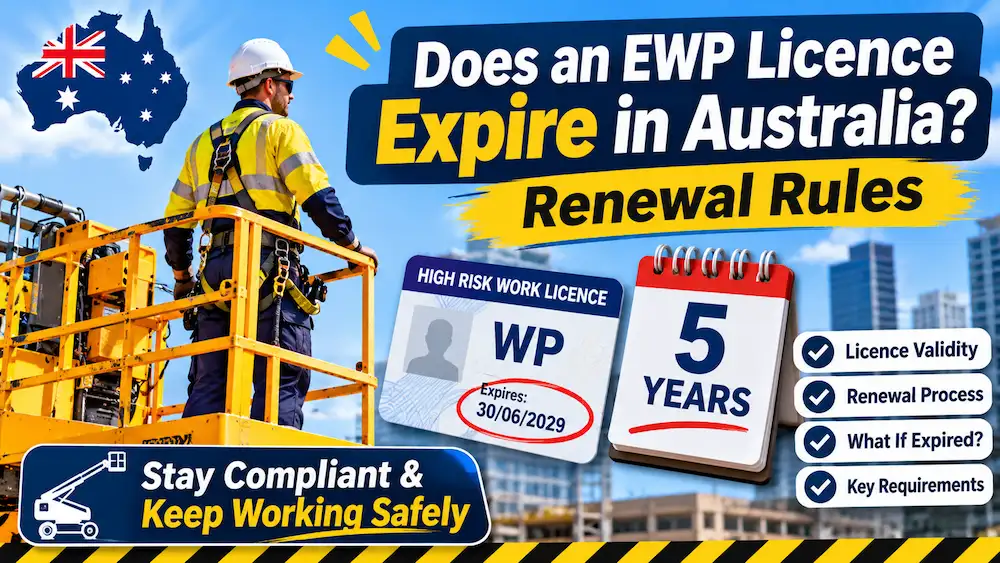
A WP high risk work licence is generally valid for five years. The expiry date is shown on your licence, so check the card rather than relying on when you remember completing your training.
Important reminder
The five-year validity period applies to the high risk work licence. If you hold multiple high risk work classes, check the expiry details for your licence and confirm which classes are included in your renewal application.
Getting an EWP licence vs renewing one: What’s the difference?
The main difference is that a first-time applicant must demonstrate competency through the required training and assessment process. An existing licence holder is generally applying to continue holding a licence, subject to the regulator’s renewal requirements.
| Requirement | First-time WP licence | Licence renewal |
|---|---|---|
| Training | Required through an appropriate RTO. | Not generally repeated for an eligible renewal. |
| Assessment | Competency assessment is required. | The regulator may require reassessment in relevant circumstances. |
| Application | Apply after completing the required assessment process. | Apply through the relevant state or territory regulator. |
| Validity | Generally five years. | Generally renewed for a further five-year period. |
| Main consideration | Demonstrating competency for the WP class. | Applying on time and meeting renewal requirements. |
For most eligible licence holders, renewal is therefore simpler than starting again. However, it is not automatic: you must follow the application process set by the regulator responsible for your licence.
What has changed about EWP licence renewal in 2026?
The most useful thing to understand in 2026 is not that every state has introduced a completely new renewal system. Rather, the renewal process is administered by state and territory regulators, and the practical steps can differ depending on where you live.
1. Renewal notices and online applications
Several regulators provide online renewal services and send reminders before a licence expires. For example, SafeWork NSW says it sends renewal reminders around 60 days before expiry, while WorkSafe Queensland advises that renewal notices are generally sent four to six weeks before expiry.
These reminders are helpful, but you remain responsible for checking your licence expiry date and submitting your application correctly.
2. Your state or territory regulator matters
Although high risk work licensing operates under a harmonised framework in many Australian jurisdictions, you should not assume that every administrative detail is identical. Application methods, renewal notices, identity requirements and exceptional circumstances can vary.
For example:
- New South Wales: SafeWork NSW and Service NSW provide an online renewal process. Eligible holders can generally renew within 12 months after expiry.
- Queensland: WorkSafe Queensland provides online renewal services. An application lodged before or on the expiry date can keep the licence valid while the regulator makes its decision. An application lodged after expiry does not authorise the holder to carry out the licensed work.
- Victoria: WorkSafe Victoria allows applications to renew an expired licence within 12 months. If it has been expired for longer, evidence of exceptional circumstances may be required.
- Other states and territories: Check the relevant regulator’s current instructions before applying, particularly if your licence has already expired or you have moved interstate.
3. Maintaining competency remains important
Renewal is not simply about paying a fee and receiving a new card. Licence holders must meet the regulator’s requirements, including maintaining competency in the high risk work class they are renewing.
A regulator may require reassessment if there are concerns about a person’s ability to carry out the work safely and competently. Employers may also have their own site-specific competency checks, refresher training or verification of competency (VOC) requirements.
How to renew your EWP WP licence in Australia
The exact process depends on your state or territory, but the following steps provide a useful starting point.
Find the expiry date on your WP high risk work licence and confirm that your contact details with the regulator are current.
Use the regulator responsible for your licence and your usual state or territory of residence. If you have moved interstate, check whether you need to transfer your licence.
You may need your licence number, renewal reference, identity documents and access to the regulator’s online account or application service.
Follow the regulator’s instructions, confirm the licence classes you intend to renew and pay the applicable fee.
Retain your application confirmation and follow any instructions from the regulator. Do not assume your licence has been renewed until you have the required confirmation.
Planning tip
Set a reminder several months before your licence expires. This gives you time to update your details, contact the regulator and resolve any application issues before your current licence expires.
What happens if your EWP licence expires?
This is where operators need to be particularly careful. An expired WP licence does not give you permission to continue operating equipment that requires the licence, even if you intend to renew it shortly.
Under the model WHS framework, a licence holder can generally apply for renewal within 12 months after the expiry date. However, the licence is not valid for carrying out high risk work during the period after it has expired and before it is renewed.
| Licence status | What it means |
|---|---|
| Current licence | You may carry out the high risk work covered by the licence, subject to its conditions and workplace requirements. |
| Renewal submitted before expiry | In jurisdictions applying the relevant WHS provisions, the licence may continue while the renewal application is being decided. Check your regulator’s rules and confirmation. |
| Expired less than 12 months | You may generally be able to apply for renewal, but you must not perform the licensed work until your licence is renewed. |
| Expired more than 12 months | You will generally need to complete the required training and assessment again before applying for a new licence, unless the regulator allows an exception. |
Important: The 12-month renewal period is not permission to keep working for 12 months after expiry. It is a timeframe in which an eligible person may be able to apply for renewal. Always check the rules of your regulator.
For a more detailed explanation of expiry dates, renewal eligibility and what happens when a WP licence lapses, read our related guide:
Does an EWP Licence Expire in Australia? Renewal Rules
Understand the five-year validity period, the renewal window and what to do if your high risk work licence has already expired.
Does renewing your EWP licence mean you are automatically job-ready?
Not necessarily. Renewing your WP licence confirms that you have met the relevant licensing requirements. It does not automatically demonstrate that you are familiar with every machine, worksite or operating procedure you may encounter.
For example, an operator returning to work after several years away from boom lifts may need time to become familiar with different controls, emergency lowering systems, pre-start inspections and site-specific hazards.
Employers may request a Verification of Competency (VOC) or refresher training before allowing an operator to use particular equipment. These checks are separate from the licence renewal process and may depend on the employer’s safety procedures and the work being performed.
Want to improve your EWP operating skills?
Explore practical guidance on operating elevated work platforms safely, understanding equipment controls and building confidence at different heights.
Should you add an EWP under 11 metres qualification?
If you already operate boom-type EWPs over 11 metres, expanding your skills to include other types of elevated work platforms may improve your flexibility across different worksites.
Some operators choose to complete training for both over-11-metre and under-11-metre equipment. The right training pathway depends on the machines you need to operate and the competency requirements of your workplace.
Looking to expand your EWP skills?
Explore the EWP Over and Under 11 Metres Combo Package and learn more about the available training pathway.
Is renewing an EWP licence easier or harder than getting it the first time?
For an eligible WP licence holder who applies within the required timeframe, renewal is generally easier. You usually do not need to repeat the full training and assessment process simply because your five-year licence period is ending.
However, there are three situations to keep in mind:
- Renewing before expiry: Usually the simplest option. Follow your regulator’s application process and maintain competency.
- Renewing after expiry: You may still be eligible to apply within the applicable renewal period, but you cannot carry out work requiring the WP licence until it is renewed.
- Missing the renewal window: You will generally need to complete training and assessment again before applying for a new licence. Some regulators may consider exceptional circumstances.
The best approach is straightforward: check your expiry date early, keep your contact details current and follow the instructions issued by your regulator.
Frequently asked questions about renewing an EWP licence
1. How often do I need to renew my EWP WP licence in Australia?
A WP high risk work licence is generally valid for five years. You should check the expiry date printed on your licence and follow your state or territory regulator’s renewal process.
2. Do I need to complete the EWP course again to renew my WP licence?
Not usually, if you are eligible for renewal and meet the regulator’s requirements. However, if your licence has been expired beyond the permitted renewal period, you will generally need to complete training and assessment again.
3. Can I operate an EWP if my WP licence has expired?
No. You cannot carry out high risk work requiring a WP licence while your licence is expired. Being eligible to apply for renewal after expiry does not allow you to continue operating the equipment.
4. Can I renew my WP licence after it expires?
Under the model WHS framework, a person can generally apply to renew an expired high risk work licence within 12 months after its expiry. State and territory requirements, including exceptional circumstances, should be checked with the relevant regulator.
5. Can I keep working while my renewal application is being processed?
This depends on when you lodged the application and the rules applying in your jurisdiction. For example, SafeWork NSW and WorkSafe Queensland state that an application submitted before expiry can keep the licence valid while a decision is pending. Do not assume the same arrangements apply everywhere.
6. Is refresher training compulsory when renewing a WP licence?
A full refresher course is not generally required for every routine renewal. However, a regulator may require reassessment in certain circumstances, and an employer may require refresher training or a VOC before allowing you to operate equipment.
7. Does an EWP under 11 metres require a WP licence?
The WP class applies to boom-type EWPs with a boom length of 11 metres or more. Other equipment, including many scissor lifts, does not require a WP licence solely for operation, but operators still need suitable training and instruction.
Final thoughts: Don’t leave your EWP licence renewal until the last minute
1. How often do I need to renew my EWP WP licence in Australia?
A WP high risk work licence is generally valid for five years. You should check the expiry date printed on your licence and follow your state or territory regulator’s renewal process.
2. Do I need to complete the EWP course again to renew my WP licence?
Not usually, if you are eligible for renewal and meet the regulator’s requirements. However, if your licence has been expired beyond the permitted renewal period, you will generally need to complete training and assessment again.
3. Can I operate an EWP if my WP licence has expired?
No. You cannot carry out high risk work requiring a WP licence while your licence is expired. Being eligible to apply for renewal after expiry does not allow you to continue operating the equipment.
4. Can I renew my WP licence after it expires?
Under the model WHS framework, a person can generally apply to renew an expired high risk work licence within 12 months after its expiry. State and territory requirements, including exceptional circumstances, should be checked with the relevant regulator.
5. Can I keep working while my renewal application is being processed?
This depends on when you lodged the application and the rules applying in your jurisdiction. For example, SafeWork NSW and WorkSafe Queensland state that an application submitted before expiry can keep the licence valid while a decision is pending. Do not assume the same arrangements apply everywhere.
6. Is refresher training compulsory when renewing a WP licence?
A full refresher course is not generally required for every routine renewal. However, a regulator may require reassessment in certain circumstances, and an employer may require refresher training or a VOC before allowing you to operate equipment.
7. Does an EWP under 11 metres require a WP licence?
The WP class applies to boom-type EWPs with a boom length of 11 metres or more. Other equipment, including many scissor lifts, does not require a WP licence solely for operation, but operators still need suitable training and instruction.
Renewing your EWP WP licence in 2026 is generally much simpler than completing the qualification for the first time, provided you meet the renewal requirements and apply within the permitted timeframe.
But remember: an expired licence cannot be used to carry out the high risk work it covers. If you miss the renewal window, you may need to complete training and assessment again. Keeping track of your expiry date is a small task that can save you significant time and disruption.
Ready to get your EWP WP licence?
Whether you are entering the industry or looking to build your elevated work platform skills, explore EWP over 11 metres training with Safety Australia Training.
View EWP Over 11 Metres Training →
Check course availability, locations and entry requirements.
Official information and further reading
For the latest renewal requirements, always refer to the regulator responsible for your licence: