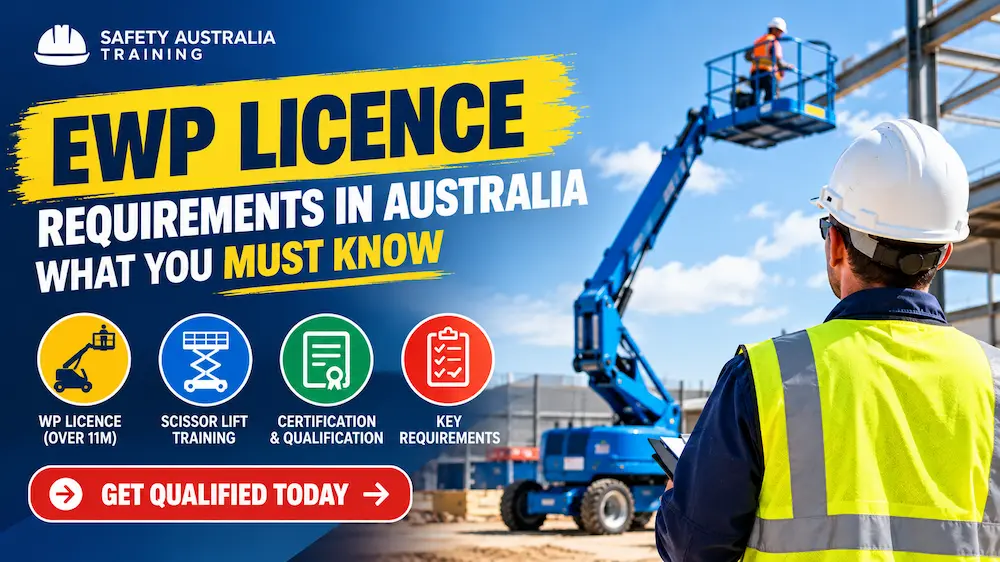
If you’re planning to operate an elevated work platform in Australia, understanding the EWP licence requirements is essential. The qualification you need depends on the type of equipment you operate and, for boom-type EWPs, the boom length.
Quick Answer: Do You Need an EWP Licence in Australia?
You need a High Risk Work Licence (WP class) to operate a boom-type elevated work platform with a boom length of 11 metres or more. Standard scissor lifts and other EWPs that do not fall within this licensing category generally do not require a WP licence, but operators must still receive appropriate training, information and instruction.
- Boom-type EWP, 11 metres or more: WP High Risk Work Licence required.
- Standard scissor lift: No WP licence generally required, but suitable training is essential.
- Other EWP types: Requirements depend on the equipment and work being performed.
Always confirm the requirements for your equipment, workplace and state or territory. The licensing threshold relates to boom length, not simply the height at which you intend to work.
Get Qualified to Operate an EWP
Choose the appropriate training pathway for your equipment and career goals. Safety Australia Training offers courses for EWPs under and over 11 metres.
EWP Over 11 Metres Course
EWP Under 11 Metres Course
Check course eligibility, assessment arrangements and the qualification offered before enrolling.
What Is an EWP?
EWP stands for Elevating Work Platform, also commonly called an elevated work platform. It is a type of mobile equipment designed to raise workers, tools and materials so tasks can be completed at height.
EWPs are commonly used in construction, building maintenance, warehousing, electrical work, facility management and industrial operations.
Common types of elevated work platforms include:
- Scissor lifts: Raise a platform vertically using a crossed-support mechanism.
- Boom lifts: Use an extending or articulated boom to position workers at height.
- Vertical mast lifts: Provide compact vertical access for suitable tasks.
- Trailer-mounted and vehicle-mounted EWPs: Provide elevated access for maintenance and other work.
The equipment type matters because the licensing rules for a boom-type EWP are different from the requirements for a standard scissor lift.
EWP Licence Requirements in Australia
There is no single licence requirement that applies to every elevated work platform. The key question is whether the machine falls within the definition of a boom-type EWP requiring a WP High Risk Work Licence.
| Equipment | WP Licence Required? | What Operators Need |
|---|---|---|
| Boom-type EWP with a boom length of 11 metres or more | Yes | Required training, assessment and the appropriate WP High Risk Work Licence. |
| Standard scissor lift | Generally no | Appropriate equipment-specific training, instruction and workplace authorisation. |
| Boom-type EWP below the 11-metre licensing threshold | Generally no | Appropriate training and instruction for the machine and task. |
| Other specialised EWP equipment | Depends on the equipment | Confirm the applicable licensing category and workplace requirements. |
Important: The WP licensing threshold is based on the boom length as defined in the relevant regulations, not merely the platform’s advertised working height. When in doubt, check the equipment specifications and seek confirmation from your state or territory WHS regulator.
What Is an EWP Licence or WP Licence?
The WP High Risk Work Licence is the formal licence class for operating a boom-type elevating work platform where the boom length is 11 metres or more.
To obtain this licence, eligible candidates must complete the relevant training and assessment through an appropriately authorised training provider and meet the applicable licensing requirements. After successfully completing the required assessment, candidates must apply to the relevant state or territory regulator.
Completing an EWP course and holding a High Risk Work Licence are not always the same thing. For example, a course completion document or training certificate for a scissor lift does not automatically constitute a WP licence.
Looking for a WP Licence Course?
If you need to operate a boom-type EWP with a boom length of 11 metres or more, explore the relevant course and confirm its licensing and assessment pathway.
Do You Need a Scissor Lift Licence in Australia?
One of the most common questions is whether a scissor lift requires a licence. In general, operating a standard scissor lift does not require the WP High Risk Work Licence because that licence applies to qualifying boom-type EWPs.
However, not needing a WP licence does not mean you can operate a scissor lift without training. Employers must ensure operators have the necessary skills, information, instruction and supervision to use the equipment safely.
Before operating a scissor lift, workers should understand:
- How to use the machine’s controls and safety systems.
- How to complete pre-start checks and identify defects.
- How to assess ground conditions, slopes and overhead hazards.
- How to work within the machine’s rated capacity.
- How to follow emergency and rescue procedures.
- What site-specific rules, personal protective equipment and authorisations apply.
If you need training for equipment under 11 metres, review the course details here:
View the EWP Under 11 Metres Course →
EWP Certification vs EWP Qualification: What’s the Difference?
The terms EWP certification, EWP qualification and EWP licence are often used interchangeably, but they may refer to different outcomes.
| Term | What It Usually Means |
|---|---|
| EWP training | Instruction and practical learning to operate particular equipment safely. |
| EWP certification | A broad term that may refer to evidence of training or successful assessment. Check exactly what the certificate covers. |
| EWP qualification | A qualification or statement of attainment associated with a specified training outcome. |
| WP High Risk Work Licence | The formal licence required for qualifying boom-type EWPs with a boom length of 11 metres or more. |
Before enrolling, confirm the course’s nationally recognised status where applicable, the equipment it covers, the assessment requirements and the document or licence you will receive after successful completion.
What Are the Requirements to Get an EWP Licence?
If you are applying for the WP High Risk Work Licence, the usual pathway involves training, assessment and an application to the relevant regulator.
- Check the licence category. Confirm that the equipment requires a WP licence.
- Check eligibility. High Risk Work Licence applicants must generally be at least 18 years old and satisfy the relevant requirements.
- Choose an appropriate training provider. Verify that the provider is authorised to deliver the relevant nationally recognised training and assessment.
- Complete training. Learn about safe operation, equipment checks, hazards, risk controls and emergency procedures.
- Pass the required assessment. Demonstrate the necessary knowledge and practical skills.
- Apply for the licence. Submit the required application to the relevant state or territory regulator within the required timeframe.
For a High Risk Work Licence, Safe Work Australia advises that the application must generally be lodged within 60 days of receiving the statement of attainment or equivalent. Confirm the current process and fees with your local regulator.
What Do You Learn in EWP Training?
EWP training is designed to help operators understand the equipment, recognise hazards and work safely at height. The exact content depends on the course and machine type.
Training commonly covers:
- Identifying EWP components and operating controls.
- Conducting pre-operational inspections.
- Assessing ground conditions and the work area.
- Recognising overhead obstructions and other hazards.
- Understanding safe working loads and equipment limitations.
- Using appropriate personal protective equipment.
- Following safe operating procedures and emergency plans.
- Reporting defects and unsafe conditions.
For additional guidance, read our article on how an EWP High Risk Licence helps prevent workplace accidents.
How Long Does an EWP Licence Take to Get?
The time required depends on the course, the equipment, your existing experience, training availability and assessment arrangements. A short equipment-specific training course and the process of obtaining a High Risk Work Licence are not necessarily the same pathway.
For a WP licence, allow time for training, assessment and the regulator’s application process. Contact the training provider before booking to confirm course duration, prerequisites, assessment arrangements and the next available dates.
Why Is EWP Training Important?
Operating an elevated work platform involves risks such as falls, overturning, collisions, entrapment and contact with overhead hazards. Appropriate training helps workers recognise these risks and use the machine according to its design and operating instructions.
Completing the right training can help you:
- Understand safe EWP operating procedures.
- Recognise hazards before starting work.
- Meet applicable workplace training and licensing requirements.
- Demonstrate relevant skills to employers.
- Prepare for work in construction, maintenance and industrial environments.
Learn more about EWP operation skills and safe working practices.
Where Can an EWP Qualification Help You Work?
EWP training may be relevant to roles that involve working at height, depending on the equipment, employer and job requirements. Examples include:
- Construction and building maintenance.
- Electrical installation and maintenance.
- Warehouse and industrial facility maintenance.
- Painting, cleaning and building inspections.
- Infrastructure and utilities maintenance.
- Sign installation and other elevated-access tasks.
Training alone does not guarantee employment. Employers may also require relevant experience, site inductions, additional tickets or task-specific competencies.
Frequently Asked Questions About EWP Licence Requirements
1. What is an EWP licence?
An EWP licence commonly refers to the WP High Risk Work Licence required to operate a boom-type elevated work platform with a boom length of 11 metres or more. The term is also sometimes used informally to describe training for other types of EWPs.
2. Do I need an EWP licence in Australia?
You need a WP High Risk Work Licence to operate a qualifying boom-type EWP with a boom length of 11 metres or more. Other EWP operators still need appropriate training, instruction and supervision.
3. Do I need a scissor lift licence?
A standard scissor lift generally does not require a WP High Risk Work Licence. However, you still need suitable training and must follow workplace safety requirements.
4. Is EWP certification the same as a WP licence?
No, not necessarily. EWP certification may refer to evidence of training or assessment, while the WP High Risk Work Licence is a specific licence class. Always check what a course provides.
5. How old do you need to be to get a WP licence?
Applicants for a High Risk Work Licence generally need to be at least 18 years old and meet the applicable training, assessment and application requirements.
6. How do I get an EWP qualification?
First, identify the equipment you need to operate. Then select suitable training, complete the required learning and assessment, and obtain the relevant training outcome or licence for that equipment.
7. Can I use my EWP licence throughout Australia?
A valid High Risk Work Licence is generally recognised across Australia, but you should confirm any relevant requirements with the regulator in the state or territory where you intend to work.
8. What is the difference between EWP under 11 metres and over 11 metres?
The key licensing distinction concerns boom length. A boom-type EWP with a boom length of 11 metres or more requires a WP High Risk Work Licence. Equipment outside this category can still require suitable operator training and workplace authorisation.
9. Where can I complete EWP training?
You can explore the relevant training options through Safety Australia Training. Check the course information to confirm the equipment covered, eligibility, assessment and qualification or licence pathway.
Ready to Take the Next Step?
Choose EWP training that matches the equipment you plan to operate. Start by reviewing the course details and confirming the qualification you need for your role.
Book EWP Over 11m Training →
Explore EWP Under 11m Training →
Review course availability, entry requirements and assessment details before booking.
Final Thoughts
Understanding EWP licence requirements in Australia helps you choose the right training and avoid confusing a general training certificate with a formal High Risk Work Licence. For qualifying boom-type EWPs with a boom length of 11 metres or more, the WP licence is required. For scissor lifts and other equipment, appropriate training and workplace safety measures remain essential.
Identify the machine you will operate, check the applicable requirements and choose a course that matches your intended work.
This article provides general information only and is not legal advice. Licensing and workplace requirements should be confirmed with the relevant state or territory regulator and the training provider.