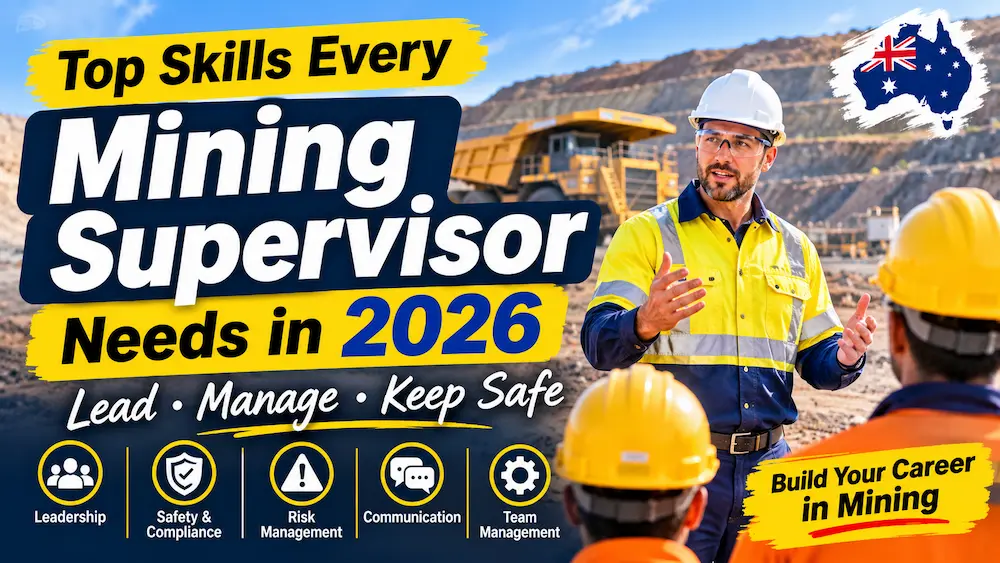
Technical expertise alone is no longer enough to succeed as a mining supervisor in Australia. In 2026, supervisors are expected to lead diverse teams, manage workplace risks, communicate operational information clearly and maintain compliance in increasingly complex mining environments.
Whether you are an experienced supervisor or preparing to move into a leadership position, developing the right combination of technical, safety and people-management skills can make a significant difference to your effectiveness.
Modern mining supervisors must do more than allocate tasks and monitor production. They need to recognise hazards, support workers, make informed decisions, coordinate operations and create a workplace culture where safety and productivity go hand in hand.
Quick Answer: What Skills Does a Mining Supervisor Need in 2026?
A mining supervisor needs strong leadership, risk management, communication, safety compliance, decision-making, problem-solving and team coordination skills.
The most important capabilities include: leading workers, identifying and controlling hazards, communicating instructions, managing incidents, understanding site procedures, resolving conflicts and monitoring operational performance.
For supervisors who want to strengthen these capabilities, structured training can help develop essential competencies in workplace risk management, safety and health investigations, and communication.
Develop Your Mining Supervisory Skills
Build essential supervisory competencies with Mining Supervisor Training covering G1, G8 and G9. Develop your knowledge of risk management, safety investigations and workplace communication.
1. Leadership Skills
Strong leadership is the foundation of effective mining supervision. Mining supervisors are responsible for guiding workers, coordinating daily activities and maintaining a productive working environment, often under challenging operational conditions.
In 2026, effective leadership means more than giving instructions. Supervisors must understand how to motivate people, build trust, manage different personalities and create a culture where workers feel comfortable raising safety concerns.
Key leadership abilities include:
- Decision-making under pressure: Making appropriate decisions when operational conditions change or unexpected problems arise.
- Team motivation: Encouraging workers to perform consistently while maintaining safe work practices.
- Conflict resolution: Addressing disagreements professionally and fairly.
- Accountability: Taking responsibility for decisions, actions and work outcomes.
- Delegation: Assigning tasks according to workers’ capabilities, experience and authorisation.
- Leading by example: Demonstrating the safety and professional standards expected from the team.
Supervisors who lead by example can build stronger working relationships and encourage workers to take greater responsibility for safety and performance.
2. Risk Management and Hazard Identification
Mining is a high-risk industry, making risk management one of the most important competencies for any supervisor. Hazards can arise from mobile equipment, ground conditions, working at heights, electrical systems, hazardous substances, manual tasks and changing environmental conditions.
A supervisor must understand how to identify hazards, assess risks, implement suitable controls and monitor whether those controls remain effective.
Important risk management skills include:
- Identifying workplace hazards before work begins.
- Assessing the likelihood and potential consequences of incidents.
- Applying the hierarchy of controls when selecting risk controls.
- Participating in job safety analyses and workplace risk assessments.
- Monitoring changing site conditions.
- Reviewing controls when work methods or circumstances change.
- Encouraging workers to report hazards and near misses.
Risk management should not be treated as a paperwork exercise. It is an ongoing process that needs to be integrated into everyday operational decisions.
Example: Managing a changing workplace risk
If heavy rain changes road conditions at a mine, a supervisor may need to reassess vehicle movements, inspect affected areas, communicate revised instructions and ensure appropriate controls are in place before operations continue.
Developing formal risk management knowledge is an important part of becoming a capable mining supervisor. The G1 competency, RIIRIS301E – Apply Risk Management Processes, covers essential skills in identifying, assessing and managing workplace risks.
3. Communication Skills
Clear communication is essential for coordinating mining operations and preventing misunderstandings. Supervisors regularly communicate with operators, tradespeople, contractors, safety personnel, engineers and senior management.
Instructions that are unclear, incomplete or misunderstood can contribute to unsafe work practices, operational delays and mistakes.
Modern mining supervisors must be able to:
- Deliver clear and practical work instructions.
- Conduct effective pre-start meetings and toolbox talks.
- Communicate across diverse teams and work groups.
- Provide constructive feedback.
- Listen to worker concerns and respond appropriately.
- Prepare accurate shift handovers and operational reports.
- Report hazards, incidents and changing conditions promptly.
- Communicate emergency instructions clearly.
Communication also involves checking that workers understand the information being provided. Asking questions, encouraging feedback and confirming critical instructions can reduce misunderstandings.
The G9 competency, RIICOM301E – Communicate Information, develops relevant communication skills, including planning, presenting and communicating workplace information.
4. Workplace Health and Safety Compliance
Mining supervisors must understand the workplace health and safety requirements that apply to their operations. Australian mining safety obligations are influenced by state and territory legislation, the type of mining operation and site-specific procedures.
Supervisors play an important role in ensuring workers follow relevant safety requirements and that workplace risks are managed appropriately.
Core compliance knowledge includes:
- Understanding applicable WHS or mine safety legislation.
- Following site-specific safety management systems and procedures.
- Understanding workers’ safety responsibilities.
- Ensuring appropriate training, authorisations and competencies are considered before work is assigned.
- Maintaining accurate workplace records and documentation.
- Reporting incidents and unsafe conditions through the correct processes.
- Monitoring whether required risk controls are being followed.
Compliance is not simply about avoiding penalties. It helps protect workers, contractors and the wider operation by ensuring that safety responsibilities are understood and applied.
Supervisors should also recognise the limits of their authority and seek guidance when a legal, technical or operational issue requires specialist input.
5. Incident Investigation and Problem-Solving
Even with effective safety systems, incidents and near misses can occur. Mining supervisors need to understand how to respond appropriately, secure the area where necessary, report the event and support the investigation process.
The objective of an investigation is to understand what happened, identify contributing factors and determine appropriate actions to help prevent recurrence.
Important investigation skills include:
- Recognising when an incident or near miss needs to be reported.
- Following site incident response and notification procedures.
- Preserving relevant information and evidence where required.
- Gathering accurate information from relevant sources.
- Identifying immediate and underlying contributing factors.
- Recommending corrective and preventive actions.
- Communicating investigation findings to appropriate personnel.
- Following up to check whether actions have been completed.
Supervisors should avoid making assumptions or assigning blame before the facts are established. A structured investigation helps identify what needs to change in the workplace rather than focusing only on individual actions.
The G8 competency, RIIWHS301E – Conduct Safety and Health Investigations, addresses the skills involved in planning, conducting and reporting workplace safety and health investigations.
6. Decision-Making Under Pressure
Mining operations can involve rapidly changing conditions, unexpected equipment problems, weather events, production pressures and safety concerns. Supervisors must be able to assess situations and make appropriate decisions without compromising worker safety.
Effective decision-making requires a combination of operational knowledge, risk awareness, communication and sound judgement.
A capable supervisor should know how to:
- Assess the available information before making a decision.
- Recognise when work needs to stop or be reassessed.
- Prioritise safety when production targets conflict with safe work requirements.
- Escalate issues beyond their authority or technical expertise.
- Communicate decisions and explain the reasons behind them.
- Review the outcome and adjust the approach when necessary.
For example, if a worker reports an unexpected ground condition, the supervisor should follow the relevant site procedures, assess the potential risk and ensure the issue is addressed by appropriately qualified personnel before affected work proceeds.
7. Team Management and Conflict Resolution
Mining supervisors often manage workers with different experience levels, backgrounds, skills and responsibilities. Maintaining effective teamwork requires patience, fairness and the ability to manage workplace relationships.
Strong team management helps ensure that workers understand their responsibilities and that operational activities are coordinated effectively.
Essential team management skills include:
- Allocating work according to skills and competency.
- Supporting new and inexperienced workers.
- Managing disagreements respectfully.
- Recognising good performance and providing constructive feedback.
- Encouraging workers to raise concerns.
- Maintaining professional boundaries and consistent expectations.
- Coordinating activities across different work groups.
A good supervisor does not need to agree with every worker, but must be able to listen, communicate expectations and deal with workplace issues professionally.
8. Operational Planning and Time Management
Mining operations involve multiple activities that must be coordinated to meet operational requirements while maintaining safe working conditions. Supervisors need to understand how to plan tasks, allocate resources and monitor progress throughout a shift.
Key planning and coordination skills include:
- Understanding daily production or maintenance priorities.
- Coordinating workers, equipment and materials.
- Identifying potential operational delays.
- Monitoring work progress against the plan.
- Communicating changes to affected personnel.
- Completing shift handovers and relevant records.
- Balancing productivity targets with safety requirements.
Effective planning helps reduce confusion and unnecessary delays. However, a production schedule should never override the need to reassess unsafe conditions or follow required safety procedures.
9. Adaptability and Digital Skills
Mining operations increasingly use digital systems to support equipment monitoring, maintenance planning, communication, reporting and operational decision-making.
Supervisors do not necessarily need advanced technical or programming skills, but they should be comfortable using the digital tools required by their workplace.
Useful digital and adaptability skills include:
- Using digital reporting and incident management systems.
- Accessing electronic work instructions and safety documentation.
- Understanding relevant equipment monitoring information.
- Using communication and scheduling platforms.
- Adapting to updated procedures and technology.
- Recognising when information needs to be verified before acting on it.
Digital systems can improve access to information, but supervisors must still apply practical judgement. Technology supports decision-making; it does not replace responsibility for safe work practices.
10. Training, Coaching and Continuous Improvement
Mining supervisors have an important role in helping workers maintain the knowledge and skills needed to perform their jobs safely and effectively.
Workplace conditions, equipment, procedures and operational requirements can change. Supervisors should encourage continuous learning and identify when workers need additional instruction, refresher training or competency assessment.
A supervisor should be able to:
- Identify gaps in workers’ knowledge and capabilities.
- Support workplace coaching and mentoring.
- Encourage participation in toolbox talks and safety discussions.
- Communicate changes to procedures and work practices.
- Recognise when formal training or assessment is required.
- Review workplace performance and identify improvement opportunities.
Training should be relevant to the actual work being performed. Supervisors should coordinate with competent trainers, assessors and relevant site personnel rather than assuming that informal instruction replaces required formal competency assessment.
For organisations looking to develop several supervisors or upskill an entire workforce, structured group training can provide a practical way to build consistent knowledge across teams.
Upskill Your Mining Team More Efficiently
Group training can help mining organisations develop supervisory capabilities across multiple workers, improve consistency and address shared skills gaps.
Mining Supervisor Skills: Comparison Table
The following table summarises the key skills mining supervisors need and how each capability supports workplace performance.
| Skill | Why It Matters | Practical Application |
|---|---|---|
| Leadership | Builds trust and improves team performance. | Coordinating workers and allocating responsibilities. |
| Risk management | Helps prevent workplace incidents. | Identifying hazards and applying suitable controls. |
| Communication | Reduces misunderstandings and errors. | Conducting pre-start meetings and shift handovers. |
| Compliance knowledge | Supports safe and compliant operations. | Following applicable legislation and site procedures. |
| Incident investigation | Helps identify causes and prevent recurrence. | Gathering information and supporting corrective actions. |
| Decision-making | Supports appropriate responses to changing conditions. | Reassessing risks and escalating operational issues. |
| Team management | Improves cooperation and accountability. | Resolving conflicts and supporting workers. |
| Planning | Improves operational coordination. | Scheduling tasks and monitoring progress. |
| Digital skills | Supports modern operational systems. | Using reporting, communication and monitoring tools. |
| Coaching | Supports workforce development. | Mentoring workers and identifying training needs. |
How Can You Develop Your Mining Supervisor Skills?
Developing supervisory skills requires a combination of workplace experience, structured training and continuous improvement. Workers preparing for leadership roles should focus on building capabilities that can be demonstrated in real operational situations.
Practical ways to improve your skills
- Take on additional responsibilities: Look for opportunities to coordinate suitable tasks, support new workers or assist with team activities.
- Participate in safety activities: Become involved in hazard identification, workplace inspections and risk assessments within your role and authority.
- Improve communication: Practise delivering clear instructions, participating in toolbox talks and completing accurate shift handovers.
- Learn from experienced supervisors: Observe how they manage operational challenges, resolve issues and communicate with workers.
- Complete relevant training: Consider nationally recognised units that support the competencies required for your intended position.
- Ask for feedback: Identify strengths and areas where your leadership approach can improve.
- Review your performance: Use workplace feedback, operational outcomes and safety observations to identify further development opportunities.
For a broader explanation of the responsibilities and capabilities involved in this role, read our guide: What Does a Mining Supervisor Actually Do? Key Duties, Skills and Safety Responsibilities.
How Does Mining Supervisor Training Help Develop These Skills?
Formal training can help supervisors strengthen the knowledge and competencies needed to manage workplace risks, investigate safety and health incidents and communicate operational information.
For relevant roles, three important units are:
| Unit | Competency | Skill Area |
|---|---|---|
| G1 – RIIRIS301E | Apply Risk Management Processes | Workplace risk management and hazard control. |
| G8 – RIIWHS301E | Conduct Safety and Health Investigations | Incident investigation and reporting. |
| G9 – RIICOM301E | Communicate Information | Workplace communication and information sharing. |
These competencies address important aspects of frontline supervision. However, training requirements differ between mining jurisdictions and job functions. Completing these units does not automatically satisfy every statutory appointment or employer requirement.
Take the Next Step
Strengthen Your Mining Supervisory Competencies
Develop your knowledge of risk management, safety and health investigations, and workplace communication through the Mining Supervisor Training program.
- G1 – Apply Risk Management Processes
- G8 – Conduct Safety and Health Investigations
- G9 – Communicate Information
View Mining Supervisor Training and Enrol
Review the course page for delivery and assessment details, and confirm that the units meet the requirements of your intended role.
Frequently Asked Questions About Mining Supervisor Skills
What are the most important skills for a mining supervisor?
The most important mining supervisor skills include leadership, risk management, communication, WHS compliance, incident investigation, decision-making, problem-solving and team coordination. These capabilities help supervisors manage workers and operational activities while maintaining safe working conditions.
Why is leadership important in mining supervision?
Leadership helps supervisors coordinate workers, communicate expectations, manage workplace challenges and promote a strong safety culture. Effective leaders also encourage workers to report hazards and take responsibility for safe work practices.
Why does a mining supervisor need risk management skills?
Mining environments involve hazards that can change throughout a shift. Risk management skills help supervisors identify hazards, assess risks, implement controls and review whether those controls remain effective.
What communication skills does a mining supervisor need?
Mining supervisors need to deliver clear instructions, conduct pre-start meetings, communicate safety information, prepare shift handovers, provide feedback and report incidents accurately. They must also listen to workers and confirm that important instructions are understood.
What are G1, G8 and G9 in mining?
G1 refers to RIIRIS301E – Apply Risk Management Processes. G8 refers to RIIWHS301E – Conduct Safety and Health Investigations. G9 refers to RIICOM301E – Communicate Information. These units cover important competencies relevant to certain mining supervisory roles.
Can mining supervisor skills be developed through training?
Yes. Formal training can help develop knowledge in areas such as risk management, workplace investigations and communication. Practical workplace experience, coaching and site-specific training are also important for applying these skills effectively.
Is technical knowledge enough to become a mining supervisor?
No. Technical knowledge is important, but supervisors also need people-management, communication, risk management and decision-making skills. They must be able to coordinate workers and ensure activities are performed safely and in accordance with relevant procedures.
How can mining companies upskill their supervisors?
Mining companies can use structured training, workplace coaching, mentoring, competency development and group training programs. Training should address the specific skills gaps of the workforce and the requirements of the operation.
What is the difference between a mining supervisor and a mining manager?
A mining supervisor generally coordinates workers and operational activities within a particular work area or team. A mining manager usually has broader responsibility for managing mine operations, resources, compliance and overall performance. Specific statutory responsibilities depend on the jurisdiction and position.
Conclusion: Successful Mining Supervisors Need More Than Technical Expertise
What are the most important skills for a mining supervisor?
The most important mining supervisor skills include leadership, risk management, communication, WHS compliance, incident investigation, decision-making, problem-solving and team coordination. These capabilities help supervisors manage workers and operational activities while maintaining safe working conditions.
Why is leadership important in mining supervision?
Leadership helps supervisors coordinate workers, communicate expectations, manage workplace challenges and promote a strong safety culture. Effective leaders also encourage workers to report hazards and take responsibility for safe work practices.
Why does a mining supervisor need risk management skills?
Mining environments involve hazards that can change throughout a shift. Risk management skills help supervisors identify hazards, assess risks, implement controls and review whether those controls remain effective.
What communication skills does a mining supervisor need?
Mining supervisors need to deliver clear instructions, conduct pre-start meetings, communicate safety information, prepare shift handovers, provide feedback and report incidents accurately. They must also listen to workers and confirm that important instructions are understood.
What are G1, G8 and G9 in mining?
G1 refers to RIIRIS301E – Apply Risk Management Processes. G8 refers to RIIWHS301E – Conduct Safety and Health Investigations. G9 refers to RIICOM301E – Communicate Information. These units cover important competencies relevant to certain mining supervisory roles.
Can mining supervisor skills be developed through training?
Yes. Formal training can help develop knowledge in areas such as risk management, workplace investigations and communication. Practical workplace experience, coaching and site-specific training are also important for applying these skills effectively.
Is technical knowledge enough to become a mining supervisor?
No. Technical knowledge is important, but supervisors also need people-management, communication, risk management and decision-making skills. They must be able to coordinate workers and ensure activities are performed safely and in accordance with relevant procedures.
How can mining companies upskill their supervisors?
Mining companies can use structured training, workplace coaching, mentoring, competency development and group training programs. Training should address the specific skills gaps of the workforce and the requirements of the operation.
What is the difference between a mining supervisor and a mining manager?
A mining supervisor generally coordinates workers and operational activities within a particular work area or team. A mining manager usually has broader responsibility for managing mine operations, resources, compliance and overall performance. Specific statutory responsibilities depend on the jurisdiction and position.
The role of a mining supervisor continues to involve a combination of operational knowledge, leadership and safety responsibilities. In 2026, supervisors need to be capable of managing risks, communicating effectively, supporting workers and making informed decisions in demanding environments.
Developing these skills requires ongoing learning, practical experience and a commitment to continuous improvement. Whether you are already supervising a team or preparing for your first leadership opportunity, strengthening your capabilities can help you become more effective in the workplace.
Formal training in risk management, safety and health investigations and communication can also support your development and help you prepare for the responsibilities associated with mining supervision.
Ready to Develop Your Mining Supervisor Skills?
Explore G1, G8 and G9 Mining Supervisor Training and strengthen your knowledge of workplace risk management, safety investigations and communication.
Further Reading
Information note: Mining safety and statutory competency requirements vary across Australian states and territories and may depend on the type of operation and supervisory position. Always check the current requirements with the relevant regulator and your employer.