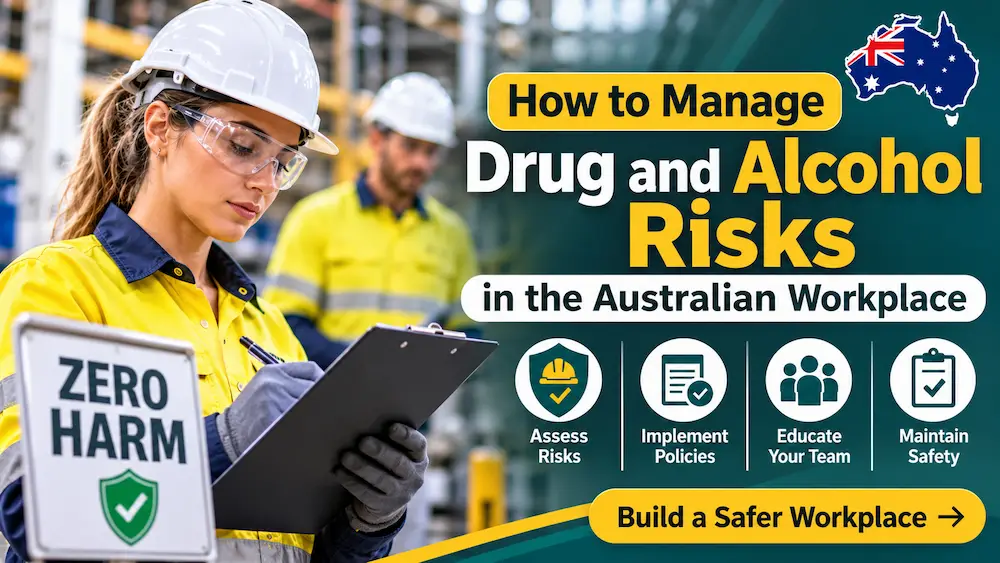
A practical guide for Australian employers, supervisors and safety managers on preventing workplace impairment, developing effective policies and creating safer working environments.
Alcohol and other drugs can affect concentration, coordination, judgement and reaction time. In workplaces involving heavy machinery, transport, construction, mining, working at heights or other safety-critical activities, impairment can create serious risks for workers and the wider community.
Managing these risks requires more than simply introducing drug testing. Australian businesses need a structured approach that combines risk assessment, clear workplace policies, worker consultation, education, appropriate screening procedures and consistent management practices.
Quick Answer: How Can Employers Manage Drug and Alcohol Risks?
Australian employers can manage workplace drug and alcohol risks by identifying potential hazards, assessing impairment risks, establishing clear policies, educating workers, responding appropriately to concerns and reviewing safety controls regularly.
- Identify roles and tasks where impairment could cause harm.
- Develop a clear drug and alcohol workplace policy.
- Train supervisors to recognise and respond to possible impairment.
- Consider risk-based screening where appropriate.
- Protect worker privacy and handle results confidentially.
- Review procedures after incidents and workplace changes.
Why Is Drug and Alcohol Risk Management Important?
Alcohol and other drugs can affect a person’s ability to perform tasks safely. The level of risk depends on the substance, individual circumstances, work environment and nature of the job.
Poorer Judgement
Reduced ability to assess hazards and make safe decisions.
Slower Reactions
Delayed responses to hazards, equipment and changing conditions.
Reduced Coordination
Difficulty safely operating machinery, tools and vehicles.
Increased Safety Risk
Greater potential for incidents, injuries and harm to others.
These risks are particularly important in safety-critical environments where one impaired decision can have serious consequences. A proactive approach helps businesses protect workers, contractors, visitors and the public.
Understanding Australian Workplace Safety Responsibilities
Under applicable Australian work health and safety laws, businesses and other duty holders must manage risks to workers and other people so far as is reasonably practicable. Workers also have responsibilities to take reasonable care of their own health and safety and avoid putting others at risk.
Safe Work Australia provides national policy and guidance, while state and territory regulators administer and enforce workplace safety laws. Victoria operates under a separate occupational health and safety framework, so businesses should check the requirements that apply in their jurisdiction.
| Workplace role | Key responsibilities |
|---|---|
| Employers and businesses | Identify hazards, assess risks, implement controls and consult with affected workers. |
| Managers and supervisors | Apply workplace procedures, respond to safety concerns and escalate incidents appropriately. |
| Workers | Take reasonable care, follow reasonable safety procedures and report hazards or impairment concerns. |
| Contractors and visitors | Follow relevant site safety instructions and avoid actions that could put others at risk. |
Important: Drug and alcohol testing is not universally mandatory across all Australian workplaces. Whether testing is appropriate depends on the work, identified risks, applicable laws, employment arrangements and relevant workplace policies.
7 Practical Steps to Manage Drug and Alcohol Risks
A structured risk management process helps businesses establish consistent procedures and respond to potential impairment before it results in an incident.
Identify Workplace Hazards
Identify jobs, tasks and environments where alcohol or drug impairment could create a safety risk.
Assess the Level of Risk
Consider the likelihood of impairment and the potential consequences for workers and others.
Develop a Clear Policy
Set expectations, responsibilities, reporting procedures and possible responses to policy breaches.
Educate Workers
Explain impairment risks, workplace expectations and how to report safety concerns.
Apply Suitable Controls
Use supervision, fitness-for-work procedures and risk-based screening where appropriate.
Respond to Concerns
Follow a consistent process when impairment is suspected or a screening result requires further assessment.
Review and Improve
Monitor incidents, review control effectiveness and update procedures when necessary.
What Should a Workplace Drug and Alcohol Policy Include?
A written drug and alcohol policy gives workers and management a clear understanding of workplace expectations. It should be practical, easy to understand and relevant to the risks associated with the business.
Essential Policy Checklist
- ✓ Purpose and scope of the policy
- ✓ Definitions of impairment and fitness for work
- ✓ Expectations regarding alcohol and drug use
- ✓ Responsibilities of workers, supervisors and management
- ✓ Procedures for reporting suspected impairment
- ✓ Testing methods and circumstances, if testing is used
- ✓ Confidentiality and management of test results
- ✓ Procedures for non-negative or inconclusive screening results
- ✓ Support, review and complaint procedures
- ✓ Consequences of policy breaches and review arrangements
Employers should consult with workers and their representatives when developing or changing relevant procedures. The policy should also be explained during induction and reinforced through regular communication.
Workplace Drug and Alcohol Testing Methods
Testing may form part of a broader workplace risk management strategy, particularly in safety-critical industries. The most appropriate method depends on the purpose of testing, the workplace environment, the substances being screened and the applicable procedures.
| Testing method | Typical purpose | Important consideration |
|---|---|---|
| Breath alcohol testing | Screens for alcohol in breath. | Equipment, procedures and interpretation must be appropriate to the testing purpose. |
| Saliva drug testing | Screens for selected drugs in oral fluid. | Detection windows and screening limitations vary by substance and device. |
| Urine drug testing | Screens for drug metabolites in urine. | A result may indicate prior exposure and does not automatically establish current impairment. |
A screening result is not the same as proof that a person is currently impaired. Screening devices have limitations, and non-negative results may require confirmatory testing and appropriate professional review under the workplace procedure.
When Might Workplace Testing Be Considered?
- Pre-employment testing: Where lawful, relevant to the role and clearly covered by recruitment and workplace procedures.
- Random testing: Where a risk assessment and applicable legal or industrial requirements support its use.
- Post-incident testing: Where testing is relevant to investigating an incident and is consistent with established procedures.
- For-cause testing: Where there are reasonable, documented grounds for concern about a worker’s fitness for duty.
Testing should be proportionate to the identified risks, conducted fairly and supported by clear procedures. Employers should consider privacy, consent, discrimination, employment arrangements and other applicable legal requirements before introducing a testing program.
How Should Employers Respond to Suspected Workplace Impairment?
If a worker appears impaired, supervisors should prioritise immediate safety rather than making assumptions about the cause.
A Practical Response Process
Remove the worker from safety-critical tasks where necessary and prevent further exposure to risk.
Record relevant behaviour, performance issues and objective observations without making unsupported accusations.
Notify the appropriate manager and apply the established fitness-for-work or testing process.
Consider medical assessment or other assistance where necessary. Do not allow an unfit worker to drive or perform hazardous duties.
Keep appropriate confidential records and review whether further risk controls are needed.
Supervisors should avoid diagnosing substance use based solely on appearance or behaviour. Fatigue, illness, medication and other factors can also affect a person’s performance. Decisions should follow documented procedures and appropriate professional advice.
Why Worker and Supervisor Education Matters
Policies are only effective when people understand how to apply them. Regular workplace education helps workers recognise impairment risks, understand their responsibilities and respond appropriately to safety concerns.
- Understand workplace expectations.
- Recognise impairment risks.
- Know how to report concerns.
- Understand fitness-for-work requirements.
- Recognise possible signs of impairment.
- Apply workplace procedures consistently.
- Manage sensitive conversations.
- Document and escalate concerns.
- Review workplace risk controls.
- Maintain clear policies.
- Protect confidential information.
- Support continuous improvement.
Businesses can also consider whether workplace factors such as excessive workloads, fatigue, poor supervision, bullying or inadequate support are contributing to broader health and safety risks.
Strengthen Your Workplace Drug and Alcohol Safety Practices
Explore workplace drug and alcohol screening training options to help develop practical knowledge, improve awareness and support safer workplace procedures.
Explore Drug and Alcohol Screening Training →
Visit the training page to explore available options and make an enquiry.
How to Monitor and Improve Your Workplace Safety Program
Drug and alcohol risk management should be an ongoing process. Businesses should periodically check whether their policies and controls are working as intended.
Workplace Review Checklist
- Are workers aware of the drug and alcohol policy?
- Do supervisors understand how to respond to suspected impairment?
- Are risk assessments current and relevant to actual job tasks?
- Are testing procedures fair, appropriate and clearly documented?
- Is sensitive information stored and handled securely?
- Are incidents and near misses reviewed for possible contributing factors?
- Are workers consulted when procedures change?
- Are training and awareness activities updated regularly?
Review the program after significant incidents, changes to work activities, new equipment or changes in relevant laws and workplace arrangements. A consistent review process helps identify gaps and improve safety over time.
Related Reading
For more information about workplace screening procedures and protecting workers, read our related guide:
Protecting Your Workforce: The Essentials of Drug and Alcohol Screening →
Frequently Asked Questions
1. Are Australian employers required to conduct workplace drug and alcohol testing?
There is no universal requirement for every Australian employer to conduct drug and alcohol testing. However, employers must manage relevant workplace health and safety risks. Testing may be considered where it is appropriate to the identified risks and complies with applicable laws, employment arrangements and workplace policies.
2. What should a workplace drug and alcohol policy include?
A policy should explain workplace expectations, responsibilities, reporting procedures, fitness-for-work requirements, testing arrangements where applicable, confidentiality, response procedures and possible consequences of policy breaches.
3. Which industries should pay particular attention to impairment risks?
Industries involving construction, mining, transport, warehousing, manufacturing, aviation, maritime operations and heavy machinery may have tasks where impairment can create serious safety consequences. Risk should be assessed according to actual job duties rather than industry labels alone.
4. What is the difference between a drug screening result and impairment?
A screening result indicates whether a test has detected a substance or its markers according to the device’s testing criteria. It does not automatically establish that a person is currently impaired or unable to work safely. Further assessment may be required.
5. What should a supervisor do if a worker appears impaired?
The supervisor should prioritise safety, prevent the worker from performing hazardous duties where necessary, document objective observations and follow the organisation’s established fitness-for-work and reporting procedures.
6. Can prescription medication affect workplace safety?
Yes. Some prescription and over-the-counter medicines can affect alertness, coordination or reaction time. Workers should follow medical advice and workplace reporting procedures where medication could affect their ability to perform safety-critical duties. Employers should handle medical information confidentially.
7. How often should a workplace drug and alcohol policy be reviewed?
Policies should be reviewed periodically and whenever significant incidents, operational changes, new risks or relevant legal developments occur. Businesses should also consult affected workers when reviewing relevant procedures.
8. Can an employer introduce random drug and alcohol testing?
Random testing may be considered in some workplaces, particularly where safety risks justify it. Employers should first assess the need for testing, consult relevant workers and representatives, review applicable legal and industrial requirements, and establish clear procedures covering privacy, results and follow-up action.
Final Thoughts: Creating a Safer Australian Workplace
Managing drug and alcohol risks is an important part of workplace health and safety. Effective prevention requires more than testing alone. Employers should combine clear policies, risk assessments, worker education, appropriate screening procedures and consistent responses to potential impairment.
By taking a practical and risk-based approach, Australian businesses can better protect their workforce, reduce exposure to preventable hazards and support a safer workplace culture.
Learn more about available drug and alcohol screening training options for workplace safety and awareness.