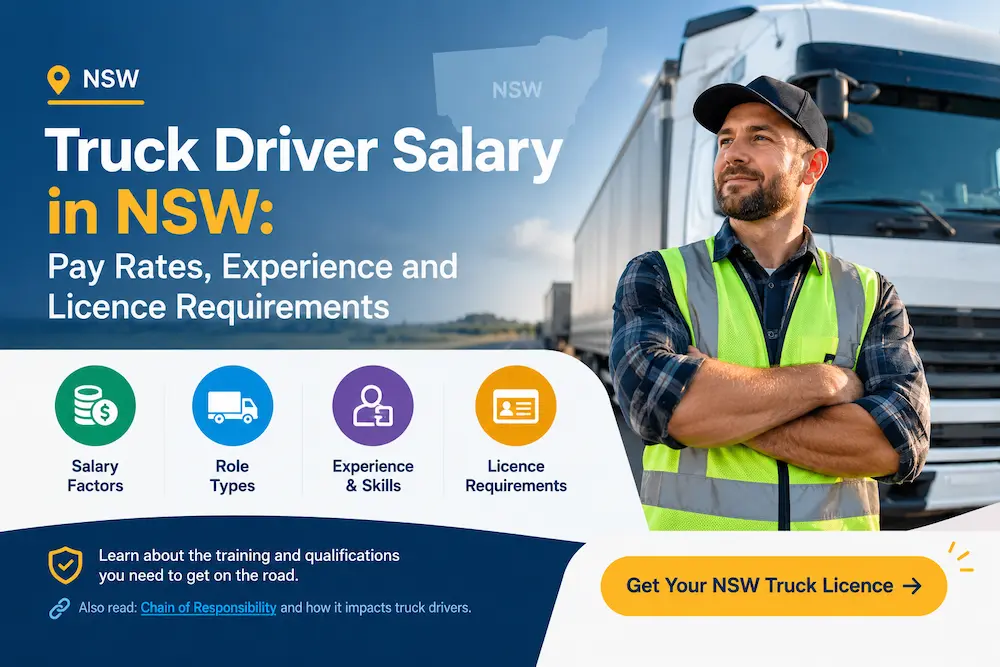
Whether you are considering your first truck driving job or looking to upgrade your existing licence, understanding these factors can help you compare opportunities and plan your next career move.
This guide explains how truck driver pay works, which roles may suit different experience levels, and how to identify the licence and training requirements for your chosen position.
Quick Answer: How Much Do Truck Drivers Earn in NSW?
There is no single salary for truck drivers in NSW. Pay depends on the role, licence class, experience, employer, roster and applicable award or enterprise agreement.
- Entry-level drivers: May begin in local delivery, distribution or other suitable roles, depending on their licence and the employer’s requirements.
- Experienced drivers: May qualify for more specialised work, supervisory responsibilities or complex delivery operations.
- Heavy combination and multi-combination drivers: Can access additional articulated-vehicle roles when they meet the relevant licensing and experience requirements.
- Additional pay: Overtime, shift penalties and allowances may affect total earnings where applicable.
For current minimum pay rates, check the applicable Road Transport and Distribution Award or your employer’s enterprise agreement.
Planning a Career in Truck Driving?
Find out about truck licence options in NSW and explore training pathways for the type of vehicle you want to drive.
1. What Factors Affect Truck Driver Salary in NSW?
Two truck drivers working in NSW can receive different pay even when they have similar licences. Employers consider several factors when determining salary, hourly rates and employment conditions.
Licence Class and Vehicle Type
The licence you hold determines which heavy vehicles you can legally drive. A driver operating a medium rigid truck may perform different duties from someone transporting freight in a prime mover and semi-trailer combination.
Higher licence classes can expand the range of jobs available, but they do not automatically guarantee a higher salary. Pay also depends on the responsibilities, experience and operating conditions associated with the role.
Driving Experience
Employers may consider your experience with vehicle handling, reversing, load restraint, route planning, fatigue management and safe delivery procedures.
Newly licensed drivers may need to build practical experience before qualifying for positions involving complex vehicles, specialised freight or demanding delivery schedules.
Industry and Type of Freight
Truck drivers work across a wide range of industries, including:
- Retail and supermarket distribution
- Construction materials and building supplies
- Waste collection and environmental services
- General freight and interstate transport
- Refrigerated and temperature-controlled deliveries
- Fuel, chemical and other specialised transport, subject to applicable requirements
- Mining, resources and regional logistics
Some specialised positions require additional training, experience, site inductions or endorsements. These requirements can influence eligibility for a role and its remuneration.
Working Hours, Overtime and Allowances
Drivers may work early mornings, overnight shifts, weekends, public holidays or extended delivery routes. Depending on the employment arrangement, these hours may attract penalty rates, overtime or other allowances.
When comparing job offers, check whether the advertised figure represents a base salary, an hourly rate or an estimated total package. Also clarify how overtime, superannuation, travel expenses and other applicable payments are treated.
Location and Employer
Opportunities and pay conditions can differ between metropolitan Sydney, regional NSW and interstate routes. Fleet size, freight demand, employment type and the employer’s pay arrangements can also affect total earnings.
2. Truck Driving Roles and Their Salary Potential
The most suitable truck driving role depends on your qualifications, preferred working environment and career goals. The table below compares common job types without assuming that every position pays the same rate.
| Truck Driving Role | Typical Work | What Can Affect Pay? |
|---|---|---|
| Local delivery driver | Deliveries to shops, businesses and customers. | Delivery volume, loading duties, route complexity and hours. |
| Rigid truck driver | Distribution, building supplies and other rigid-truck operations. | Vehicle class, industry experience and job responsibilities. |
| Heavy combination driver | Semi-trailer freight and other approved heavy combinations. | Combination type, freight, route and experience. |
| Multi-combination driver | B-doubles and other permitted multi-combination vehicles. | Vehicle configuration, operating conditions and specialist experience. |
| Specialist or regional driver | Regional freight, specialised loads or industry-specific transport. | Additional qualifications, roster, travel and employer requirements. |
Important: These are role descriptions, not guaranteed salary rankings. A local delivery position with overtime may offer a different total package from a long-distance position with a higher base rate. Compare the actual duties and employment conditions before deciding.
3. Truck Driver Pay Rates in NSW: What Should You Check?
Before accepting a truck driving job, identify which industrial instrument or employment agreement covers the position. The relevant minimum rates and entitlements depend on the employee’s classification and circumstances.
The Road Transport and Distribution Award 2020 sets minimum pay and conditions for covered employees. Its classifications and rates should be checked against the actual duties performed.
For example, the award includes different provisions for ordinary hours, overtime, shiftwork, weekend work and casual employment. Not every driver is covered by the same award, and an enterprise agreement or another applicable instrument may determine the relevant conditions.
How to Compare Two Salary Offers
- Base pay: Confirm the annual salary or ordinary hourly rate.
- Employment status: Establish whether the role is permanent, part-time, casual or offered under another arrangement.
- Overtime: Ask when overtime applies and how it is calculated.
- Penalty rates: Check applicable evening, weekend and public holiday provisions.
- Allowances: Confirm whether meal, travel, accommodation or other allowances apply.
- Superannuation: Clarify whether the advertised package includes or excludes employer superannuation contributions.
- Hours and roster: Compare expected working hours, breaks, overnight stays and time away from home.
Practical tip: Do not compare jobs using annual salary alone. A realistic comparison should consider expected hours, roster patterns, additional payments and the responsibilities of each position.
4. Which Truck Licence Do You Need in NSW?
NSW uses several heavy vehicle licence classes. The correct class depends on the vehicle’s specifications and configuration, rather than its job title alone.
| Licence Class | Vehicle Category | Potential Work Examples |
|---|---|---|
| LR | Light rigid vehicles. | Eligible small truck and bus roles. |
| MR | Medium rigid vehicles, including trucks over 8 tonnes GVM with two axles. | Suitable delivery and distribution trucks. |
| HR | Heavy rigid vehicles, generally over 8 tonnes GVM with three or more axles. | Eligible heavy rigid transport and distribution work. |
| HC | Heavy combination vehicles, including qualifying articulated combinations. | Semi-trailer and other eligible combination work. |
| MC | Multi-combination vehicles, including B-doubles and qualifying road-train combinations. | Eligible multi-combination freight transport. |
These descriptions are a general guide. Check the official NSW requirements and the vehicle’s configuration before applying for a licence or accepting a driving position.
Read the NSW Government guide to obtaining a heavy vehicle licence for the latest eligibility rules and assessment pathways.
What Are the Basic Eligibility Requirements?
For standard NSW heavy vehicle licence applications, the published minimum car-licence holding periods generally include:
- LR and MR: At least one year holding a Class C licence or equivalent.
- HR: At least two years holding a Class C licence or equivalent.
- HC: At least one year holding an eligible MR or HR licence or equivalent, subject to the unrestricted-licence requirements.
- MC: At least one year holding an eligible HR or HC licence, together with the applicable assessment and other requirements.
Applicants must also meet the relevant knowledge, eyesight, assessment and other licensing requirements. Medical requirements may apply, and the pathway varies by licence class and individual circumstances.
Always confirm your eligibility with Service NSW or Transport for NSW before booking training.
Take the Next Step Towards Truck Driving
Choosing the right licence is an important first step towards qualifying for truck driving opportunities in NSW. Review your options before committing to a training pathway.
5. Does Experience Increase Truck Driver Salary?
Experience can improve a driver’s competitiveness for certain roles, particularly where employers require a reliable safety record, strong vehicle-control skills and familiarity with specialised operations.
However, there is no universal salary progression that applies to every driver. Employers may assess experience differently, and the effect on pay depends on the position and employment conditions.
New Drivers
Focus on the required licence, safe driving habits, punctuality, communication and building a practical employment record.
Experienced Drivers
Demonstrate dependable performance, route knowledge, load security, vehicle inspections and fatigue management.
Specialist Drivers
Consider the additional licence classes, training, endorsements or site-specific competencies required for the target role.
Skills Employers May Value
- Safe operation of the relevant heavy vehicle class
- Pre-start inspections and reporting mechanical defects
- Load restraint and cargo-handling awareness
- Understanding of fatigue-management requirements
- Accurate paperwork and delivery documentation
- Professional communication with dispatch teams and customers
- Compliance with road transport laws and workplace procedures
Keeping relevant licences current and maintaining a strong safety record can help you demonstrate your suitability when applying for more demanding driving roles.
6. Why Chain of Responsibility Training Matters
Truck driving involves more than operating a vehicle. Under Australia’s Chain of Responsibility (CoR) framework, parties across the heavy vehicle supply chain can have safety obligations, including obligations relating to transport activities they influence or control.
Depending on the operation, relevant parties may include employers, operators, schedulers, consignors, consignees, loading managers and drivers. Responsibilities are determined by the law and the circumstances of the activity.
Drivers should understand their role in safe transport practices, including compliance with applicable speed, fatigue, vehicle-mass and load-restraint requirements.
For a more detailed explanation, read Chain of Responsibility training: TLIF0009.
You can also explore whether truck drivers need Chain of Responsibility training in Australia to understand how training relates to the duties of different transport industry participants.
Training can help workers understand their responsibilities, but it does not replace legal compliance, workplace procedures or any training specifically required for a position.
7. How to Find Truck Driving Jobs in NSW
If you want to enter the transport industry or improve your career prospects, use a structured approach to identify suitable opportunities.
- Identify your target role. Decide whether you want to work in local delivery, distribution, construction, general freight or another area.
- Check the required licence. Review job advertisements and verify that your licence covers the vehicle you would operate.
- Compare training options. Confirm eligibility, course arrangements, assessment requirements and total costs before enrolling.
- Build relevant experience. Apply for positions that match your current qualifications and demonstrate your reliability and safety awareness.
- Review the complete pay package. Compare base rates, hours, penalties, overtime and applicable allowances.
- Continue developing your skills. Consider further licensing or role-specific training when it aligns with your career objectives.
For additional career ideas, explore our guide to truck driving jobs in NSW and the licences they require. Use the information to compare job types and qualifications, rather than treating any advertised salary as a guaranteed outcome.
Frequently Asked Questions About Truck Driver Salaries in NSW
1. How much does a truck driver earn in NSW?
Truck driver earnings in NSW vary by licence class, experience, industry, employer and working hours. Check current job advertisements and the applicable award or enterprise agreement to understand the rates relevant to a particular role.
2. Do truck drivers with an HC or MC licence earn more?
An HC or MC licence can provide access to additional heavy combination or multi-combination driving positions. Whether these roles pay more depends on the vehicle, employer, freight, experience and employment conditions.
3. What is the best truck licence to get in NSW?
The best licence depends on your career goals. MR and HR licences may suit particular rigid-truck roles, while HC and MC licences are relevant to eligible combination vehicles. Check the vehicles used in your target jobs and the official eligibility requirements before choosing a pathway.
4. Can new drivers get truck driving jobs in NSW?
Yes, some employers recruit drivers with limited commercial experience, provided they meet the licence and other job requirements. Entry opportunities depend on the employer, vehicle type, insurance conditions and the applicant’s skills.
5. Do truck drivers receive overtime and weekend penalty rates?
Some truck drivers are entitled to overtime, weekend penalties, shift allowances or other payments under the applicable industrial instrument or agreement. Entitlements vary according to coverage, classification, working arrangements and the hours worked.
6. Is truck driving a good long-term career in NSW?
Truck driving may suit people who enjoy practical work, transport operations and independent responsibility. Career suitability depends on working hours, physical demands, safety responsibilities, personal preferences and available employment opportunities.
7. Do truck drivers need Chain of Responsibility training?
Drivers must understand and comply with the Chain of Responsibility obligations relevant to their work. Whether a particular formal course is required depends on the role, employer, applicable requirements and training arrangements. Read our guide to truck drivers and Chain of Responsibility training.
8. Where can I find current truck driver pay rates?
Start with the Fair Work Ombudsman’s award information and the enterprise agreement or employment contract relevant to the position. Compare those details with current job advertisements to understand the pay offered for similar work.
Start Planning Your Truck Driving Career
Truck driver salaries in NSW depend on much more than a licence alone. The type of vehicle, experience, industry, roster and applicable pay conditions all influence what a driver may earn.
Start by identifying the type of work you want to do, checking the relevant licence requirements and comparing real job offers. The right training pathway can help you work towards the qualifications needed for your preferred role.
Ready to explore your options? Visit NSW truck licence training at Safety Australia Training to learn more about available pathways.