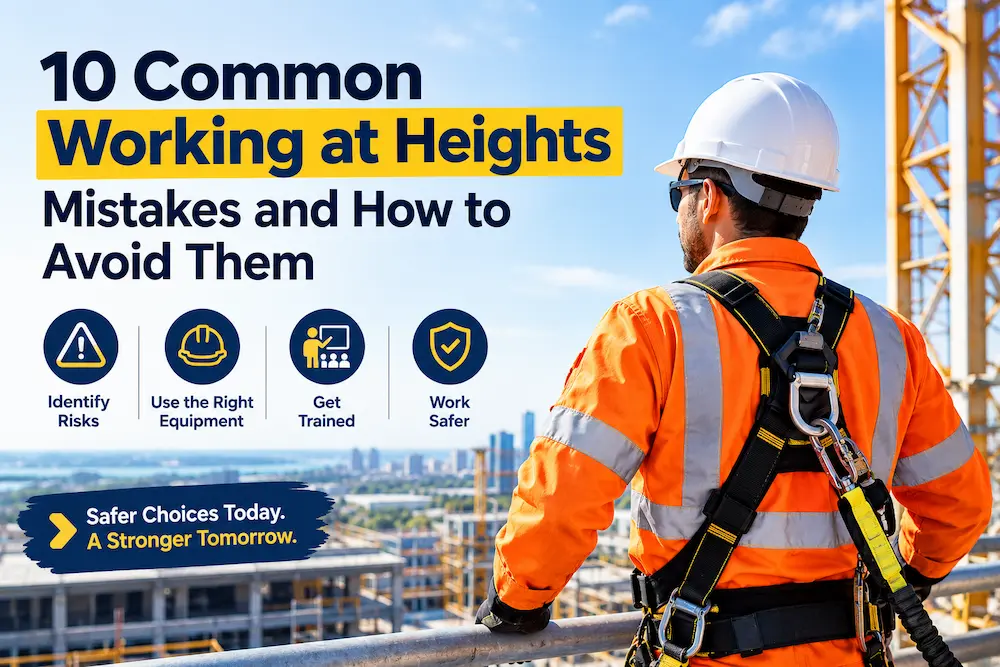
Working at heights is a routine part of many jobs across Australia, including construction, roofing, maintenance, telecommunications and industrial work. However, even familiar tasks can become dangerous when workers overlook hazards, rush through safety checks or use equipment incorrectly.
Whether you are a worker, supervisor or employer, understanding these mistakes can help you make safer decisions before anyone leaves the ground.
Quick Answer: How Can You Avoid Working at Heights Mistakes?
To reduce the risk of falls, workers should:
- Complete a task-specific risk assessment before starting.
- Eliminate working at height where reasonably practicable.
- Use suitable fall prevention systems and safe access equipment.
- Inspect harnesses, lanyards, anchor points and other equipment.
- Follow site procedures and use equipment only as intended.
- Keep work areas tidy and account for weather conditions.
- Understand emergency procedures and have a workable rescue plan.
- Complete appropriate training for the work and equipment involved.
Build Safer Working at Heights Skills
Learn how to assess risks, select suitable fall protection equipment and carry out work at height more safely with practical, nationally recognised training.
10 Common Working at Heights Mistakes
1. Skipping the Risk Assessment
One of the most serious mistakes is starting work without identifying the hazards involved. Workers may be familiar with a task and assume it is safe because they have completed it many times before. However, site conditions, access arrangements and environmental hazards can change from one day to the next.
Potential hazards include unprotected edges, fragile roofing, floor openings, slippery surfaces, overhead power lines, falling objects and nearby moving plant.
How to avoid it: Assess the specific task and work area before starting. Identify who could be harmed, evaluate the risks and select appropriate controls. Review the assessment if conditions change or the work method is altered. For high-risk construction work, ensure the required Safe Work Method Statement (SWMS) is prepared and followed.
2. Relying on a Harness Instead of Preventing Falls
A safety harness is an important part of some fall protection systems, but wearing one does not automatically make a job safe. A harness connected to an unsuitable anchor point or used without adequate clearance and rescue arrangements may not provide the intended protection.
Fall-arrest equipment is generally a later option in the hierarchy of fall controls, after considering whether the risk can be eliminated or controlled with fall prevention measures.
How to avoid it: Consider whether the work can be completed at ground level. Where this is not reasonably practicable, prioritise suitable fall prevention measures such as guardrails, scaffolding or an elevating work platform where appropriate. If a fall-arrest system is required, ensure the entire system is suitable for the task and used by trained workers.
3. Using Damaged or Unsuitable Safety Equipment
Harnesses, lanyards, connectors and other equipment can deteriorate through wear, damage, exposure to chemicals or incorrect storage. Equipment may also be unsuitable for the task or incompatible with other parts of the fall protection system.
Using damaged equipment or assuming that an item is safe because it looks acceptable at a glance can expose workers to unnecessary risk.
How to avoid it: Inspect equipment before use in accordance with the manufacturer’s instructions and workplace procedures. Check for cuts, fraying, damaged stitching, corrosion, deformation and other signs of deterioration. Ensure equipment is compatible, within its service life where applicable, and has the required inspection and maintenance history. Remove suspect equipment from service and follow the appropriate reporting and inspection process.
4. Choosing the Wrong Access Equipment
Using a ladder when a properly selected scaffold or elevating work platform would provide a safer working position is a common source of risk. Ladders can be unsuitable for tasks that require extended work, heavy tools, forceful movements or frequent reaching.
Improvised platforms and makeshift access arrangements are also dangerous because they may not provide adequate stability or fall protection.
How to avoid it: Choose access equipment based on the task, height, duration, work environment and risk assessment. Use ladders only where appropriate for the circumstances and in accordance with applicable requirements and manufacturer instructions. Ensure scaffolds and elevating work platforms are suitable, properly set up and operated by competent people.
5. Failing to Check Anchor Points and Connections
Fall-arrest equipment can only work as intended when its components are correctly selected, connected and used. Attaching a lanyard to an unverified structure, unsuitable fitting or point that has not been designed for the intended load can have serious consequences.
Incorrect connections can also affect fall clearance, increase swing-fall risks or prevent the system from functioning as intended.
How to avoid it: Use designated anchor points that are suitable for the system and task, and ensure installation and verification are carried out by appropriately competent people. Follow the equipment manufacturer’s instructions and workplace procedures. Check connectors and system compatibility before use, and never assume that a convenient structural member is a safe anchor point.
6. Ignoring Weather and Surface Conditions
Rain, wind, heat, poor lighting and slippery surfaces can change the level of risk when working at height. Roofs and elevated platforms may become particularly hazardous when wet, while strong winds can affect balance, materials and the safe operation of equipment.
Fragile roof sheets and skylights can also create a fall-through hazard, even when the surface appears solid.
How to avoid it: Check weather forecasts and actual site conditions before and during the task. Follow equipment limits and site procedures, secure materials where required, and stop work when conditions make it unsafe. Identify fragile surfaces and openings, and install suitable protection rather than relying on workers to recognise hazards while moving around.
7. Leaving Tools and Materials Unsecured
Objects dropped from height can injure people working below. Loose tools, fasteners, building materials and equipment can also create trip hazards for workers on the elevated surface.
This risk is sometimes overlooked when attention is focused mainly on preventing a worker from falling.
How to avoid it: Secure tools and materials where necessary, maintain good housekeeping, and establish exclusion zones beneath overhead work when appropriate. Use suitable tool lanyards, barriers, toe boards or other controls based on the risk assessment. Coordinate work so that people are not exposed to falling objects unnecessarily.
8. Rushing or Taking Shortcuts
Time pressure can lead workers to skip inspections, bypass barriers, overreach from a ladder or disconnect from a fall protection system to move more quickly. These shortcuts may save a few minutes but can create a serious hazard.
Familiarity with a site can also cause people to become complacent and stop following established procedures.
How to avoid it: Plan enough time for safe access, equipment checks and setup. Never bypass a required safety control to meet a deadline. Supervisors should support workers who stop a task because conditions are unsafe, and any change to the planned work method should be assessed before continuing.
9. Working Without Appropriate Training or Supervision
Workers may understand the general dangers of heights but still lack the practical skills needed to use specific fall protection systems, inspect equipment or follow safe access procedures.
Training needs vary depending on the work being performed, the equipment used and the worker’s responsibilities. A general site induction should not be treated as a substitute for task-specific competency where that is required.
How to avoid it: Provide suitable information, instruction, training and supervision for the work. Workers should understand the relevant procedures, equipment limitations, hazard controls and emergency arrangements before starting. Consider nationally recognised training such as RIIWHS204E – Work safely at heights where it is appropriate to the role and workplace requirements.
Read more about available options in our guide to training related to working at heights.
10. Having No Effective Emergency or Rescue Plan
Some workplaces focus on preventing a fall but fail to plan what happens if a worker does fall or becomes stranded at height. When a fall-arrest system has been activated, prompt and appropriate rescue arrangements may be critical.
Simply assuming that emergency services will handle every situation may not provide a sufficiently effective response for the particular worksite and equipment involved.
How to avoid it: Establish an emergency and rescue plan before work begins where required. Make sure workers understand how to raise the alarm, who is responsible for coordinating the response, what rescue equipment is available and how it will be used. Rescue arrangements must suit the worksite and the system in use, and people assigned rescue duties need suitable training. Never attempt an improvised rescue that puts additional people at risk.
Ready to Improve Your Working at Heights Safety?
Learn about hazard identification, risk controls, personal protective equipment and safe work practices through Safety Australia Training’s Work Safely at Heights course.
Working at Heights Mistakes: Quick Comparison
Common Mistake
Potential Risk
Safer Approach
Skipping risk assessments
Hazards remain unidentified
Assess the task and site before starting
Relying only on a harness
Fall risk may not be adequately controlled
Prioritise elimination and fall prevention
Using damaged equipment
Equipment may fail or not work correctly
Inspect and maintain equipment properly
Choosing unsuitable access equipment
Loss of balance or unsafe access
Select equipment suited to the task
Ignoring anchor points
Fall protection system may not perform as intended
Use suitable, verified anchor points
Ignoring weather conditions
Slips, loss of balance or unstable equipment
Monitor conditions and stop when unsafe
Leaving tools unsecured
Falling objects and trip hazards
Secure materials and manage exclusion zones
Taking shortcuts
Safety controls are bypassed
Follow procedures and allow time for safe work
Insufficient training
Incorrect equipment use or unsafe decisions
Provide role-appropriate training and supervision
No rescue plan
Delayed or unsafe emergency response
Prepare and communicate a suitable rescue plan
A Practical Checklist Before Working at Heights
| Common Mistake | Potential Risk | Safer Approach |
|---|---|---|
| Skipping risk assessments | Hazards remain unidentified | Assess the task and site before starting |
| Relying only on a harness | Fall risk may not be adequately controlled | Prioritise elimination and fall prevention |
| Using damaged equipment | Equipment may fail or not work correctly | Inspect and maintain equipment properly |
| Choosing unsuitable access equipment | Loss of balance or unsafe access | Select equipment suited to the task |
| Ignoring anchor points | Fall protection system may not perform as intended | Use suitable, verified anchor points |
| Ignoring weather conditions | Slips, loss of balance or unstable equipment | Monitor conditions and stop when unsafe |
| Leaving tools unsecured | Falling objects and trip hazards | Secure materials and manage exclusion zones |
| Taking shortcuts | Safety controls are bypassed | Follow procedures and allow time for safe work |
| Insufficient training | Incorrect equipment use or unsafe decisions | Provide role-appropriate training and supervision |
| No rescue plan | Delayed or unsafe emergency response | Prepare and communicate a suitable rescue plan |
Before starting a task, workers and supervisors should confirm that the following points have been addressed, where relevant to the work:
- The task and work area have been assessed for fall hazards.
- The safest reasonably practicable work method has been selected.
- Required risk controls and site-specific procedures are in place.
- Any required SWMS has been prepared, communicated and followed.
- Access equipment and fall protection systems are suitable for the task.
- Equipment has been checked in accordance with applicable procedures.
- Workers have the required skills, training and supervision.
- Weather, lighting, surface conditions and nearby hazards have been considered.
- Tools and materials are managed to prevent falling objects.
- Emergency communication and rescue arrangements are understood.
This checklist is a starting point, not a substitute for a task-specific risk assessment, workplace procedures or applicable WHS requirements.
Why Working at Heights Training Matters
Safe work at height requires more than knowing that falls are dangerous. Workers need to recognise hazards, understand control measures, select and use suitable equipment, and follow procedures that match the work being performed.
Training can help workers develop these practical skills and understand their responsibilities. Safety Australia Training offers the nationally recognised unit RIIWHS204E – Work safely at heights, with theory and practical assessment. The course covers identifying hazards and risks, applying control methods, selecting and using personal protective equipment, and checking the fitting, adjustment and anchoring of fall protection equipment.
Course suitability and any training requirements depend on the work, workplace and relevant rules. Employers should ensure that training aligns with the risks and competencies required for each role.
Explore the Work Safely at Heights course to review the course details and available locations. You can also read more about training options related to working at heights.
Frequently Asked Questions
1. What is the most common mistake when working at heights?
There is no single mistake that applies to every worksite. However, failing to assess the risks before starting is a serious error because it can leave hazards unidentified and suitable controls unimplemented.
2. Is wearing a safety harness enough to work safely at heights?
No. A harness is only one component of a suitable fall protection system. The work method, anchor point, connections, fall clearance, equipment compatibility, worker competency and rescue arrangements must also be considered.
3. How often should working at heights equipment be inspected?
Equipment should be checked before use and inspected, maintained and stored according to the manufacturer’s instructions, relevant standards and workplace procedures. Formal inspection intervals depend on the equipment type and applicable requirements. Damaged or suspect equipment should be removed from service.
4. Is a SWMS required for working at heights in Australia?
A SWMS is required for high-risk construction work as defined by the applicable WHS legislation. Construction work involving a risk of a person falling more than two metres is included in the model WHS framework, but requirements and commencement dates can vary by jurisdiction and must be checked against the rules that apply to the site.
5. What training is useful for working at heights?
The appropriate training depends on the task and equipment involved. The nationally recognised unit RIIWHS204E – Work safely at heights is designed to develop relevant skills and knowledge, including hazard assessment, control methods and the use of fall protection equipment.
6. Why is a rescue plan important when using fall-arrest equipment?
If a worker falls and is suspended by a fall-arrest system, an effective rescue plan helps the worksite respond in a coordinated way. The plan should suit the site and equipment, and workers assigned rescue duties should have suitable training and equipment.
Final Thoughts: Make Safety Part of Every Task
1. What is the most common mistake when working at heights?
There is no single mistake that applies to every worksite. However, failing to assess the risks before starting is a serious error because it can leave hazards unidentified and suitable controls unimplemented.
2. Is wearing a safety harness enough to work safely at heights?
No. A harness is only one component of a suitable fall protection system. The work method, anchor point, connections, fall clearance, equipment compatibility, worker competency and rescue arrangements must also be considered.
3. How often should working at heights equipment be inspected?
Equipment should be checked before use and inspected, maintained and stored according to the manufacturer’s instructions, relevant standards and workplace procedures. Formal inspection intervals depend on the equipment type and applicable requirements. Damaged or suspect equipment should be removed from service.
4. Is a SWMS required for working at heights in Australia?
A SWMS is required for high-risk construction work as defined by the applicable WHS legislation. Construction work involving a risk of a person falling more than two metres is included in the model WHS framework, but requirements and commencement dates can vary by jurisdiction and must be checked against the rules that apply to the site.
5. What training is useful for working at heights?
The appropriate training depends on the task and equipment involved. The nationally recognised unit RIIWHS204E – Work safely at heights is designed to develop relevant skills and knowledge, including hazard assessment, control methods and the use of fall protection equipment.
6. Why is a rescue plan important when using fall-arrest equipment?
If a worker falls and is suspended by a fall-arrest system, an effective rescue plan helps the worksite respond in a coordinated way. The plan should suit the site and equipment, and workers assigned rescue duties should have suitable training and equipment.
Many working at heights incidents are linked to preventable problems: poor planning, unsuitable equipment, overlooked hazards, rushed decisions or gaps in training. Addressing these issues before work begins can make a meaningful difference to the safety of everyone on site.
Employers and supervisors should provide suitable systems of work, equipment, information and training, while workers should follow procedures, report hazards and avoid shortcuts that compromise safety. Every task needs controls that reflect its actual risks.
Take the Next Step Towards Safer Work at Heights
Explore practical training designed to help workers understand fall hazards, use fall protection systems appropriately and follow safer work practices.