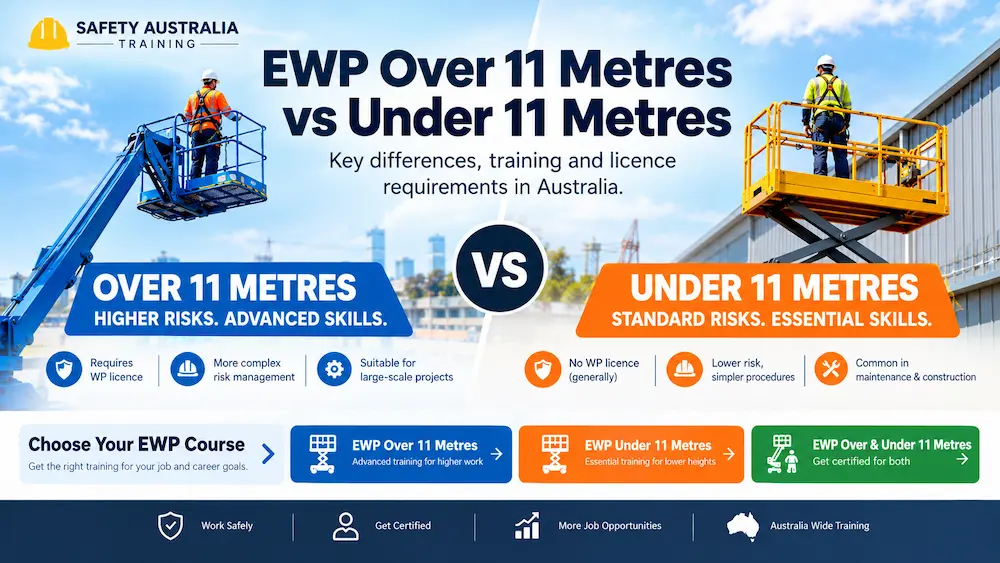
Choosing between an EWP over 11 metres course and an EWP under 11 metres course depends on the equipment you intend to operate, your career goals and the training required for your workplace. In Australia, elevating work platforms (EWPs) are widely used in construction, maintenance, warehousing, electrical work and industrial operations.
The most important distinction is that operating a boom-type elevating work platform with a boom length of 11 metres or more requires the relevant High Risk Work Licence (HRWL), known as the WP class. Operating other EWPs generally requires appropriate training, instruction and workplace authorisation, even where a WP licence is not required.
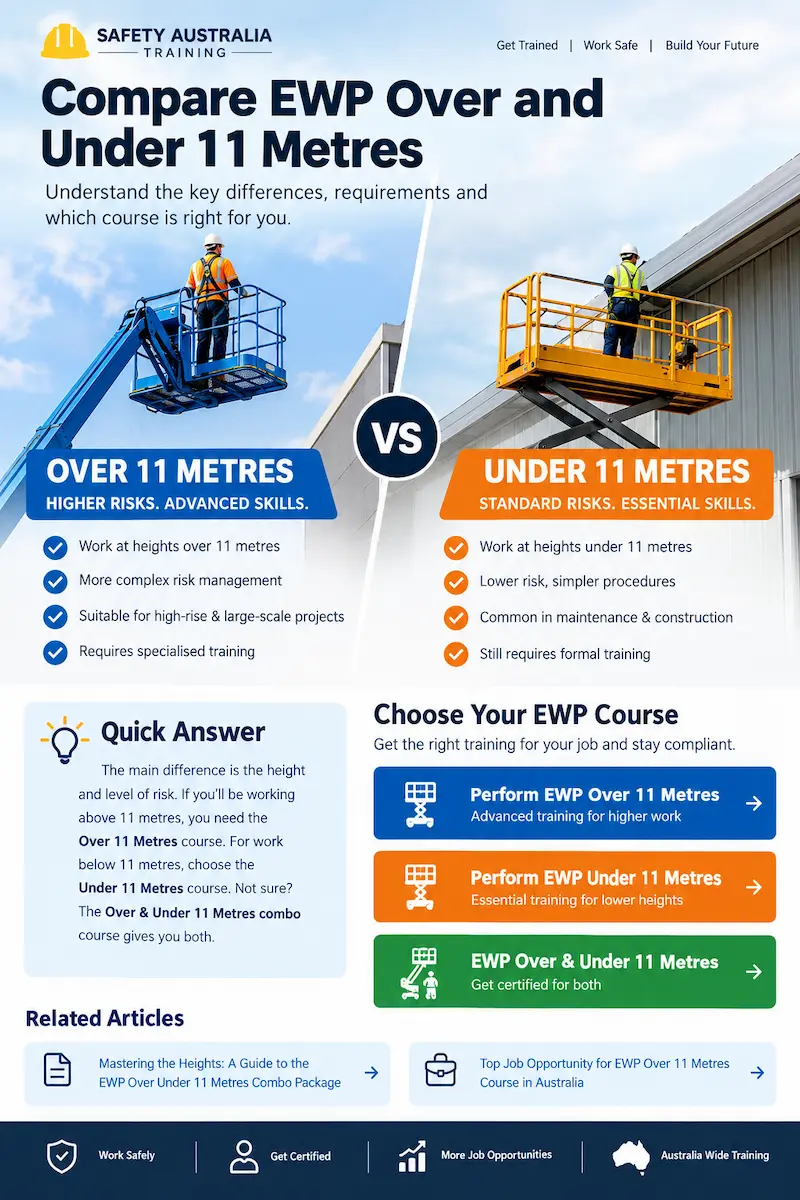
Quick Answer: EWP Over 11m vs Under 11m
- EWP over 11 metres: A boom-type EWP with a boom length of 11 metres or more requires the WP High Risk Work Licence in Australia.
- EWP under 11 metres: Operators generally need appropriate equipment-specific training and workplace instruction, but a WP licence is not normally required solely for operating a boom-type EWP below the licensing threshold.
- Course choice: Select the course that matches your intended work, equipment and the requirements of your employer.
- Want both options? The combined course may suit people who want training for both under-11-metre and over-11-metre EWP operations.
Ready to enrol? Choose the course that suits your needs:
EWP Over 11 Metres CourseEWP Under 11 Metres CourseEWP Over and Under 11 Metres Combo Course
What Is an Elevating Work Platform (EWP)?
An elevating work platform is a type of machinery designed to lift workers, tools and equipment to an elevated work area. EWPs allow workers to access difficult-to-reach locations while providing a platform from which to perform tasks.
Common EWP types include:
- Scissor lifts
- Self-propelled boom lifts
- Articulating boom lifts
- Telescopic boom lifts
- Trailer-mounted EWPs
- Truck-mounted boom lifts
- Vertical mast lifts
Not every EWP is subject to the same licensing requirements. The WP licence threshold specifically relates to boom-type elevating work platforms, so workers should not assume that every machine capable of reaching a particular height falls into the same licensing category.
EWP Over 11 Metres vs Under 11 Metres: Comparison Table
The following table outlines the main differences to consider when choosing EWP training in Australia.
| Feature | EWP Under 11 Metres | EWP Over 11 Metres |
|---|---|---|
| Typical training pathway | Equipment-specific EWP training | Training and assessment for the WP HRW licence |
| WP licence required? | Generally not solely for operating a boom-type EWP below the threshold | Yes, for boom-type EWPs meeting the 11-metre threshold |
| Licence class | WP class is generally not required solely for this operation | WP — Boom-Type Elevating Work Platform |
| Typical applications | Indoor maintenance, lower-level access and selected construction tasks | Elevated construction, industrial maintenance and extended-reach work |
| Safety training | Required according to the machine and workplace risks | Required, together with applicable HRW licensing |
| Best suited for | Workers whose roles require lower-reach EWP operation | Workers who need to operate qualifying boom-type EWPs |
Important: The regulatory threshold is 11 metres or more, not strictly more than 11 metres. The boom length is determined under the applicable rules, and the machine’s original design may affect the assessment. Confirm the requirements with the relevant state or territory regulator and training provider.
Important: Is the 11-Metre Rule Based on Platform Height?
Not necessarily. For a boom-type EWP, the licensing measurement considers the greater of the specified vertical measurement to the platform floor at maximum height and the horizontal measurement from the boom’s rotation centre to the outer edge of the platform at maximum reach. This means you should not rely only on the advertised working height when deciding whether a WP licence is required.
1. What Is an EWP Under 11 Metres Course?
An EWP under 11 metres course is intended for workers who need to develop the skills and knowledge to operate relevant elevating work platforms below the WP high-risk licensing threshold. The training pathway depends on the equipment, the course being delivered and the requirements of the workplace.
Workers may use smaller EWPs in construction, facilities management, retail maintenance, warehousing, electrical work and commercial property maintenance.
What Can You Learn?
Depending on the course, training may cover:
- Identifying EWP components and operating controls
- Completing pre-start checks and identifying defects
- Assessing ground conditions and surrounding hazards
- Understanding platform capacity and safe operating limits
- Positioning and manoeuvring the equipment
- Using required personal protective equipment
- Following emergency and rescue procedures
- Shutting down and securing equipment after use
The exact content and assessment requirements vary by training product and provider. Employers must also ensure workers receive appropriate site-specific instruction and supervision.
Who Should Consider Under-11-Metre EWP Training?
- Maintenance workers who use smaller access platforms
- Tradespeople who need elevated access for routine jobs
- Construction workers whose tasks involve lower-reach EWPs
- Workers whose employers require evidence of equipment-specific competency
Get the right training for your role: Explore the EWP Under 11 Metres Course.
2. What Is an EWP Over 11 Metres Course?
An EWP over 11 metres course prepares eligible participants for the relevant training and assessment pathway associated with operating a boom-type elevating work platform that meets the WP licensing threshold.
Under Australian WHS requirements, a person operating a boom-type EWP with a boom length of 11 metres or more must hold the appropriate WP High Risk Work Licence, subject to the applicable legal provisions and exceptions. Completing training and assessment is part of the licensing process; the training certificate alone should not be confused with the issued licence.
What Does WP Licence Training Cover?
Training and assessment for the WP class generally address the knowledge and practical skills needed to operate qualifying boom-type EWPs safely and competently. Depending on the approved training and assessment arrangements, this can include:
- Understanding EWP components, functions and limitations
- Conducting pre-operational inspections
- Identifying hazards and assessing workplace risks
- Setting up and operating boom-type EWPs
- Understanding load limits and operating envelopes
- Working around overhead obstructions and electrical hazards
- Applying fall prevention and personal protective equipment requirements
- Responding to emergencies and following rescue procedures
- Demonstrating the required practical competency during assessment
What Jobs May Require a WP Licence?
A WP licence may be relevant to roles involving qualifying boom-type EWPs in industries such as:
- Commercial construction and infrastructure
- Industrial plant maintenance
- Building and structural maintenance
- Electrical and communications infrastructure work
- Sign installation and elevated external maintenance
- Selected mining, resources and industrial projects
Employers may also require experience, site inductions, additional safety training and equipment-specific familiarisation. A WP licence does not replace these workplace requirements.
Take the Next Step Towards WP Licensing
Planning to operate boom-type EWPs that meet the 11-metre licensing threshold? Review the course information and confirm the eligibility, assessment and licence application process before enrolling.
For more information about potential career pathways, read our related guide: Top Job Opportunities for the EWP Over 11 Metres Course in Australia.
3. EWP Over 11 Metres vs Under 11 Metres: Which Course Should You Choose?
The best course depends on the machinery you expect to operate and whether your role requires a WP High Risk Work Licence.
| Your situation | Course to consider |
|---|---|
| You only need to operate relevant EWPs below the licensing threshold | EWP Under 11 Metres |
| Your work requires a qualifying boom-type EWP at 11 metres or more | EWP Over 11 Metres / WP licence training pathway |
| You want to prepare for a wider range of EWP tasks | Consider the Over and Under 11 Metres Combo Course |
| Your employer specifies a particular machine or qualification | Confirm the required training with your employer and training provider |
Before paying for a course, ask your employer which machine types you will use, whether a WP licence is required and whether any additional competency evidence is needed for your worksite.
4. Is the EWP Over and Under 11 Metres Combo Course Worth It?
If you want training for both categories, the EWP Over and Under 11 Metres Combo Course may be a convenient option to investigate. It can be worth considering when your current role involves smaller EWPs but your future career plans may involve qualifying boom-type platforms as well.
Potential Benefits of a Combined Course
- Broader preparation: Explore training pathways relevant to more than one type of EWP work.
- Career flexibility: Build a training plan that aligns with changing job requirements.
- Convenience: Check whether a combined enrolment suits your schedule and training needs.
- Clearer planning: Discuss the qualifications and assessments you need with the training provider.
A combined course does not automatically mean that every EWP licence, competency or employer requirement is covered. Confirm the exact units, assessments, outcomes and any separate licence application requirements before enrolling.
Looking for Both EWP Training Options?
Compare the course details to determine whether the combined pathway fits your work requirements and career plans.
Read the related article for more detail: Mastering the Heights: A Guide to the EWP Over and Under 11 Metres Combo Package.
5. EWP Safety Requirements Every Operator Should Know
Regardless of platform size, operating an EWP involves hazards that must be assessed and controlled. Workers and employers should follow applicable WHS laws, the manufacturer’s instructions, site procedures and relevant codes of practice.
Pre-Start Safety Checklist
- Inspect the machine and report defects before use.
- Check tyres, wheels, controls, emergency systems and safety devices as applicable.
- Assess ground stability, slopes, holes and uneven surfaces.
- Identify overhead powerlines, structures and other obstructions.
- Confirm the rated capacity and do not exceed the manufacturer’s limits.
- Use required harnesses and attachment points where specified by the equipment instructions and risk assessment.
- Establish exclusion zones where people could be exposed to moving equipment or falling objects.
- Ensure emergency lowering and rescue arrangements are understood.
- Follow site traffic management and communication procedures.
Construction work involving a risk of a person falling more than two metres is generally classified as high-risk construction work under the model WHS framework and requires a Safe Work Method Statement (SWMS). Check the laws applicable in your jurisdiction and the circumstances of the work.
6. Career Opportunities After EWP Training
EWP training can support workers seeking employment or additional responsibilities in construction, maintenance, facilities management and industrial environments. The most appropriate qualification depends on the machinery used in the role and the employer’s requirements.
Potential roles where EWP competency may be useful include:
- Construction labourer or trades assistant
- Facilities maintenance worker
- Industrial maintenance technician
- Electrical or communications infrastructure worker
- Sign installation and maintenance worker
- Elevated building maintenance worker
Training alone does not guarantee employment. Employers may also consider practical experience, other licences, safety records, relevant trade skills, availability and location.
Explore our related guide: Top Job Opportunities for the EWP Over 11 Metres Course in Australia.
7. How to Enrol in the Right EWP Course
Use these steps to select the most suitable training option:
- Identify the equipment. Find out whether you will use a scissor lift, boom lift or another type of EWP.
- Confirm the licensing threshold. For boom-type EWPs, check whether the machine meets the 11-metre WP licensing threshold.
- Check your employer’s requirements. Some workplaces require specific training or evidence of competency in addition to legal licensing requirements.
- Compare course outcomes. Review prerequisites, duration, assessment arrangements, fees and the qualification or statement of attainment provided.
- Confirm the training provider. For nationally recognised training, verify the provider and the relevant course on the National Register of VET.
- Complete the training and assessment. If applying for the WP HRW licence, follow the relevant regulator’s application process and time limits.
Choose Your EWP Training Pathway
Ready to take the next step? Compare the available courses and select the option that matches your equipment, work responsibilities and career goals.
Frequently Asked Questions
1. What is the difference between an EWP over 11 metres and an EWP under 11 metres?
The main difference is the applicable training and licensing pathway. Operating a boom-type EWP with a boom length of 11 metres or more requires the WP High Risk Work Licence, while other EWP operations generally require appropriate training, instruction and workplace competency arrangements.
2. Do I need a licence for an EWP under 11 metres in Australia?
A WP High Risk Work Licence is generally not required solely to operate a boom-type EWP below the licensing threshold. However, workers still need appropriate training and instruction, and other requirements may apply to the equipment and workplace.
3. Is a WP licence required for an EWP exactly 11 metres?
Yes, where the boom-type EWP meets the applicable 11-metre boom-length threshold. The requirement applies at 11 metres or more, not only above 11 metres.
4. Does the 11-metre rule apply to scissor lifts?
The WP licensing rule specifically applies to boom-type EWPs. Scissor lifts are a different EWP type and do not require a WP licence solely because of their platform height, although appropriate training, instruction and other workplace requirements still apply.
5. Does completing an EWP over 11 metres course automatically give me a WP licence?
No. Completing the required training and assessment provides the relevant qualification or evidence needed for the licensing process. You must follow the applicable state or territory regulator’s requirements to obtain the actual High Risk Work Licence.
6. Can I complete EWP over and under 11 metres training together?
A combined course may be available for people who want both training pathways. Check the course page to confirm the units covered, assessment arrangements and whether it meets your particular licensing and workplace needs.
7. How long does EWP training take?
Course duration varies according to the training product, provider, participant experience and assessment requirements. Contact the training provider for the current timetable and any prerequisites.
8. Can an EWP course help me get a job in construction?
EWP training may help demonstrate relevant skills for construction, maintenance and industrial roles. Employment depends on the job requirements, experience, other qualifications and employer selection criteria.
9. How do I choose the right EWP course?
Start by identifying the machine you will operate and confirming whether its boom length meets the WP licensing threshold. Then compare the course outcomes and check your employer’s requirements before enrolling.
Find the Right EWP Course for Your Career
Whether you need training for lower-reach equipment, a WP licensing pathway or both, start by comparing the course requirements and outcomes.