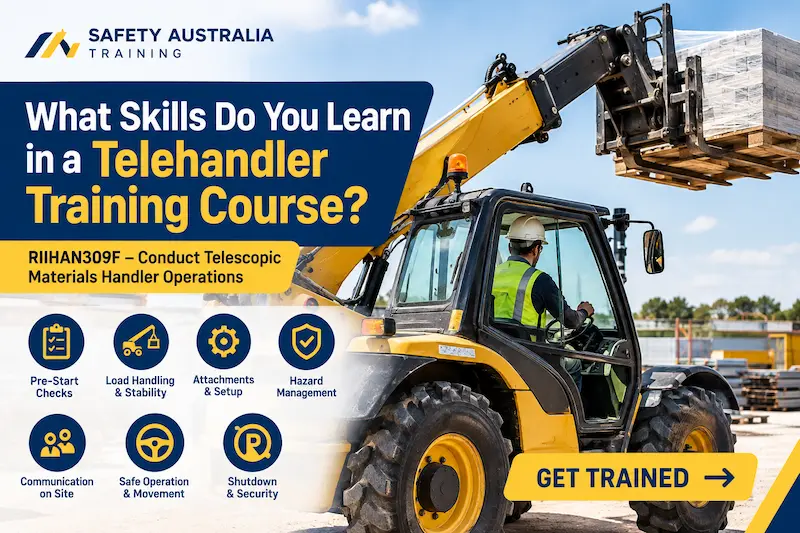
Quick Answer: What Skills Do You Learn in a Telehandler Training Course?
A telehandler training course develops the practical and theoretical skills needed to operate a telescopic materials handler safely and competently. Key skills include:
- Planning lifting and material-handling operations.
- Identifying workplace hazards and applying risk controls.
- Performing pre-start inspections and checking attachments.
- Understanding load capacity, machine stability and safe lifting limits.
- Operating the telehandler and moving loads safely.
- Selecting, fitting and removing approved attachments.
- Communicating with other workers and following site procedures.
- Parking, securing and shutting down the machine correctly.
Ready to develop these skills? Explore the RIIHAN309F Telehandler Training Course offered by Safety Australia Training.
1. Planning and Preparing for Telehandler Operations
Before operating a telehandler, workers need to understand the task, the worksite conditions and the equipment required. Planning helps operators identify potential risks before moving materials or extending the boom.
During training, participants develop skills in:
- Reading and understanding equipment operating manuals and workplace instructions.
- Confirming the load-handling task and the required equipment.
- Inspecting the work area for obstructions, uneven ground and restricted access.
- Identifying overhead hazards, nearby workers and other mobile plant.
- Assessing risks and applying appropriate control measures.
- Selecting and wearing the personal protective equipment required for the task.
Effective planning is especially important on busy construction and civil infrastructure sites, where poor visibility, changing ground conditions and interactions with other equipment can create significant hazards.
2. Performing Telehandler Pre-Start Inspections
Pre-start inspections help operators identify equipment defects before commencing work. A telehandler must be checked in accordance with the manufacturer’s instructions, workplace procedures and applicable inspection requirements.
Depending on the machine and workplace procedures, an inspection may include:
- Tyres, wheels and visible structural components.
- Hydraulic hoses, cylinders and visible signs of fluid leaks.
- Brakes, steering and operating controls.
- Lights, mirrors, cameras, alarms and other fitted safety systems.
- Boom condition and visible signs of damage.
- Forks, locking mechanisms and attachment connection points.
- Load charts, safety labels and relevant operating documentation.
Operators also learn to identify common faults, recognise abnormal equipment behaviour and report defects according to site procedures. Equipment with a safety-critical defect should not be operated until the issue has been appropriately addressed.
Why Are Pre-Start Checks Important?
A pre-start inspection can help detect faults before they contribute to equipment failure, dropped loads or other incidents. It is an essential part of safe telehandler operation, not simply an administrative task.
3. Understanding Load Capacity, Stability and Safe Lifting
One of the most important skills in telehandler training is understanding how the machine’s lifting capacity changes with boom position, load reach and operating conditions.
Unlike a conventional forklift, a telehandler uses an extendable boom. Extending or raising the boom can significantly affect the machine’s stability and permitted load capacity.
Participants learn to:
- Locate and interpret the correct load chart for the machine and configuration.
- Understand the relationship between load weight, boom extension and load centre.
- Consider the approved operating configuration and fitted attachment.
- Recognise conditions that may affect stability, including ground conditions and slope.
- Keep loads within the applicable rated capacity and operating limits.
- Recognise the risks associated with overloading and uncontrolled boom movement.
Operators must never assume that a telehandler can lift its maximum rated load at every boom angle or reach. The manufacturer’s load chart and instructions must be followed for the specific machine and attachment configuration.
4. Operating a Telehandler and Moving Loads Safely
Practical training helps participants develop the control and coordination required to manoeuvre a telehandler and handle materials in accordance with workplace requirements.
Depending on the training equipment and assessment tasks, practical skills may include:
- Starting the machine and checking that operating systems function correctly.
- Using the steering, transmission and controls appropriately.
- Positioning the machine for a load-handling task.
- Approaching, engaging and lifting a load safely.
- Raising, lowering and extending the boom within permitted limits.
- Carrying and placing materials at the required location.
- Travelling safely while accounting for visibility, load position and ground conditions.
- Manoeuvring around obstacles while maintaining a safe working area.
Operators must adapt their actions to the manufacturer’s instructions, the load chart, the load being handled and the conditions at the worksite. Training does not mean every machine or load can be operated using an identical technique.
5. Selecting and Using Telehandler Attachments
Telehandlers can be fitted with different attachments for specific material-handling tasks. However, an attachment must be suitable for the machine, approved for its intended use and compatible with the required lifting operation.
| Attachment | Typical Application | Important Consideration |
|---|---|---|
| Forks | Moving pallets and suitable packaged materials | Load positioning, capacity and fork condition |
| Bucket | Handling compatible bulk materials | Approved use, material weight and attachment limits |
| Crane jib | Lifting suspended loads where permitted | Rated capacity, lifting gear and applicable licensing requirements |
| Grab attachment | Handling suitable materials that require gripping | Compatibility, secure connection and approved operating method |
Training covers the selection, fitting, checking, use and removal of approved attachments within the scope of the course and applicable procedures. The equipment’s rated capacity and operating limits must always be considered when changing attachments.
Important: Training in standard telehandler operation does not automatically authorise every crane or slewing operation. Additional high-risk work licensing requirements may apply depending on the equipment and task.
6. Communicating with Other Workers on Site
Telehandler operators often work alongside doggers, riggers, construction workers, truck drivers and other mobile plant operators. Clear communication helps coordinate movements and reduces the risk of collisions or unsafe load handling.
Skills may include:
- Understanding and using agreed hand signals.
- Responding to audible signals and workplace communication systems.
- Following site traffic management arrangements.
- Maintaining awareness of pedestrians and workers in the operating area.
- Communicating when visibility is restricted or a task becomes unsafe.
- Reporting hazards, defects and incidents through the required channels.
Operators should stop the task when communication breaks down or they cannot safely confirm the movement of a load. Site-specific procedures and the applicable lifting arrangements must always be followed.
7. Managing Hazards and Working Safely
Safe telehandler operation requires more than knowing how to move the controls. Operators must recognise changing hazards and understand when work should be stopped or reassessed.
Training helps participants identify and manage risks such as:
- Unstable or uneven ground.
- Overhead powerlines and other overhead obstructions.
- Pedestrians and other mobile equipment.
- Restricted visibility and blind spots.
- Unstable, poorly secured or incorrectly positioned loads.
- Excessive boom extension or operation outside the load chart.
- Changing weather and environmental conditions.
Risk controls depend on the task, worksite and equipment. Operators must follow the site risk assessment, exclusion zones, manufacturer’s instructions and applicable workplace safety requirements rather than relying on a generic checklist alone.
8. Parking, Shutdown and Equipment Security
Completing a telehandler task safely includes leaving the machine in a secure condition. Participants learn to follow the correct shutdown process and prepare the equipment for the next use.
Depending on the manufacturer’s instructions and site procedures, this may involve:
- Moving the machine to an authorised parking location.
- Lowering the boom and attachment to the specified safe position.
- Applying the parking brake and securing the machine.
- Shutting down the engine and removing the key where required.
- Reporting faults or damage identified during operation.
- Cleaning the work area and storing tools and equipment appropriately.
Correct shutdown procedures help prevent unauthorised use, reduce workplace hazards and ensure equipment is ready for subsequent operations.
Telehandler Training Skills at a Glance
The following table summarises the core skills covered by RIIHAN309F training and why they matter in the workplace.
| Skill | What You Learn | Workplace Benefit |
|---|---|---|
| Planning | Interpret instructions and prepare for the task | Better task preparation |
| Pre-start inspections | Check equipment, controls and attachments | Early identification of defects |
| Load handling | Lift, carry and place loads within permitted limits | Safer material movement |
| Attachment use | Select and use approved attachments | Task-appropriate equipment setup |
| Hazard management | Identify hazards and implement controls | Improved risk awareness |
| Communication | Use signals and follow site procedures | Better coordination with work crews |
| Shutdown and housekeeping | Park, secure and leave the equipment safely | Safer handover and worksite completion |
Ready to Build Your Telehandler Operating Skills?
Develop the knowledge and practical skills needed for telescopic materials handler operations with nationally recognised RIIHAN309F training through Safety Australia Training.
- Course duration listed as one day.
- Theory and practical assessment.
- No formal prerequisite listed on the course page.
- Training with fork tynes, with other attachments available where arranged.
Check the course details, available locations and upcoming dates before booking.
What Assessment Is Required for RIIHAN309F?
RIIHAN309F assessment checks whether a participant can demonstrate the required knowledge and practical performance for telescopic materials handler operations. Assessment methods are determined by the training provider and must meet the unit’s assessment requirements.
The official assessment requirements include demonstrating relevant operational tasks on at least two occasions. These tasks include:
- Completing pre-start, start-up and shutdown procedures.
- Checking controls, brakes and attachments.
- Operating the telescopic materials handler.
- Attaching and securing appropriate lifting gear.
- Moving loads and using approved attachments.
- Transporting equipment between worksites where required.
- Parking and securing the machine.
- Identifying hazards, reporting faults and communicating effectively.
Participants may need to complete both theoretical and practical assessment activities. Successful completion depends on demonstrating competency against the applicable requirements, not simply attending the course.
RIIHAN309F vs Telehandler Licence: What Is the Difference?
One common question is whether completing a telehandler training course automatically provides every licence required to operate any type of telehandler.
RIIHAN309F is a nationally recognised unit of competency, but it does not automatically replace a High Risk Work Licence where a licence is legally required. Licensing requirements depend on the machine configuration, lifting task and relevant state or territory regulations.
For more information, read our guide: Telehandler Licence vs RIIHAN309F: Which Telehandler Qualification Do You Need in Australia?
It is also important to understand that telehandler and forklift training are not automatically interchangeable. Read our related guide: Telehandler vs Forklift: Why You Need a Separate Non-Slewing Licence in Australia.
Before enrolling, confirm that the course matches the equipment you intend to operate and check any additional licensing requirements that apply to your work.
Frequently Asked Questions About Telehandler Training
1. What skills do you learn in a telehandler training course?
You learn how to plan telehandler operations, inspect equipment, identify hazards, interpret load charts, operate the machine, handle materials, use approved attachments, communicate with other workers and secure the equipment after use.
2. What is RIIHAN309F in Australia?
RIIHAN309F is the nationally recognised unit of competency titled Conduct Telescopic Materials Handler Operations. It covers the skills and knowledge required to conduct telescopic materials handler operations in relevant resources and infrastructure work settings.
3. Is telehandler training theory-based or practical?
RIIHAN309F requires both underpinning knowledge and demonstrated practical competency. Safety Australia Training lists theory and practical assessment for its course.
4. Do I need previous telehandler experience to enrol?
Safety Australia Training lists no formal prerequisite for its RIIHAN309F course. However, participants should confirm the provider’s enrolment conditions, identification requirements and any language or learning support needs before attending.
5. How long does a telehandler training course take?
Safety Australia Training lists its RIIHAN309F course as a one-day program. Actual training and assessment arrangements can vary between providers, so check the course details for your chosen location.
6. Will I learn to use different telehandler attachments?
Participants learn about selecting and using approved attachments within the scope of their training. Safety Australia Training lists fork tynes as the standard training attachment and advises that other attachments may be available by arrangement.
7. Does RIIHAN309F allow me to operate a slewing telehandler?
Not automatically. RIIHAN309F training does not replace any High Risk Work Licence required for a particular slewing telehandler or lifting operation. Confirm the machine classification and applicable state or territory licensing rules before operating it.
8. What certificate do you receive after completing RIIHAN309F?
Successful participants who meet the assessment requirements can receive a Statement of Attainment for RIIHAN309F from the relevant training provider. Any additional card or documentation depends on the course arrangement and provider.
9. Can telehandler training help me work in construction or mining?
Telehandler competency can support applications for relevant material-handling roles in construction, civil infrastructure and resources industries. Employment also depends on employer requirements, experience, other qualifications and the duties of the position.
10. Where can I book RIIHAN309F telehandler training?
You can review the course offered by Safety Australia Training, including its available locations and upcoming dates, on the RIIHAN309F Telehandler Training course page.
Build Your Skills with RIIHAN309F Telehandler Training
Telehandler operators need a combination of practical machine-control skills, equipment knowledge, hazard awareness and safe load-handling techniques. RIIHAN309F training helps participants demonstrate the competency required for telescopic materials handler operations within the scope of the unit and the relevant workplace requirements.
If you want to develop these skills for construction, civil infrastructure or resources work, review the course details and confirm that the training suits your intended equipment and duties.
Take the Next Step Towards Telehandler Competency
Explore course information, training locations, fees and upcoming dates for RIIHAN309F with Safety Australia Training.