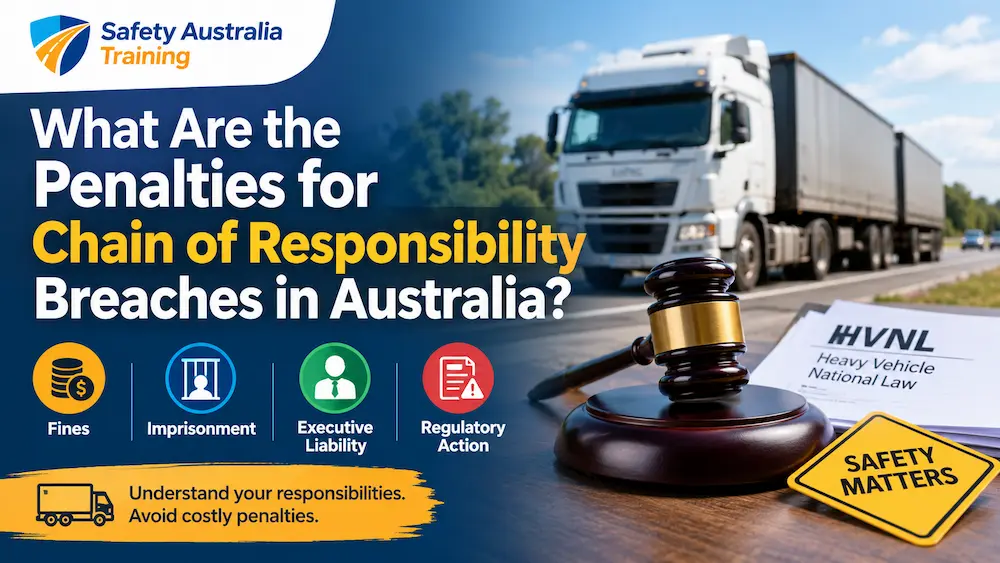
Chain of Responsibility (CoR) breaches in Australia can result in substantial financial penalties, regulatory action and, for the most serious offences, imprisonment. Under the Heavy Vehicle National Law (HVNL), transport businesses and other parties involved in heavy vehicle operations must take reasonably practicable steps to manage safety risks. Executives may also face personal liability if they fail to meet their due diligence duties.
Quick Answer: What Are the Penalties for Chain of Responsibility Breaches?
The penalties depend on the offence, its seriousness, the applicable law and whether the defendant is an individual or a corporation.
- Individuals: The most serious Primary Duty offence can attract a maximum penalty of $424,794 or five years’ imprisonment, or both, under the NHVR’s published 2025/26 penalty guidance.
- Businesses: The maximum penalty for the most serious Primary Duty offence is listed as $4,113,837 in that guidance.
- Executives: Directors, managers and other qualifying executives can face personal penalties if they fail to exercise due diligence.
- Other consequences: Depending on the circumstances, enforcement may include infringement notices, improvement notices, court proceedings and other regulatory action.
Important: The figures above are from the NHVR’s 2025/26 guidance, not a verified 2026/27 penalty schedule. Penalties are indexed and may change. Check the current schedule and the specific offence before relying on a dollar amount.
Reduce Your Chain of Responsibility Compliance Risks
Build your understanding of transport safety duties, risk management and CoR compliance through dedicated training.
Explore TLIF0009 CoR Training →
Learn about the course, its requirements and how it relates to your role.
1. What Is a Chain of Responsibility Breach?
Chain of Responsibility is a framework under the Heavy Vehicle National Law that recognises safety responsibilities across the heavy vehicle supply chain. Responsibility may extend beyond the driver to businesses and individuals whose activities influence the safe use of heavy vehicles.
A CoR breach may occur when a party fails to meet its legal obligations, including the Primary Duty to ensure, so far as is reasonably practicable, the safety of its transport activities.
Examples of conduct that may create compliance risks include:
- Pressuring drivers to exceed speed limits or drive while fatigued.
- Setting unrealistic delivery schedules that encourage unsafe driving.
- Allowing heavy vehicles to operate with unsafe loads or inadequate load restraint.
- Failing to identify and manage foreseeable transport safety risks.
- Failing to provide appropriate safety procedures, resources, training or monitoring.
- Ignoring known safety incidents or failing to act on identified hazards.
A serious incident does not necessarily need to occur before a Primary Duty breach can be prosecuted. A failure to implement reasonably practicable safety measures may itself lead to enforcement action.
For further guidance, read our article on how to stay compliant with Chain of Responsibility laws in 2026.
2. Chain of Responsibility Penalties in Australia: Fines and Imprisonment
The HVNL provides different penalties for different offences. The maximum penalty for a serious Primary Duty offence is not the same as the penalty for every loading, fatigue, speeding or documentation offence.
The following table summarises the published NHVR figures for the most serious category of Primary Duty offence, using the 2025/26 guidance for which figures could be verified.
| Who may be liable? | Published maximum penalty | What it means |
|---|---|---|
| Individual | $424,794, or 5 years’ imprisonment, or both | Applies to the most serious category of Primary Duty offence under the cited guidance. |
| Corporation | $4,113,837 | A business can face a substantial financial penalty if the offence is proven. |
| Executive | May face personal penalties for a proven breach of the Executive Due Diligence Duty. | Liability depends on the executive’s legal duties and the circumstances of the alleged breach. |
Source: NHVR, Regulatory Advice – The Primary Duty and the 2026 Master Code of Practice. The monetary amounts above are from 2025/26 guidance. Do not treat them as the current 2026/27 amounts. Maximum penalties are not automatic fines; the applicable offence, legislation, evidence and court process determine the outcome.
To confirm the applicable amounts, consult the NHVR’s official penalties and infringements page and its latest Heavy Vehicle National Law penalty schedule.
3. Can Company Directors and Managers Be Personally Liable?
Yes. Under the HVNL, qualifying executives of a business that is a party in the Chain of Responsibility must exercise due diligence to ensure the business complies with its Primary Duty and other relevant safety duties.
The term executive can include directors, managers and other people who participate in managing the business, depending on the legal definition and circumstances.
Executive due diligence involves taking reasonable steps to:
- Keep up to date with knowledge about safe transport activities.
- Understand the transport operations and the hazards associated with them.
- Ensure the business has appropriate resources to manage safety risks.
- Establish and implement processes to eliminate or minimise risks.
- Ensure safety information and incident reports are received, considered and acted on promptly.
- Verify that safety systems and controls are actually being used.
An executive may be investigated or prosecuted for a breach of their own duty even if the business has not been charged with a Primary Duty offence. Separate provisions may also apply where an executive knowingly authorised or permitted certain offences.
Read the NHVR’s official guidance on Executive Due Diligence for further details.
4. What Other Consequences Can Follow a CoR Breach?
Financial penalties are only one part of the potential impact. Depending on the offence and the regulator’s response, a business may also experience:
Regulatory action
Infringement notices, improvement notices, investigations or court proceedings, where authorised by law.
Business disruption
Time and resources spent responding to investigations, correcting unsafe processes and reviewing operations.
Reputation and contracts
Possible damage to customer confidence and commercial relationships, depending on the circumstances.
Personal consequences
Individuals may face court-imposed penalties, and the most serious offences can involve imprisonment.
Not every breach results in prosecution or every consequence listed above. The response depends on the legal provision, seriousness of the conduct, available evidence and applicable enforcement powers.
5. Which Industries Need to Understand CoR Penalties?
Chain of Responsibility obligations can apply to a range of businesses involved in heavy vehicle transport activities. A business does not necessarily avoid its responsibilities by outsourcing transport work to a contractor.
- Road freight and transport companies.
- Freight forwarders and logistics providers.
- Warehousing and distribution operations.
- Businesses that consign or receive transported goods.
- Loading, packing and load-restraint operations.
- Companies involved in transport scheduling and delivery planning.
- Other businesses whose activities influence the safe use of heavy vehicles.
Whether a particular legal duty applies depends on the transport activity and the relevant provisions of the HVNL. Learn more in our guide to industries that must comply with Chain of Responsibility laws.
6. How Can Businesses Reduce the Risk of CoR Penalties?
Businesses should establish and maintain practical safety systems that address the transport risks they can reasonably control or influence. Training can support those systems by helping workers and managers understand their responsibilities.
Use the following checklist as a starting point:
CoR Compliance Checklist
- Identify the transport activities and parties involved in your supply chain.
- Assess risks involving fatigue, speeding, loading, vehicle condition and scheduling.
- Set realistic delivery schedules and avoid incentives that encourage unsafe conduct.
- Provide suitable training, equipment, procedures and supervision.
- Document risk assessments, control measures, training and incident responses.
- Review whether safety controls are effective and update them when conditions change.
- Ensure executives understand and fulfil their due diligence obligations.
For additional practical steps, see our guide to staying compliant with Chain of Responsibility laws in 2026.
7. How Does TLIF0009 Training Help With CoR Compliance?
TLIF0009 – Ensure the Safety of Transport Activities (Chain of Responsibility) is a nationally recognised unit of competency focused on the safety of transport activities and Chain of Responsibility obligations.
Relevant training can help participants understand their responsibilities, recognise transport safety risks and contribute to safer workplace practices. It should form part of a wider compliance system rather than being treated as a guarantee against penalties.
Training alone does not automatically establish compliance. Businesses must still implement and monitor appropriate controls, provide suitable resources and meet their legal obligations.
Safety Australia Training
Build Your Chain of Responsibility Knowledge
Explore TLIF0009 training to understand transport safety responsibilities and support your organisation’s CoR compliance efforts.
View TLIF0009 Course Details →
Review course information and determine whether it suits your training needs.
Frequently Asked Questions About CoR Penalties
1. What is the maximum fine for a Chain of Responsibility breach in Australia?
The maximum penalty depends on the offence. In the NHVR’s published 2025/26 guidance, the most serious category of Primary Duty offence carries a maximum of $4,113,837 for a corporation and $424,794 for an individual, or five years’ imprisonment, or both, for an individual. Check the current penalty schedule for the applicable 2026/27 amount.
2. Can you go to jail for a Chain of Responsibility breach?
Yes. The most serious category of Primary Duty offence can carry imprisonment of up to five years for an individual under the cited NHVR guidance. Imprisonment is not an automatic consequence of every CoR breach.
3. Can a company director be personally fined for a CoR breach?
Yes. An executive may be personally liable for failing to exercise the due diligence required by the HVNL. Whether a director or manager is liable depends on the applicable duty and the evidence in the case.
4. Can a business be penalised if no accident occurred?
Yes. A Primary Duty breach may be established by a failure to implement reasonably practicable safety measures even if a crash or injury has not occurred. The specific facts and legal requirements still need to be established.
5. Is Chain of Responsibility training legally mandatory for every truck driver?
Not necessarily. The legal duties and training requirements depend on the person’s role, the applicable provisions and the employer’s safety arrangements. Drivers may need relevant instruction and training as part of their employer’s compliance system, but this does not mean every driver is automatically required to hold TLIF0009.
6. How can a transport business reduce the risk of CoR fines?
Businesses should identify transport safety risks, implement reasonably practicable controls, provide appropriate resources and training, monitor performance and respond to hazards and incidents. Executives should also exercise due diligence.
7. Does completing TLIF0009 guarantee that a business will avoid penalties?
No. Training can improve awareness and support compliance, but it does not guarantee immunity from enforcement. A business must also meet its legal duties and implement effective safety systems.
Official Sources and Further Reading
- NHVR: Penalties and Infringements
- NHVR: Regulatory Advice – The Primary Duty
- NHVR: Executive Due Diligence Duty
- NHVR: Chain of Responsibility FAQs
- training.gov.au: National Training Register
Disclaimer: This article provides general educational information, not legal advice. HVNL requirements, offence categories and maximum penalties may change and can vary according to the applicable jurisdiction and offence. Check current official guidance or obtain independent legal advice for a specific matter.
1. What is the maximum fine for a Chain of Responsibility breach in Australia?
The maximum penalty depends on the offence. In the NHVR’s published 2025/26 guidance, the most serious category of Primary Duty offence carries a maximum of $4,113,837 for a corporation and $424,794 for an individual, or five years’ imprisonment, or both, for an individual. Check the current penalty schedule for the applicable 2026/27 amount.
2. Can you go to jail for a Chain of Responsibility breach?
Yes. The most serious category of Primary Duty offence can carry imprisonment of up to five years for an individual under the cited NHVR guidance. Imprisonment is not an automatic consequence of every CoR breach.
3. Can a company director be personally fined for a CoR breach?
Yes. An executive may be personally liable for failing to exercise the due diligence required by the HVNL. Whether a director or manager is liable depends on the applicable duty and the evidence in the case.
4. Can a business be penalised if no accident occurred?
Yes. A Primary Duty breach may be established by a failure to implement reasonably practicable safety measures even if a crash or injury has not occurred. The specific facts and legal requirements still need to be established.
5. Is Chain of Responsibility training legally mandatory for every truck driver?
Not necessarily. The legal duties and training requirements depend on the person’s role, the applicable provisions and the employer’s safety arrangements. Drivers may need relevant instruction and training as part of their employer’s compliance system, but this does not mean every driver is automatically required to hold TLIF0009.
6. How can a transport business reduce the risk of CoR fines?
Businesses should identify transport safety risks, implement reasonably practicable controls, provide appropriate resources and training, monitor performance and respond to hazards and incidents. Executives should also exercise due diligence.
7. Does completing TLIF0009 guarantee that a business will avoid penalties?
No. Training can improve awareness and support compliance, but it does not guarantee immunity from enforcement. A business must also meet its legal duties and implement effective safety systems.
- NHVR: Penalties and Infringements
- NHVR: Regulatory Advice – The Primary Duty
- NHVR: Executive Due Diligence Duty
- NHVR: Chain of Responsibility FAQs
- training.gov.au: National Training Register
Disclaimer: This article provides general educational information, not legal advice. HVNL requirements, offence categories and maximum penalties may change and can vary according to the applicable jurisdiction and offence. Check current official guidance or obtain independent legal advice for a specific matter.