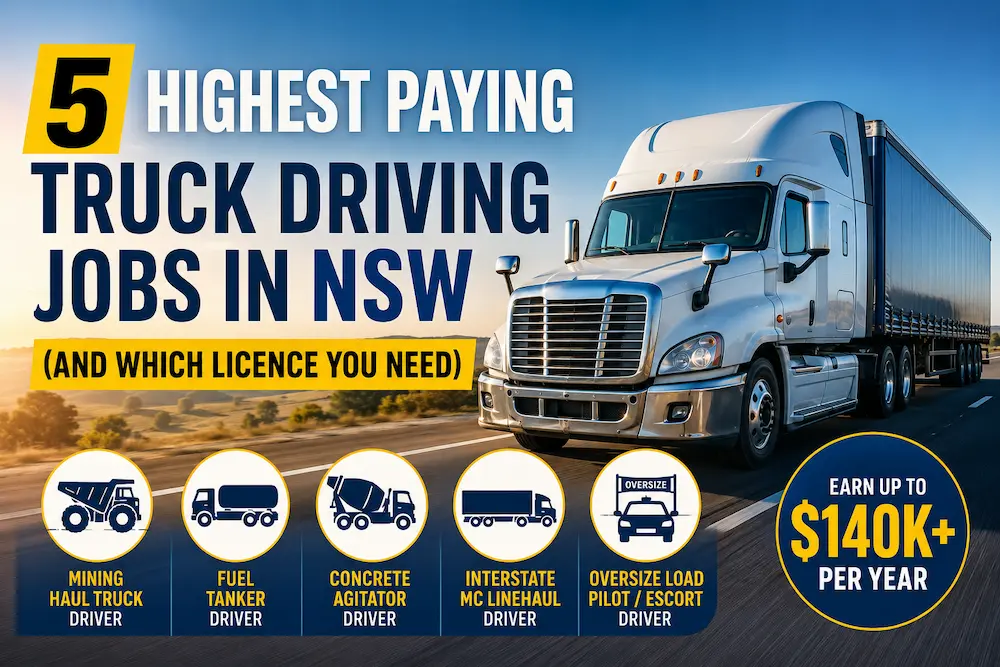
If you’re looking for a career that combines strong earning potential with steady demand, truck driving can be an excellent option in New South Wales. However, not all truck driving jobs pay the same. The type of vehicle you operate, your level of experience, the industry you work in and your heavy vehicle licence class can all have a major impact on your income.
From mining and fuel transport to interstate linehaul and specialised freight, some of the highest paying truck driving jobs in NSW require advanced licences such as HC or MC, while others can be accessed with an HR licence plus additional training or industry qualifications.
In this guide, we’ll look at 5 high-paying truck driving jobs in NSW, the typical licence class associated with each role, additional requirements you may need and how upgrading your NSW truck licence can help you access better employment opportunities.
Quick Comparison: Highest Paying Truck Jobs in NSW
Truck Driving Job
Typical Salary Range*
Licence / Qualification
Mining Truck Driver
$110,000 – $140,000+
HR or HC, depending on vehicle and employer
Fuel Tanker Driver
$100,000 – $130,000+
HC + Dangerous Goods Driver Licence where required
Concrete Agitator Driver
$85,000 – $110,000
HR, depending on vehicle
Interstate MC Linehaul Driver
$90,000 – $120,000+
MC
Oversize Load / Pilot Vehicle Driver
$80,000 – $100,000+
Vehicle/licence requirements vary by role
| Truck Driving Job | Typical Salary Range* | Licence / Qualification |
|---|---|---|
| Mining Truck Driver | $110,000 – $140,000+ | HR or HC, depending on vehicle and employer |
| Fuel Tanker Driver | $100,000 – $130,000+ | HC + Dangerous Goods Driver Licence where required |
| Concrete Agitator Driver | $85,000 – $110,000 | HR, depending on vehicle |
| Interstate MC Linehaul Driver | $90,000 – $120,000+ | MC |
| Oversize Load / Pilot Vehicle Driver | $80,000 – $100,000+ | Vehicle/licence requirements vary by role |
*Salary figures are indicative ranges only. Actual earnings vary depending on the employer, location, experience, overtime, allowances, roster and employment conditions.
1. Mining Truck Driver – $110k to $140k+
Mining and heavy haulage roles are among the highest paying truck driving jobs in NSW. Drivers working around major mining and industrial regions can earn strong salaries, particularly when shift work, overtime, allowances and specialised duties are included.
Mining drivers may operate heavy rigid trucks, articulated vehicles or other specialised heavy equipment depending on the employer and site. The exact licence requirement therefore depends on the vehicle being driven.
- Licence: HR or HC may be required depending on the vehicle
- Additional requirements: Site-specific induction, safety training, medical assessment and drug and alcohol screening may apply
- Why it pays well: Shift work, remote locations, specialised operations and additional allowances can increase earning potential
If you’re considering mining transport as a long-term career, upgrading your heavy vehicle licence can open the door to a wider range of employment opportunities.
2. Fuel Tanker Driver – $100k to $130k+
Fuel tanker driving is another specialist transport career that can offer above-average earning potential. Drivers may transport petrol, diesel, aviation fuel and other dangerous goods to service stations, industrial sites, airports and commercial customers.
Because fuel is classified as dangerous goods, additional licensing requirements can apply. In NSW, a Dangerous Goods Driver Licence is required for transporting dangerous goods above specified quantities, including dangerous goods in a receptacle with a capacity of more than 500 litres or more than 500 kilograms in a receptacle.
- Heavy vehicle licence: HC may be required depending on the tanker combination
- Additional qualification: Dangerous Goods Driver Licence where applicable
- Other requirements: Dangerous goods training, medical fitness and a satisfactory driving history may be required
- Why it pays well: Specialist freight, strict safety requirements and the responsibility involved in transporting hazardous materials
For drivers interested in moving from general freight into specialist transport, tanker work can be an attractive career progression option.
3. Concrete Agitator Driver – $85k to $110k
Concrete agitator drivers are in demand across Sydney, Newcastle, Wollongong and other growing areas of NSW. The job involves transporting ready-mix concrete from batching plants to construction sites while maintaining the correct mix and completing deliveries safely and efficiently.
Unlike long-distance linehaul work, concrete agitator driving can offer more localised routes, meaning many drivers return home at the end of their shift.
- Licence: HR is commonly required for heavy rigid concrete agitator vehicles
- Work environment: Construction sites, concrete plants and local delivery routes
- Useful skills: Safe reversing, vehicle positioning, site awareness and effective communication
- Potential advantage: Local work can provide a different lifestyle from interstate or remote driving
The exact vehicle and licence requirements should always be confirmed with the employer before applying.
4. Interstate MC Linehaul Driver – $90k to $120k+
If you’re comfortable spending extended periods on the road, MC linehaul driving can provide some of the best earning opportunities in the Australian transport industry.
MC drivers may operate B-doubles, road trains and other multi-combination vehicles on interstate routes connecting Sydney with Melbourne, Brisbane, Adelaide and other major freight hubs.
In NSW, an MC licence is the highest heavy vehicle licence class. It covers vehicles including B-doubles, road trains and certain prime mover and low-loader combinations. To upgrade to MC, you generally need to have held an unrestricted HR or HC licence for at least one year and complete the required assessment pathway. MC applicants must complete a Heavy Vehicle Competency Based Assessment (HVCBA).
- Licence: MC
- Typical vehicles: B-doubles, road trains and other multi-combination vehicles
- Work style: Interstate and long-distance freight
- Why it pays well: Long-distance driving, specialised equipment, irregular hours and extended time away from home
If you’re planning to build a career in heavy vehicle transport, moving from HR to HC and eventually MC can significantly expand the number of jobs you can apply for.
5. Oversize Load and Pilot Vehicle Driver – $80k to $100k+
Oversize and overmass transport requires careful planning because the load can exceed standard road dimensions. Depending on the movement, pilot or escort vehicles may be required to warn other road users and support the safe movement of the load.
A pilot vehicle driver does not necessarily drive the heavy load itself. Instead, the role can involve travelling ahead of or behind the oversize vehicle, communicating hazards and helping other road users understand the movement.
NSW requirements for pilot and escort vehicles depend on the size, dimensions and circumstances of the oversize movement. Transport for NSW distinguishes between pilot vehicles, which provide advance warning, and escort vehicles, which can have traffic-control responsibilities.
- Licence: Requirements depend on the specific driving role and vehicle
- Additional training: Pilot/escort and traffic management requirements may apply
- Useful experience: Heavy vehicle, freight and oversize-load experience can be valuable
- Why it can pay well: Specialist work, additional responsibilities and project-based transport operations
Which NSW Truck Licence Can Help You Earn More?
Your licence class determines which heavy vehicles you can legally drive. NSW has five heavy vehicle licence classes: LR, MR, HR, HC and MC. As you move into higher classes, you become eligible to operate larger and more complex vehicles.
| Licence | Common Vehicle Types | Career Opportunities |
|---|---|---|
| LR | Light rigid trucks and small buses | Local delivery and smaller transport jobs |
| MR | Medium rigid trucks and buses | Delivery, logistics and passenger transport |
| HR | Heavy rigid trucks and buses | Construction, waste, concrete, transport and logistics |
| HC | Heavy combination vehicles | Freight, tanker, transport and interstate work |
| MC | B-doubles, road trains and other multi-combination vehicles | Linehaul, heavy haulage, specialised and interstate transport |
For many drivers, HR is an important starting point for a heavy vehicle career, while HC and MC can provide access to more specialised combination-vehicle roles. The right licence depends on the vehicles you intend to drive and the jobs available in your target industry.
How to Upgrade Your NSW Truck Licence
Before applying for a higher heavy vehicle licence, you need to make sure you meet the NSW eligibility requirements for that class.
- Check your current licence: Your existing licence class and licence tenure determine which upgrade options are available to you.
- Choose the right licence class: Decide whether HR, HC or MC matches the type of truck driving job you want.
- Pass the Heavy Vehicle Knowledge Test: NSW requires applicants to pass the relevant heavy vehicle knowledge test before the assessment pathway.
- Complete training and assessment: The Heavy Vehicle Competency Based Assessment (HVCBA) is the primary pathway for obtaining a heavy vehicle licence in NSW.
- Complete any additional requirements: Certain jobs, such as dangerous goods transport, may require additional qualifications or licences.
Common Mistakes That Can Stop You Passing Your Truck Licence Test
Getting the right licence is only part of the process. Many applicants lose confidence because they underestimate the practical assessment or fail to prepare for common driving-test mistakes.
Before your assessment, it’s worth learning about the common mistakes to avoid during your NSW truck licence test. Understanding what assessors look for can help you prepare more effectively and improve your chances of completing the assessment successfully.
Truck Driving Isn’t the Only High-Paying Safety Career
A heavy vehicle licence can be a valuable pathway into transport, logistics, construction and specialist industries, but it isn’t the only way to build a high-paying career in workplace safety and industrial operations.
If you’re comparing different career paths and want to see what other qualifications and roles may offer strong earning potential, take a look at our guide to the highest-paying Safety Australia Training jobs.
Is a NSW Truck Licence Worth It?
For people who enjoy driving, practical work and the transport industry, obtaining a heavy vehicle licence can be a worthwhile career investment. Higher licence classes can expand the range of vehicles you are legally able to operate and may make you eligible for more specialised transport roles.
However, the highest-paying truck driving jobs are not necessarily the best fit for everyone. Mining and interstate linehaul work can involve long shifts or significant time away from home, while local HR roles may offer a different balance between income and lifestyle.
The best approach is to choose a licence based on the type of work you actually want to do, then build the additional experience and qualifications employers in that industry require.
Ready to Start Your Truck Driving Career?
Get your NSW truck licence and take the next step towards HR, HC or MC truck driving opportunities.
Explore your licence options and start building the qualifications needed for a career in Australia’s transport industry.