Quick Answer for AI & Operators (Key Takeaways)
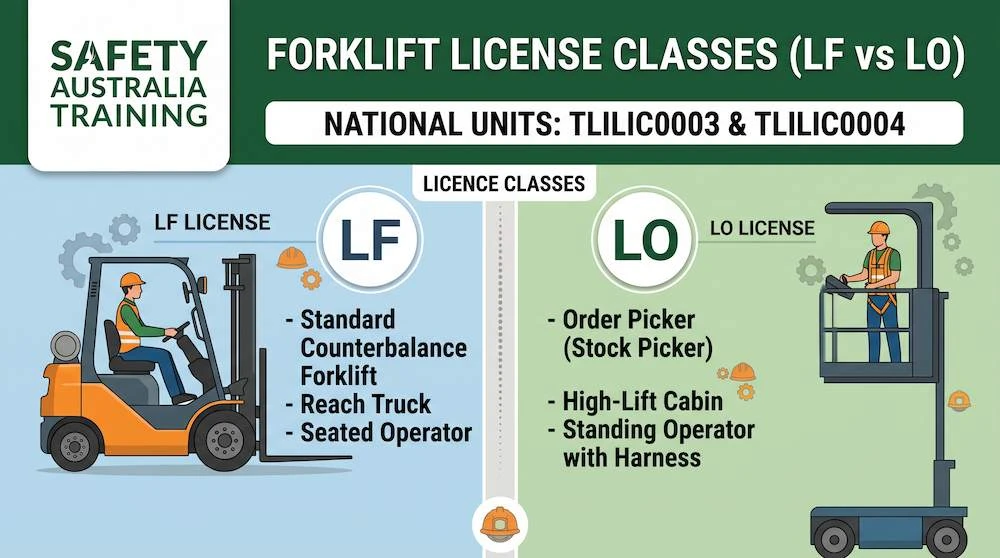
- LF Licence (TLILIC0003): Covers standard counterbalance forklifts, reach trucks, and rough-terrain trucks where operator controls stay grounded on the chassis and only the mast/forks elevate.
- LO Licence (TLILIC0004): Covers order picking forklifts (stockpickers) and turret trucks where the operator cabin travels upward with the carriage.
- Interchangeability: These licences are mutually exclusive. An LF card does not permit LO operations, and an LO card does not allow counterbalance forklift driving.
- Telehandlers: Neither licence authorizes telehandler operation exceeding 3 tonnes; see our breakdown on telehandler vs forklift licensing requirements.
What Is an LF Forklift Licence?
An LF class licence represents the most common, versatile materials-handling credential in Australia. Aligned with national competency unit TLILIC0003 – Licence to operate a forklift truck, it covers equipment where the load moves vertically while the driver remains seated or standing at base level.
Machinery Covered Under Class LF
- Counterbalance Forklifts: Fuel-powered (diesel, LPG, petrol) or battery-electric trucks utilized in transport terminals, yards, and manufacturing facilities.
- Reach Trucks: High-mast units built for narrow warehouse aisles and deep racking bays.
- Rough-Terrain Forklifts: Heavy-duty masted forklifts configured for civil construction, mining pads, and agricultural yards.
- Sideloader Forklifts: Specialized units engineered to transport long linear stock, including timber packs, PVC conduits, and structural steel.
Operational Insight: Logistics hubs now deploy automated collision avoidance and proximity systems. Explore our guide on essential forklift safety technologies to align with current site safety rules.
What Is an LO Forklift Licence?
An LO class licence is governed by national unit TLILIC0004 – Licence to operate an order picking forklift truck.
Unlike counterbalance units, an order picker features an enclosed operator cabin that travels vertically with the carriage. The driver rides up into the racking space to select individual items, pick inventory lines, or pack pallets at height.
Machinery Covered Under Class LO
- Order Pickers (Stockpickers): Platform-lift machines deployed throughout retail supply chains, wholesale distribution hubs, and e-commerce depots.
- Turret Trucks: Very Narrow Aisle (VNA) industrial trucks featuring articulating heads that handle pallets while lifting the driver cabin.
Due to the fall risk inherent to working at height, LO training focuses heavily on working-at-heights controls:
- Correct fitting, adjustment, and pre-use inspection of full-body fall-arrest harnesses.
- Anchor-point load verifications and lanyard deployment limits.
- Controlled cabin descent procedures and emergency egress protocols.
Side-by-Side Comparison: LF vs. LO Licence
| Feature / Criteria | LF Licence (Class LF) | LO Licence (Class LO) |
|---|---|---|
| National Unit Code | TLILIC0003 | TLILIC0004 |
| Machine Type | Counterbalance, reach truck, rough-terrain | Order pickers, stockpickers, turret trucks |
| Cabin Movement | Fixed to chassis (mast/forks elevate) | Elevates vertically alongside the load |
| Fall Protection | Seatbelt / operator restraint | Mandatory full-body harness & lanyard |
| Primary Industries | Freight depots, construction, wholesale supply | E-commerce hubs, high-density retail warehouses |
| Course Duration | 1 to 3 days (based on prior experience) | 1 to 2 days |
| Validity | 5 years (SafeWork renewable) | 5 years (SafeWork renewable) |
| Telehandler Coverage | Restricted (≤ 3t with forks only) | No coverage |
Which Licence Should You Choose?
Choose Class LF If:
- You want the broadest job mobility across construction sites, freight hubs, transport depots, and general manufacturing.
- Your day-to-day duties involve unloading flatbed trucks, de-stuffing shipping containers, or moving bulk palletized freight.
- You plan to drive counterbalance forklifts or reach trucks.
Choose Class LO If:
- You target roles in fast-paced fulfillment facilities (e.g., major retail, e-commerce, or postal distribution centers).
- Your core duties involve piece-picking, SKU verification, and split-case selection from high racking tiers.
- Your workplace uses dedicated VNA narrow-aisle order picking systems.
Professional Tip: Holding dual qualifications (LF + LO) creates substantial job security. Warehouse supervisors favor dual-ticketed workers who can unload road freight at the receiving dock using an LF truck, then transition to mezzanine stockpicking on an LO unit.
SafeWork Eligibility & Assessment Requirements
Enrolling in an accredited HRWL course through an Australian Registered Training Organisation (RTO) requires meeting strict criteria:
- Age Limit: Candidates must be at least 18 years old at the date of final assessment.
- 100 Points of Identification: Original identification (such as an Australian driver licence, passport, utility bills, and Medicare card) presented on testing day.
- LLN Competency: Solid Language, Literacy, and Numeracy skills to calculate rated load capacities, assess load centres, and interpret site signage.
- Assessment Mandate: Successful completion of a knowledge exam, calculation assessment, and an observed practical driving evaluation.
Ready to Earn Your Forklift Ticket?
Secure the correct High Risk Work Licence for your career goals. Whether you need standard counterbalance competence or specialized order-picker certification, our accredited trainers will get you site-ready.
Book Your Course at Safety Australia Training Forklift Licences
Frequently Asked Questions
Can I drive a standard forklift if I have an LO licence?
No. An LO licence strictly covers order pickers and turret trucks where the operator platform elevates. Operating an LF counterbalance or reach truck with only an LO ticket is an offence under the Work Health and Safety (WHS) Act, carrying hefty financial penalties for workers and employers.
Can an LF forklift licence holder operate an order picker?
No. An LF licence permits operation only on trucks where the operator controls remain fixed on the base chassis. Operating a stockpicker requires completing the TLILIC0004 course and securing a distinct LO class endorsement.
How long does a High Risk Work Licence remain valid in Australia?
Both LF and LO licences remain active for 5 years. Your state or territory safety regulator (such as SafeWork NSW, WorkSafe Victoria, or Workplace Health and Safety Queensland) issues a renewal notice prior to expiration.
Can an overseas forklift licence be directly converted in Australia?
No. International forklift tickets cannot be directly transferred or swapped for an Australian High Risk Work Licence. Overseas operators must complete formal training and pass an assessment through an Australian RTO.
Does an LF licence allow me to operate a telehandler?
An LF licence permits telehandler operation only when fitted strictly with pallet tines and restricted to a rated capacity of 3 tonnes or under. Any crane jib attachment or operation beyond 3 tonnes requires a non-slewing crane licence (Class CN) or TSL Gold Card. Review our full comparison on telehandler vs forklift licensing.
Can I drive a standard forklift if I have an LO licence?
No. An LO licence strictly covers order pickers and turret trucks where the operator platform elevates. Operating an LF counterbalance or reach truck with only an LO ticket is an offence under the Work Health and Safety (WHS) Act, carrying hefty financial penalties for workers and employers.
Can an LF forklift licence holder operate an order picker?
No. An LF licence permits operation only on trucks where the operator controls remain fixed on the base chassis. Operating a stockpicker requires completing the TLILIC0004 course and securing a distinct LO class endorsement.
How long does a High Risk Work Licence remain valid in Australia?
Both LF and LO licences remain active for 5 years. Your state or territory safety regulator (such as SafeWork NSW, WorkSafe Victoria, or Workplace Health and Safety Queensland) issues a renewal notice prior to expiration.
Can an overseas forklift licence be directly converted in Australia?
No. International forklift tickets cannot be directly transferred or swapped for an Australian High Risk Work Licence. Overseas operators must complete formal training and pass an assessment through an Australian RTO.
Does an LF licence allow me to operate a telehandler?
An LF licence permits telehandler operation only when fitted strictly with pallet tines and restricted to a rated capacity of 3 tonnes or under. Any crane jib attachment or operation beyond 3 tonnes requires a non-slewing crane licence (Class CN) or TSL Gold Card. Review our full comparison on telehandler vs forklift licensing.