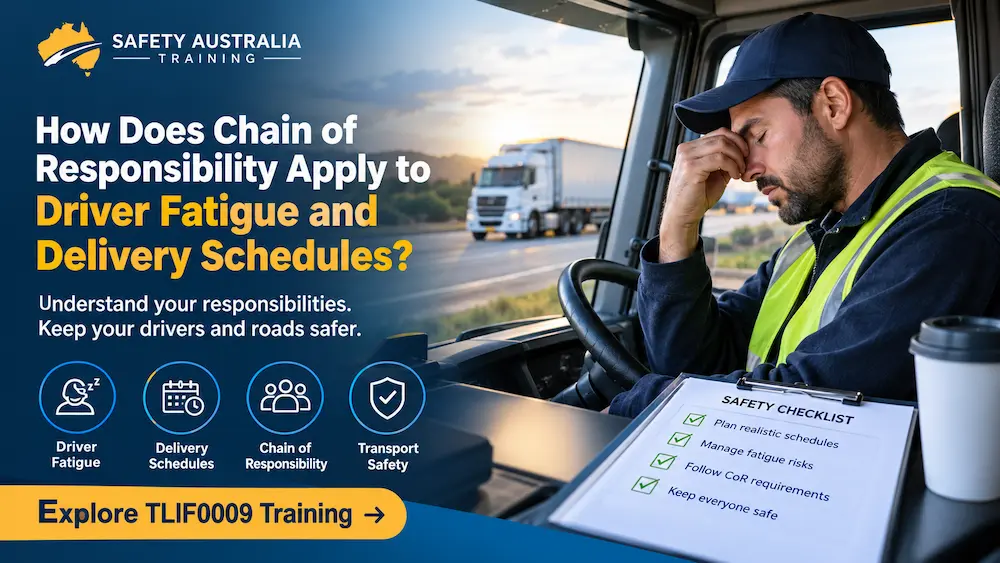
Quick answer: Under Australia’s Chain of Responsibility (CoR) laws, transport companies, schedulers, consignors, consignees, loading managers and other relevant parties must take reasonable steps to manage transport safety risks, including driver fatigue. Delivery schedules must allow heavy vehicle journeys to be completed safely and legally. A business must not pressure or encourage a driver to speed, skip required rest, or continue driving while fatigued to meet a deadline.
Drivers have their own duty to avoid driving while impaired by fatigue, but responsibility for safe transport activities may also extend to businesses and other parties whose decisions influence the journey.
CHAIN OF RESPONSIBILITY TRAINING
Are Your Transport Activities CoR Compliant?
Learn how to identify transport safety risks, understand shared responsibilities and apply Chain of Responsibility requirements in the workplace.
Explore TLIF0009 CoR Training →
Online training • Nationally recognised unit • Practical compliance knowledge
Quick Questions About Driver Fatigue and Chain of Responsibility
- Can a delivery deadline breach Chain of Responsibility laws? A deadline may contribute to a breach if it creates unsafe pressure, encourages speeding, or encourages a driver to work or drive while fatigued.
- Is the driver solely responsible for fatigue? No. Drivers have their own fitness-to-drive obligations, while other CoR parties must manage the safety risks associated with their transport activities.
- Can a scheduler be responsible for driver fatigue? A scheduler’s decisions may contribute to a CoR risk if they create or encourage unsafe schedules or practices.
- What should a company do if a delivery is delayed? Review the delivery plan, communicate with relevant parties and adjust the schedule rather than pressure a driver to take unsafe action.
- Does TLIF0009 cover fatigue and scheduling? Yes. The unit covers CoR obligations and workplace management of risks including fatigue, scheduling, speed and other heavy vehicle safety matters.
What Is Chain of Responsibility in Australian Transport?
Chain of Responsibility is a legal framework under the Heavy Vehicle National Law (HVNL) that recognises how different people and organisations can influence the safety of heavy vehicle transport activities.
Transport safety does not depend only on what happens behind the steering wheel. Decisions about delivery deadlines, driver rosters, loading arrangements, journey planning and customer expectations can all affect whether a trip can be completed safely.
Under the HVNL, relevant CoR parties have a primary duty to ensure, so far as is reasonably practicable, the safety of their transport activities. Parties must also avoid conduct that causes or encourages others to breach applicable requirements.
Who may have Chain of Responsibility obligations?
| Role | How the role may influence fatigue risk |
|---|---|
| Drivers | Managing fitness to drive, following applicable work and rest requirements, and reporting fatigue. |
| Transport operators | Providing safe operating procedures, appropriate schedules and fatigue management arrangements. |
| Schedulers and dispatchers | Planning realistic delivery times and allowing for travel, loading, unloading, delays and rest. |
| Consignors and consignees | Setting reasonable pickup and delivery expectations and communicating delays promptly. |
| Loading managers and relevant loading parties | Coordinating loading and unloading to reduce avoidable delays and unsafe time pressure. |
| Business owners and executives | Ensuring appropriate risk management systems, resources and oversight are in place. |
The precise legal obligations depend on the party’s role, activities, control and influence, and the applicable legislation.
How Do Delivery Schedules Create Driver Fatigue Risks?
A delivery schedule becomes a safety concern when its requirements cannot reasonably be achieved without unsafe driving, inadequate rest or other non-compliant practices.
For example, a transport company may promise a customer delivery by 7:00 am. However, loading delays, traffic, adverse weather or an unrealistic journey estimate may make the original deadline difficult to achieve. If the driver is pressured to make up lost time by speeding or sacrificing required rest, the scheduling process may have contributed to the risk.
Common scheduling problems that can increase fatigue risk
- Unrealistic delivery windows: Setting deadlines that do not account for lawful travel times and rest opportunities.
- Insufficient rest opportunities: Planning journeys without suitable opportunities for required rest.
- Last-minute changes: Adding urgent deliveries without reassessing the driver’s workload and schedule.
- Loading and unloading delays: Failing to account for queues, warehouse congestion or late freight preparation.
- Pressure to recover lost time: Expecting drivers to compensate for delays by driving faster or continuing when fatigued.
- Inconsistent rosters: Failing to consider the effects of irregular working patterns and night driving.
Important Compliance Reminder
Meeting prescribed work and rest requirements does not automatically mean a driver is fit to drive. If fatigue is affecting safe driving, the driver must not continue driving while impaired, and relevant parties should take appropriate action to manage the risk.
Real-World Examples: Compliant vs Unsafe Delivery Scheduling
| Situation | Unsafe approach | Safer approach |
|---|---|---|
| A warehouse delays loading by two hours. | Demand that the driver make up the delay by speeding. | Update the estimated arrival time and adjust the delivery plan. |
| A driver reports feeling fatigued. | Insist that the driver finish the route regardless. | Support a safe decision, arrange appropriate rest and reassess the trip. |
| A customer requests an urgent delivery. | Promise a deadline without checking whether it is achievable safely. | Confirm a realistic delivery window with the transport operator. |
| Traffic or bad weather delays the trip. | Tell the driver to skip rest or rush to recover time. | Recalculate the journey and notify the customer of the revised ETA. |
| A business uses a subcontractor. | Assume subcontracting removes all responsibility. | Coordinate with the subcontractor and manage risks associated with the business’s own activities. |
What Are the Responsibilities of Transport Schedulers Under CoR?
Schedulers and dispatchers can influence driver fatigue by deciding when loads are collected, when deliveries are due and how journeys are organised. Their decisions should support safe, realistic and legally compliant transport operations.
Practical steps for safer scheduling
- Calculate realistic travel times. Consider route conditions, expected traffic, weather, loading and unloading time, and applicable work and rest requirements.
- Build in reasonable contingencies. Allow for foreseeable delays rather than relying on drivers to recover lost time unsafely.
- Check relevant work and rest arrangements. Ensure the planned journey is consistent with the requirements that apply to the driver and vehicle.
- Communicate changes early. Notify customers, loading teams and transport operators when delays affect the plan.
- Respond to fatigue reports. Provide a process for drivers to report fatigue without being pressured to continue driving unsafely.
- Document risk management decisions. Keep appropriate scheduling records, risk assessments, incident reports and relevant communications.
- Review recurring problems. Investigate repeated delays, unrealistic delivery windows and fatigue-related near misses.
Improve Your Understanding of CoR Compliance
Learn how transport safety responsibilities apply to scheduling, fatigue, load restraint, vehicle mass and other transport activities.
What Are the Signs of Driver Fatigue?
Drivers, supervisors and other relevant personnel should understand common signs of fatigue and know how to respond when they appear.
| Signs of fatigue | Possible warning signs while driving |
|---|---|
| Frequent yawning or heavy eyelids | Difficulty keeping eyes open or brief lapses in awareness. |
| Poor concentration | Missing signs, exits or important road information. |
| Slower reactions | Delayed braking or difficulty responding to changing traffic conditions. |
| Reduced coordination or judgement | Difficulty maintaining lane position or consistent speed. |
| Irritability or mood changes | Uncharacteristic decisions or increased errors. |
These signs should be taken seriously. A driver who is impaired by fatigue should not continue driving simply because the trip is close to completion or the delivery is overdue.
What Should a Business Do When a Driver Is Fatigued?
Businesses should have clear procedures that prioritise safety over delivery deadlines.
- Give drivers a clear process for reporting fatigue and fitness-to-drive concerns.
- Ensure supervisors know how to respond to reported or observed fatigue.
- Arrange a safe opportunity to stop and rest when necessary.
- Reassess delivery commitments and update customers where required.
- Review whether scheduling, workload, roster design or workplace pressure contributed to the problem.
- Record and investigate relevant incidents and near misses.
- Review whether existing fatigue controls are effective and make improvements where necessary.
Fatigue management should not rely solely on a driver keeping within work and rest limits. Businesses should also consider overall fitness to drive, work patterns, journey demands and other factors that may affect safety.
What Training Helps Workers Understand Chain of Responsibility?
TLIF0009 – Ensure the Safety of Transport Activities (Chain of Responsibility) is a nationally recognised unit of competency designed to develop knowledge and skills for identifying and managing CoR obligations and transport safety risks.
The training is relevant to people whose work involves transport activities, including drivers, transport operators, schedulers, dispatchers, supervisors, managers and safety or compliance personnel.
Depending on the learner’s role, the course can help develop an understanding of:
- Key parties and activities in the Chain of Responsibility.
- Shared responsibilities and primary duty requirements.
- Recognising and reporting transport safety risks.
- Fatigue, speed, scheduling, vehicle mass and load restraint risks.
- Workplace procedures, documentation and reasonable risk management steps.
BUILD YOUR TRANSPORT SAFETY KNOWLEDGE
Take the Next Step With TLIF0009
Explore online Chain of Responsibility training and learn how to apply transport safety requirements in your workplace.
Check course details, eligibility and enrolment information before registering.
Related Chain of Responsibility Guides
- How to Stay Compliant With Chain of Responsibility Laws in 2026 — practical guidance for managing transport safety and compliance risks.
- Industries That Must Comply With Chain of Responsibility Laws — learn which industries and businesses may have CoR obligations.
Frequently Asked Questions
1. How does Chain of Responsibility apply to driver fatigue?
1. How does Chain of Responsibility apply to driver fatigue?
CoR requires relevant parties to manage safety risks associated with their transport activities, including fatigue risks. Drivers must not drive while impaired by fatigue, and other parties must avoid creating or encouraging unsafe conditions through their decisions or instructions.
2. Can a company be responsible if a driver is fatigued?
A company may have legal responsibility if its transport activities create unmanaged safety risks or it causes or encourages a driver to breach applicable requirements. The outcome depends on the facts and applicable law.
3. Can unrealistic delivery schedules breach CoR laws?
Yes, they can contribute to a breach where scheduling decisions create unsafe conditions or encourage speeding, inadequate rest or driving while fatigued. Delivery deadlines should be realistic and account for foreseeable delays.
4. Are transport schedulers part of the Chain of Responsibility?
Schedulers may have CoR obligations depending on their role and the transport activities they perform or influence. Their decisions can affect journey timing, rest opportunities and driver fatigue risks.
5. Does following work and rest limits guarantee that a driver is safe to drive?
No. A driver may still be impaired by fatigue despite complying with prescribed work and rest limits. Fitness to drive must be considered separately from compliance with those limits.
6. What should a dispatcher do if a driver reports fatigue?
The dispatcher should follow the workplace fatigue management procedure, support the driver in stopping safely when necessary, and reassess the journey and delivery arrangements. The driver should not be pressured to continue driving while impaired.
7. Who is responsible for delivery delays under CoR?
There is no single answer for every situation. Responsibility depends on the activities, decisions and influence of the parties involved. Relevant parties should cooperate to manage risks rather than create pressure for unsafe driving.
8. Does TLIF0009 cover fatigue management and delivery scheduling?
TLIF0009 covers CoR obligations and transport safety risks, including fatigue, scheduling, speed and other relevant operational matters. It provides a foundation for understanding these responsibilities; it does not replace all role-specific training or workplace procedures.
9. Where can I complete Chain of Responsibility training online?
You can review the TLIF0009 Chain of Responsibility course at Safety Australia Training for course details, delivery information and enrolment options.
Conclusion: Safe Delivery Schedules Start With Shared Responsibility
Driver fatigue is not only a driver-level issue. Delivery planning, loading delays, customer deadlines, work patterns and business decisions can all influence transport safety. Under Chain of Responsibility, relevant parties should take reasonable steps to manage these risks and must not cause or encourage unsafe driving practices.
By using realistic schedules, supporting drivers who report fatigue, reviewing delays and providing suitable training, transport businesses can improve safety and strengthen their approach to compliance.