Working near overhead powerlines is a serious electrical safety risk on Australian construction sites. One of the most important concepts workers, plant operators and supervisors need to understand is the No Go Zone.
Quick answer
A No Go Zone is the area around energised overhead electrical lines and associated electrical equipment that workers, vehicles, cranes, mobile plant, tools, materials and loads must not enter unless the required approval and control measures are in place. The size of the zone depends on factors such as the electrical voltage, the work being performed and the applicable state or territory requirements. Safe Work Australia’s guidance describes Zone C as the No Go Zone and states that entry requires written approval from the relevant Electricity Supply Authority.
For construction workers and non-electrical workers, understanding No Go Zones is essential when operating excavators, cranes, EWPs, concrete pumps, trucks and other mobile plant near overhead powerlines.
What Is a No Go Zone?
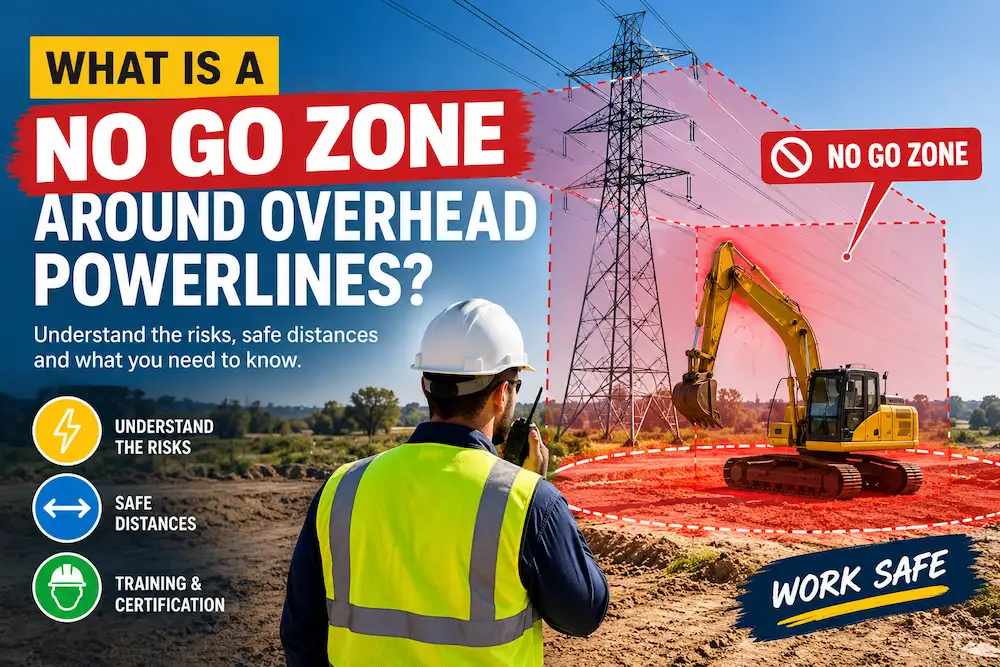
A No Go Zone is the restricted area surrounding an energised overhead electrical line and associated electrical equipment. It is an area where people, vehicles, mobile plant, cranes, loads, tools and other equipment must not enter while the electrical installation remains energised unless the appropriate authority has provided the required written approval and the necessary safety controls have been implemented.
Importantly, a No Go Zone is not simply a line marked on the ground. The exclusion area extends around the electrical infrastructure, and the risk must be considered in three dimensions. This is particularly important when working with equipment that can extend upwards, such as crane booms, EWP platforms, excavator arms and concrete placing equipment.
Safe Work Australia’s guidance states that the No Go Zone extends in all directions around energised overhead electric lines and associated electrical equipment, rather than only extending horizontally from the line.
Why Are No Go Zones Important?
Overhead powerlines can cause serious injury or death even when a worker or machine does not appear to be directly touching the conductor. Electrical energy can cause an arc or travel through conductive equipment, creating a potentially fatal hazard.
Construction sites can increase the risk because workers frequently operate tall or mobile equipment close to electrical infrastructure. Plant can also move unexpectedly, ground conditions can change and powerlines may sag or move because of environmental conditions.
Safe Work Australia recommends identifying electrical lines, determining their voltage and insulation, consulting relevant workers and electricity supply authorities, and establishing safe approach distances and work zones before work begins.
What Are the Different Zones Around Overhead Powerlines?
Australian guidance commonly describes three work zones around overhead electric lines: Zone A, Zone B and Zone C. The exact requirements and approach distances can vary depending on the circumstances and jurisdiction.
| Zone | General description | Key requirement |
|---|---|---|
| Zone A | Area further away from the electrical line for unauthorised persons | Workers must remain outside the relevant restricted approach distance |
| Zone B | Area closer to the electrical line for authorised workers | Requires appropriate training, risk controls and safety arrangements |
| Zone C | No Go Zone closest to the energised electrical line | Entry requires the required Electricity Supply Authority approval and control measures |
Safe Work Australia’s guidance explains that Zone A is for unauthorised persons, Zone B is for appropriately authorised persons working under the required controls, and Zone C is the No Go Zone where Electricity Supply Authority approval is required.
How Far Is the No Go Zone From an Overhead Powerline?
There is not one universal No Go Zone distance that applies to every overhead powerline in Australia.
The required approach distance can depend on the voltage of the electrical line, the type of work, the equipment being used, the worker’s level of authorisation and the requirements of the relevant electricity supply authority and state or territory regulator.
This is why workers should not rely on a generic distance found online when planning work near a specific powerline. The electrical network operator and applicable workplace requirements should be consulted to determine the appropriate controls.
Safe Work Australia’s guidance specifically states that approach distances vary according to the voltage of the overhead electric line and the level of authorisation of the people carrying out the work.
What Is the Difference Between a No Go Zone and a Safe Approach Distance?
A safe approach distance is the minimum distance that must be maintained from energised electrical apparatus to manage the risk of electrical contact or arcing.
A No Go Zone is a specific restricted work zone in which entry is prohibited unless the required authority approval and safety controls are in place.
In simple terms:
- Safe approach distance: the required separation between people, plant or equipment and electrical apparatus.
- No Go Zone: the restricted area where entry is not permitted without the required approval and controls.
Both concepts are important because a worker may unintentionally breach the required separation when operating mobile plant, raising a boom, tipping a load or moving equipment across a construction site.
Can Mobile Plant Enter a No Go Zone?
Mobile plant should not enter a No Go Zone around energised overhead electrical lines without the required approval and controls.
This applies to equipment such as:
- Excavators
- Cranes
- Elevating work platforms (EWPs)
- Telehandlers
- Concrete pumps
- Tip trucks
- Loaders
- Scaffolding and other elevated equipment
The risk is not limited to the physical body of the machine. Booms, buckets, forks, loads, cables, attachments and other components can extend into an electrical exclusion area.
Safe Work Australia’s guidance specifically addresses cranes and mobile plant operating near overhead electric lines and states that Zone C is a No Go Zone unless the required written approval has been obtained.
What Should You Do Before Working Near Overhead Powerlines?
Work near overhead electrical infrastructure should be planned before machinery or workers enter the area.
Important steps include:
- Identify overhead powerlines and associated electrical equipment.
- Determine the voltage and relevant electrical network information where required.
- Assess the work area, including line height, visibility, sag, sway, ground conditions and weather.
- Identify the equipment envelope, including the maximum height and reach of plant, tools and loads.
- Determine the required approach distances and work zones.
- Establish appropriate exclusion zones and physical controls.
- Consult the relevant electricity supply authority where required.
- Ensure workers have the required training and authorisation.
- Use a safety observer where required.
- Make sure workers understand the emergency procedure before work starts.
Safe Work Australia recommends assessing line visibility, height, sway and sag as well as site conditions such as weather, ground and traffic when managing overhead electrical risks.
What Is an Electrical Safety Observer?
A safety observer may be required when work is being performed close enough to overhead electrical lines that additional monitoring is necessary.
The observer’s role is to monitor the work area, communicate with the operator or workers and help prevent people or equipment from entering a prohibited or unsafe area.
However, a safety observer should not be treated as a substitute for proper planning, risk assessment, isolation or other required controls.
Safe Work Australia also warns that judging distances from ground level can be difficult, particularly when observing equipment operating near overhead powerlines.
Can a Safety Observer Make It Safe to Enter a No Go Zone?
No. Simply having a safety observer does not automatically make it permissible to enter a No Go Zone.
A safety observer is one possible control within a broader safe system of work. Where work would enter a No Go Zone around energised electrical lines, the required approval from the relevant electricity supply authority and other specified controls must be addressed.
This distinction is important because workers sometimes assume that having another person watching the machine is sufficient protection against electrical contact. It is not.
What Happens If a Machine Contacts an Overhead Powerline?
If mobile plant or equipment contacts an overhead powerline, the situation should be treated as a serious electrical emergency.
Workers should follow their site’s emergency procedure and the instructions provided during their electrical safety training. The machine, surrounding ground and nearby objects may be energised, creating additional hazards for anyone approaching the equipment.
Workers should not casually approach or touch the machine or attempt to assist the operator without following the established emergency procedure and obtaining appropriate assistance.
UETDREL006 includes knowledge and performance requirements relating to unplanned events, emergency procedures, electrical hazards and the safe use of plant and equipment near live electrical apparatus.
Why Do Construction Workers Need Electrical Safety Training?
Electrical hazards are not limited to electricians. Excavator operators, crane operators, EWP operators, labourers, supervisors and other construction workers may encounter electrical risks while performing ordinary site activities.
For example, a worker may not be performing electrical work but could still operate a machine underneath an overhead powerline or use equipment that can enter an electrical exclusion zone.
UETDREL006, Work safely in the vicinity of live electrical apparatus as a non-electrical worker, is specifically designed around the skills and knowledge required for non-electrical workers operating near live electrical apparatus. The unit includes safe approach distances for workers, plant, tools and equipment.
For a broader explanation of why this training matters for people who are not electricians, read why every construction worker needs electrical safety training even if they’re not an electrician.
What Does UETDREL006 Cover?
UETDREL006 covers the knowledge and skills required to work safely in the vicinity of live electrical apparatus as a non-electrical worker.
The unit includes areas such as:
- Identifying electrical hazards
- Assessing electrical risks
- Applying risk controls
- Determining and maintaining safe approach distances
- Identifying electricity network assets
- Understanding low-voltage and high-voltage networks
- Selecting and using appropriate PPE
- Communicating with a safety observer
- Understanding work permits
- Responding to unplanned events
- Understanding emergency procedures
- Understanding electrical risks including arc flash, touch potential and step potential
- Understanding the safe use of plant and equipment near electrical apparatus
These requirements are set out in the national training register for UETDREL006.
You can also learn more about nationally accredited UETDREL006 training and what the unit covers.
Is Working Near a No Go Zone High-Risk Construction Work?
Some construction activities carried out on or near energised electrical installations or services can fall within the definition of high-risk construction work and may require a Safe Work Method Statement (SWMS).
Safe Work Australia lists construction work carried out on or near energised electrical installations or services among the categories of high-risk construction work requiring a SWMS.
However, the exact legal requirements depend on the work being performed and the applicable state or territory legislation. Employers and PCBUs should consult the relevant regulator and electricity supply authority when planning work near electrical infrastructure.
How Can Construction Sites Prevent No Go Zone Incidents?
Preventing electrical incidents requires multiple layers of control rather than relying on workers to simply “be careful”.
1. Identify powerlines before work starts
Overhead electrical infrastructure should be identified during site planning and before mobile plant is positioned or operated.
2. Eliminate the electrical hazard where possible
Where reasonably practicable, de-energising electrical lines or equipment can eliminate the electrical risk. Safe Work Australia recommends considering de-energisation as part of managing electrical risks.
3. Establish exclusion zones
Clearly defined barriers, signage and other controls can help prevent workers and plant from entering restricted areas.
4. Control plant movement
Engineering controls such as movement limiters, proximity warning systems and other plant controls may help reduce the likelihood of equipment entering an unsafe area.
5. Train workers
Workers who may operate or work around mobile plant and electrical infrastructure should receive training appropriate to their role and the risks involved.
6. Use supervision and communication
Operators, supervisors and safety observers need clear communication methods and must understand their responsibilities before work begins.
Safe Work Australia’s guidance recommends a combination of isolation, engineering controls, administrative controls and appropriate PPE depending on the risk.
What is a No Go Zone around overhead powerlines?
A No Go Zone is a restricted area around energised overhead electrical lines and associated equipment. People, vehicles, mobile plant, cranes, loads and equipment must not enter the zone unless the required approval and safety controls are in place.
How far away from overhead powerlines is a No Go Zone?
There is no single distance that applies to every powerline in Australia. Approach distances depend on factors including electrical voltage, worker authorisation, equipment and the applicable requirements of the electricity supply authority and jurisdiction.
Can an excavator operate inside a No Go Zone?
An excavator or other mobile plant should not enter a No Go Zone around energised overhead electrical lines without the required authority approval and safety controls. The excavator’s boom, bucket and other attachments must also be considered when determining the equipment’s operating envelope.
Can a safety observer allow a machine to enter a No Go Zone?
Not by themselves. A safety observer does not replace the required approval, risk controls or safe system of work for entering a No Go Zone.
What is the difference between a No Go Zone and a safe approach distance?
A safe approach distance defines the required separation from electrical apparatus, while a No Go Zone is a restricted area where entry is prohibited unless the required approval and controls are in place.
Do non-electricians need electrical safety training?
Workers who are not electricians may still need specific electrical safety training when their work brings them into the vicinity of live electrical apparatus. UETDREL006 is designed specifically for non-electrical workers working safely in these circumstances.
What is UETDREL006?
UETDREL006 is the unit of competency titled Work safely in the vicinity of live electrical apparatus as a non-electrical worker. It covers safe approach distances, electrical hazards, risk controls, PPE, safety observers, work permits and emergency procedures. Additional state, territory or workplace requirements may apply.
What should I do if my work needs to be close to an overhead powerline?
Do not assume that a generic clearance distance is sufficient. Identify the electrical infrastructure, determine the relevant voltage and approach requirements, assess the work and equipment, consult the relevant electricity supply authority where required, establish appropriate controls and ensure workers have the necessary training and authorisation.
Ready to Improve Your Electrical Safety Skills?
Working near overhead powerlines requires more than simply knowing where the cables are. Workers need to understand electrical hazards, safe approach distances, exclusion zones, mobile plant risks, safety observers, emergency procedures and the controls required for their specific work environment.
If you are a non-electrical worker who may work near live electrical apparatus, learn more about Electrical Safety Training and UETDREL006 through Safety Australia Training.
Always check the requirements that apply to your state or territory, workplace and electricity network before starting work near energised electrical infrastructure.