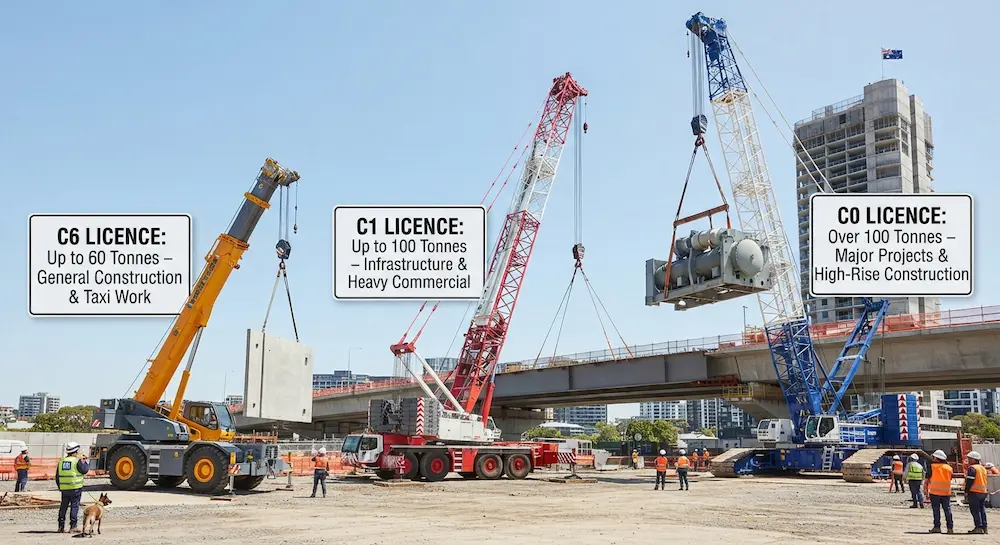
Quick Summary: Mobile Crane Licence Tiers at a Glance
- C6 Licence: Authorises operation of a slewing mobile crane with a capacity of up to 60 tonnes. The foundational ticket for mainstream commercial and civil sites.
- C1 Licence: Authorises operation of a slewing mobile crane with a capacity of up to 100 tonnes. Essential for medium infrastructure, heavy industrial settings, and larger construction projects.
- C0 Licence: Authorises operation of a slewing mobile crane with a capacity over 100 tonnes with no upper limit. Designed for heavy civil engineering, high-rise construction, and mega-projects like wind farms.
- The Essential Prerequisite: In Australia, you must hold a valid Dogging (DG) Licence before you can legally undertake training for any slewing mobile crane licence class.<
Understanding High-Risk Work Licences (HRWL) for Cranes in Australia
In Australia, operating a mobile crane is classified as performing high-risk work due to the immense weights involved, the complexity of dynamic loads, and the potential hazards posed to other workers on site. Under work health and safety (WHS) regulations, every operator must hold the correct class of national high-risk work licence specific to the capacity and design of the equipment they are operating.
Attempting to operate a crane outside your licence tier—or operating without a valid licence—carries severe legal penalties for both the worker and the PCBU (Person Conducting a Business or Undertaking), alongside extreme safety risks.
Comparison Table: C6 vs. C1 vs. C0 Mobile Crane Licences
| Licence Class | National Unit Code (Ref) | Maximum Crane Capacity | Typical Industry Applications | Prerequisites & Pathway |
|---|---|---|---|---|
| C6 Licence | TLILIC0023 (or state equivalent) | Up to 60 Tonnes | General commercial construction, residential projects, minor civil works, plant relocation. | Dogging (DG) Licence required. Usually the first slewing ticket obtained. |
| C1 Licence | Regulated National Unit | Up to 100 Tonnes | Medium infrastructure, bridge building, large commercial builds, industrial maintenance. | Dogging (DG) Licence + typically C6 experience or competency sign-off. |
| C0 Licence | Regulated National Unit | Over 100 Tonnes (No Limit) | High-rise construction, heavy industrial plants, massive civil projects, wind energy installations. | Dogging (DG) Licence + extensive logged operational experience on C1/C6 cranes. |
Deep Dive Into Each Mobile Crane Licence Class
1. C6 Mobile Crane Licence (Up to 60 Tonnes)
The C6 licence is the cornerstone of the crane operating industry. It authorises you to operate a slewing mobile crane with a maximum rated capacity of up to 60 tonnes. Depending on state-specific guidelines, holding a C6 may also cover certain aspects of non-slewing mobile cranes and vehicle-loading cranes, though dedicated tickets are often preferred.
- Who it is for: Workers stepping up from rigging or dogging roles who want to break into active crane operation. It is the most versatile and frequently requested ticket by labour hire and civil contractors.
- Core Competencies Learned: Setting up outriggers correctly on uneven ground, calculating load charts, interpreting wind speed restrictions, managing radius limitations, and communicating seamlessly with doggers.
read this : C6 Crane Training Requirements in Australia (Eligibility & Skills Guide)
2. C1 Mobile Crane Licence (Up to 100 Tonnes)
Stepping up to the C1 licence opens doors to much larger civil and industrial job sites. This licence permits you to operate slewing mobile cranes with a capacity of up to 100 tonnes.
- Who it is for: Operators who have mastered 60-tonne machines and want to handle larger all-terrain or rough-terrain cranes. Common in civil engineering, road and bridge construction, and major facility overhauls.
- Core Competencies Learned: Handling heavier multi-axle carrier configurations, understanding complex counterweight drops, executing tight-radius heavy lifts, and coordinating tandem lifts under strict engineering supervision.
3. C0 Mobile Crane Licence (Over 100 Tonnes)
The C0 licence represents the pinnacle of mobile crane operating credentials in Australia. With a C0 ticket, there is no upper weight limit—you are qualified to operate massive heavy-lift cranes ranging from 100 tonnes well past 500+ tonnes.
- Who it is for: Seasoned, highly experienced crane operators working on multi-million dollar infrastructure projects, commercial skyscraper construction, heavy manufacturing plants, and renewable energy sectors (such as assembling utility-scale wind turbines).
- Core Competencies Learned: Advanced engineering lift planning, managing complex rigging configurations, operating massive hydraulic and lattice-boom mobile cranes, and exercising precision control over multi-million dollar loads.
Important Note on Non-Slewing vs. Slewing Cranes
Keep in mind that mobile cranes are split into categories. Slewing cranes (where the boom can swing independently of the chassis) require C6, C1, or C0 tickets. If you are working with pick-and-carry cranes that do not slew (such as certain articulated mobile cranes), you may require a separate CN (Non-Slewing Mobile Crane) Licence. Always evaluate the specific fleet your employer uses.
read this : Master Safe Crane Operation with the C0 Course
Factors to Consider When Choosing Your Licence Pathway
When deciding which course to enrol in through an accredited Registered Training Organisation (RTO), weigh the following factors carefully:
- Prerequisites and Compliance: You cannot skip steps. You must hold a valid Dogging (DG) Licence before you can commence any slewing crane course. Furthermore, while some RTOs allow direct entry depending on prior learning, most employers and assessors prefer a progressive career trajectory (C6 first, then C1, then C0).
- Current Market Demand: If you want immediate, widespread employment, a C6 licence offers the highest volume of daily job opportunities across standard civil and commercial construction sites. However, if you are looking to enter specialized sectors like mining or heavy energy infrastructure, mapping a fast track to C1 and C0 will maximize your earning potential.
- Access to Machinery for Training and Logbooks: Training for higher-tier licences (like C1 and C0) often requires access to specific heavy machinery for your practical logbook hours and final assessment. Ensure your workplace or RTO can supply the correct equipment class.
Recommended Career Progression Roadmap
To build a long-term, safe, and highly marketable career in heavy lifting, industry professionals typically recommend the following step-by-step pathway:
- Step 1: Obtain your Dogging (DG) Licence and Basic Rigging (RB) Licence. Understanding how loads are slung and secured is mandatory background knowledge.
- Step 2: Complete your C6 Mobile Crane Licence (Up to 60T) and gain at least 1–2 years of active seat time on site.
- Step 3: Upgrade to a C1 Licence (Up to 100T) as you take on heavier civil and industrial projects.
- Step 4: Advance to the C0 Licence (Over 100T) to position yourself as an elite crane operator capable of handling major infrastructure and energy sector mega-lifts.
Frequently Asked Questions (FAQ)
Can I operate a 120-tonne crane if I only hold a C6 licence?
No. Operating a crane that exceeds your licence class capacity is a severe breach of Australian workplace health and safety laws. Doing so can result in massive fines, loss of licensing credentials, and immediate termination or legal prosecution in the event of an incident.
How long does it take to complete a mobile crane course?
An initial training course typically spans between 3 to 5 days of intensive theory, practical operation, and logbook preparation, followed by a formal assessment conducted by a WorkSafe-licenced assessor. Total completion time varies depending on your prior experience and the specific RTO.
Do high-risk work licences expire in Australia?
Yes. High-Risk Work Licences (HRWL) issued in Australia generally expire after 5 years. You must apply for renewal through your state or territory regulator (such as SafeWork NSW, WorkSafe Victoria, Workplace Health and Safety Queensland, etc.) before the expiry date.
Should I get my Dogging licence before my crane licence?
Yes, absolutely. In Australia, a Dogging (DG) Licence is a mandatory prerequisite for undertaking any slewing mobile crane licence training course. A crane operator must intimately understand the responsibilities of a dogger to ensure safe communication and load handling.
Can I operate a 120-tonne crane if I only hold a C6 licence?
No. Operating a crane that exceeds your licence class capacity is a severe breach of Australian workplace health and safety laws. Doing so can result in massive fines, loss of licensing credentials, and immediate termination or legal prosecution in the event of an incident.
How long does it take to complete a mobile crane course?
An initial training course typically spans between 3 to 5 days of intensive theory, practical operation, and logbook preparation, followed by a formal assessment conducted by a WorkSafe-licenced assessor. Total completion time varies depending on your prior experience and the specific RTO.
Do high-risk work licences expire in Australia?
Yes. High-Risk Work Licences (HRWL) issued in Australia generally expire after 5 years. You must apply for renewal through your state or territory regulator (such as SafeWork NSW, WorkSafe Victoria, Workplace Health and Safety Queensland, etc.) before the expiry date.
Should I get my Dogging licence before my crane licence?
Yes, absolutely. In Australia, a Dogging (DG) Licence is a mandatory prerequisite for undertaking any slewing mobile crane licence training course. A crane operator must intimately understand the responsibilities of a dogger to ensure safe communication and load handling.