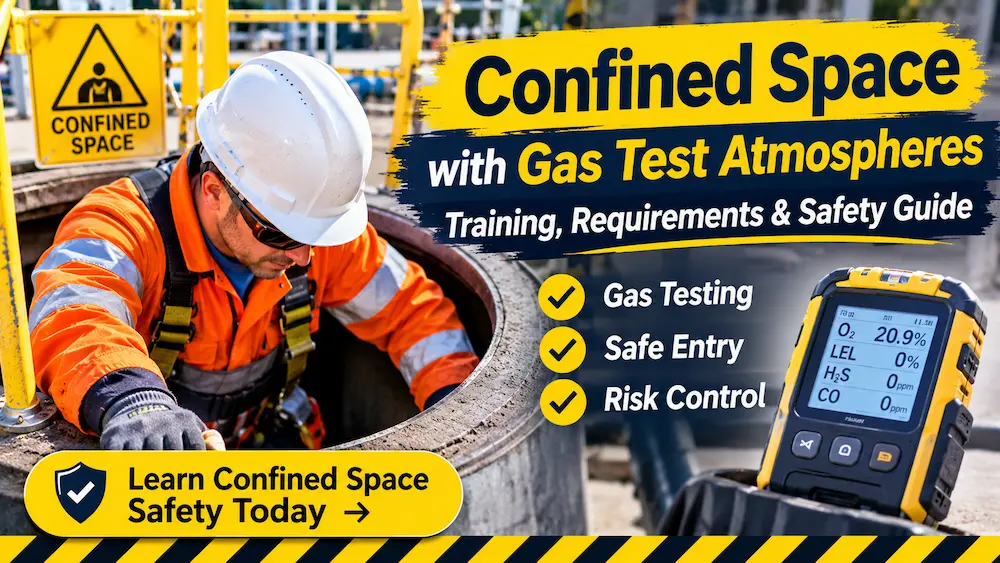
Confined space training and gas testing help workers understand how to identify confined space hazards, assess atmospheric conditions and follow safe entry procedures before carrying out work in potentially dangerous environments.
In Australia, working in a confined space is subject to specific workplace health and safety requirements. Depending on the task, workers may need training in confined space entry, atmospheric testing, gas monitoring, emergency procedures and rescue arrangements.
Gas testing is particularly important because a confined space may contain an unsafe oxygen level, toxic gases, flammable vapours or other atmospheric hazards that cannot reliably be identified by sight or smell.
Quick answer: What is confined space training with gas testing?
It is workplace safety training that prepares workers to understand confined space hazards, follow entry procedures and, where covered by the relevant course, test and monitor the atmosphere using suitable gas detection equipment. The training helps workers recognise unsafe conditions and understand when entry must not proceed.
Prepare for safer confined space work
Develop practical knowledge of confined space entry and gas test atmospheres with suitable training.
What Is a Confined Space with Gas Test Atmospheres?
A confined space is not simply a small room or an enclosed area. Under Australia’s model Work Health and Safety Regulations, a confined space generally involves an enclosed or partially enclosed space that is not designed or intended primarily to be occupied by a person and that meets specified risk criteria.
Those risk criteria include the potential for:
- An atmosphere with an unsafe oxygen level.
- Airborne contaminants that may cause impairment, loss of consciousness or asphyxiation.
- A fire or explosion caused by flammable airborne contaminants.
- Engulfment in a stored material that could surround or trap a person.
Examples may include tanks, silos, pipes, pits, sewers, underground chambers and some storage vessels. However, an area should not be classified as a confined space based on its name or appearance alone. The applicable definition and workplace risk assessment must be considered.
A gas test atmosphere refers to the assessment of air inside a confined space to identify potentially dangerous atmospheric conditions. A suitable gas detector can measure oxygen concentration and detect particular gases or vapours, depending on the instrument’s sensors and configuration.
Why Is Gas Testing Important?
Atmospheric hazards can be present before a worker enters a confined space or develop while work is underway. For example, cleaning chemicals, welding activities, chemical reactions, decomposing materials or changes in ventilation can affect the atmosphere.
Gas testing helps identify hazards that may not be visible. It can help determine whether the atmosphere is suitable for entry, whether additional controls are required and whether ongoing monitoring is necessary.
Important: A gas detector reading that appears acceptable at one point in time does not guarantee that the atmosphere will remain safe. Testing and monitoring must follow the risk assessment, entry arrangements and applicable procedures.
What Does a Gas Test Measure?
Gas testing is used to assess atmospheric conditions inside a confined space. The exact gases measured depend on the hazards identified and the equipment selected for the task.
| Atmospheric measurement | What it helps identify | Potential concern |
|---|---|---|
| Oxygen (O₂) | Oxygen concentration in the atmosphere | Oxygen deficiency or enrichment |
| Flammable gases and vapours | Potential fire or explosion hazards | Ignition and explosion risk |
| Hydrogen sulphide (H₂S) | Presence of a toxic gas | Toxic exposure and serious health effects |
| Carbon monoxide (CO) | Presence of a toxic combustion-related gas | Poisoning and impaired oxygen delivery in the body |
| Other identified contaminants | Specific chemicals or vapours relevant to the work | Exposure to hazardous substances |
Not every gas detector measures every possible contaminant. Employers and competent personnel must select equipment suitable for the hazards identified. Instrument checks, calibration requirements, sensor limitations and sampling procedures must also be considered.
What Are the Main Confined Space Training Courses?
Several types of training may be relevant to confined space work. The appropriate course depends on the worker’s responsibilities, the hazards involved and the tasks they are expected to perform.
| Training type | Main focus |
|---|---|
| Confined Space Entry Training | Understanding confined space hazards, entry procedures, permits and safety controls. |
| Gas Testing and Monitoring Training | Understanding atmospheric testing, gas detection equipment and interpretation of readings. |
| Hazardous Gas Detection Training | Recognising hazardous gases and understanding the limitations of detection equipment. |
| Confined Space Rescue Training | Understanding rescue arrangements, emergency response and relevant rescue techniques. |
| Confined Space Risk Assessment | Identifying hazards, evaluating risks and selecting suitable controls. |
| Confined Space Ventilation | Understanding ventilation controls and their role in managing atmospheric hazards. |
| Emergency Procedures Training | Understanding communication, emergency arrangements and response responsibilities. |
These are related training areas rather than a list of mandatory separate qualifications for every worker. Some courses combine several topics, while others focus on a specific competency.
For a practical overview of entry requirements and safe work procedures, read our guide to confined space entry training and procedures for safe work.
What Are the Prerequisites for Confined Space Training?
Prerequisites vary according to the training course, its assessment requirements and the type of work involved. Before enrolling, workers should check the course entry requirements with the training provider.
Depending on the course and workplace, relevant considerations may include:
- Workplace induction: Understanding the site’s safety rules, emergency arrangements and reporting procedures.
- Personal protective equipment: Having access to the PPE required for the training and work environment.
- Relevant language, literacy and numeracy skills: Being able to understand instructions, safety information and assessment requirements.
- Fitness for the task: Being capable of safely undertaking the physical activities involved, subject to the applicable workplace requirements.
- Gas testing knowledge: Where the role involves atmospheric testing, workers may need specific training and demonstrated competency in using the relevant equipment.
- Emergency response knowledge: Understanding the emergency procedures relevant to the workplace and the worker’s assigned responsibilities.
Are Working at Heights and First Aid Certificates Mandatory?
Not automatically. A Working at Heights certificate or First Aid certificate is not a universal prerequisite for every confined space training course or every confined space entry task.
However, these qualifications may be relevant when the work involves additional hazards or specific responsibilities. For example:
- Working at Heights: May be relevant when accessing elevated entry points or performing work where a fall hazard exists. Learn more about Working Safely at Heights.
- First Aid: May be required by the employer’s first aid arrangements, site procedures or the responsibilities assigned to a worker. See our First Aid training information.
- Rescue competency: Workers assigned to a confined space rescue role need training and demonstrated capability appropriate to the rescue arrangements.
Do not assume that holding one of these certificates automatically authorises a person to enter a confined space, conduct gas testing or perform a rescue.
Who Should Complete Confined Space and Gas Testing Training?
Confined space and gas testing training can be relevant to workers who may enter, supervise, assess or support work in confined spaces. The required level of training depends on their actual duties.
People who may benefit include:
- Construction workers: Workers involved in underground structures, pits, tanks and other confined work areas.
- Plumbers: Workers who may carry out maintenance or repairs in pits, tanks and drainage systems.
- Electricians: Electrical workers undertaking maintenance or installation work in relevant enclosed spaces.
- HVAC technicians: Workers involved in ventilation systems and equipment installed in restricted spaces.
- Maintenance workers: Personnel responsible for inspection, cleaning and repair activities.
- Manufacturing and industrial workers: Employees working around vessels, silos, tanks and industrial equipment.
- Welders: Workers undertaking hot work where confined space and atmospheric hazards may arise.
- Inspectors: Personnel who assess structures, equipment and work areas.
- Supervisors: People responsible for coordinating and overseeing confined space activities.
- Safety personnel: Workers involved in risk assessment, safety procedures and workplace compliance.
Looking for relevant training?
Find out more about the course designed for safe work in confined spaces with gas test atmospheres.
What Are the Main Hazards in Confined Spaces?
Confined spaces can expose workers to serious risks, particularly when hazards are not identified and controlled before entry. Atmospheric conditions are only one part of the overall risk assessment.
| Hazard | Possible consequence | Example control |
|---|---|---|
| Oxygen deficiency | Impaired judgement, unconsciousness or asphyxiation | Atmospheric testing and suitable ventilation controls |
| Toxic gases | Poisoning or serious injury | Hazard identification, gas testing and exposure controls |
| Flammable vapours | Fire or explosion | Ignition-source control and suitable atmospheric monitoring |
| Engulfment | Trapping, crushing or suffocation | Isolation and control of material movement |
| Mechanical or electrical hazards | Injury from moving equipment or electrical energy | Isolation, lockout and verification procedures |
| Restricted access and difficult evacuation | Delayed emergency response | Entry planning, communication and rescue arrangements |
For a more detailed breakdown of common risks and control measures, read our guide: Common Confined Space Hazards: How to Control Them.
What Are the Main Steps Before Entering a Confined Space?
Confined space entry requires planning and appropriate controls. Under the applicable WHS requirements, workplaces must address the risks associated with confined space work before entry takes place.
- Identify the confined space: Determine whether the area meets the applicable confined space definition and identify the work to be performed.
- Assess the risks: Identify atmospheric, physical, chemical, mechanical and other relevant hazards.
- Isolate hazards: Identify and isolate relevant energy sources, services, machinery and material flows where required.
- Prepare the entry arrangements: Establish the required confined space entry permit, communication arrangements and responsibilities.
- Test the atmosphere: Arrange appropriate atmospheric testing by a competent person using suitable equipment and procedures.
- Apply control measures: Use suitable ventilation, PPE, isolation and other controls identified by the risk assessment.
- Monitor conditions: Conduct ongoing monitoring where required by the risk assessment and entry arrangements.
- Prepare for emergencies: Ensure appropriate rescue procedures, equipment and trained personnel are available before entry.
A confined space entry permit is an important part of the process where required by the applicable regulations. It does not replace risk assessment, isolation, atmospheric testing or effective control measures.
What Jobs Can You Pursue with Confined Space Training?
Confined space training may support workers in roles across industries where tanks, pits, vessels, underground structures and other confined spaces are part of the work environment.
| Industry | Potential roles or tasks |
|---|---|
| Construction | Construction worker, maintenance worker and site technician |
| Manufacturing | Plant operator, industrial maintenance technician and equipment inspector |
| Utilities | Water and wastewater maintenance worker and utility technician |
| Mining | Maintenance worker, plant technician and mine site worker |
| Oil and gas | Industrial maintenance worker and process plant technician |
| Waste management | Wastewater technician and sewer maintenance worker |
| Petrochemical and refining | Plant maintenance worker and inspection technician |
Does confined space training guarantee a job? No. Training can help demonstrate relevant safety knowledge and competency, but employment also depends on experience, other qualifications, employer requirements and the specific role. Some positions require additional licences, technical qualifications or industry experience.
How Much Can Confined Space Workers Earn in Australia?
There is no single salary for workers who hold confined space training. Earnings vary according to occupation, location, industry, experience, employment arrangements, roster and additional qualifications.
For example, a maintenance worker, wastewater technician and mining employee may have very different pay structures even if all undertake confined space-related work. Some positions may also involve overtime, shift work or site allowances.
For a realistic salary comparison, check current job advertisements for the specific occupation and location you are interested in. A confined space training certificate alone does not determine a worker’s salary or guarantee access to higher-paid positions.
Frequently Asked Questions About Confined Space Training and Gas Testing
1. What is confined space training?
Confined space training prepares workers to understand confined space hazards and follow relevant safety procedures. Depending on the course, it may cover entry requirements, risk controls, permits, communication, atmospheric hazards and emergency arrangements.
2. What is gas testing in a confined space?
Gas testing is the process of checking the atmosphere inside a confined space for hazards such as unsafe oxygen levels, toxic gases and flammable vapours. It uses suitable gas detection equipment and procedures selected for the identified risks.
3. Is gas testing required before entering a confined space?
Atmospheric testing is an important part of assessing confined space risks. The required testing must be determined by the applicable WHS requirements and workplace risk assessment. Where atmospheric hazards may exist, suitable testing and monitoring arrangements must be established before and, where necessary, during entry.
4. Do I need a Working at Heights certificate for confined space training?
Not in every case. Working at Heights training may be relevant when the work involves a fall hazard or elevated access, but it is not a universal prerequisite for all confined space courses.
5. Do I need First Aid training to work in a confined space?
First Aid training is not automatically a prerequisite for every confined space course or entry task. However, employers must make suitable first aid arrangements, and particular workplaces or roles may require workers to hold a First Aid qualification.
6. Who can benefit from gas testing training?
Workers and supervisors involved in confined space activities may benefit from gas testing training. It is particularly relevant to people who are required to conduct atmospheric testing or understand gas monitoring results as part of their assigned duties.
7. What equipment is used for confined space gas testing?
Depending on the hazards, workers may use portable multi-gas detectors or other suitable atmospheric monitoring instruments. Equipment must be appropriate for the gases being assessed and maintained, checked and used according to the manufacturer’s instructions and workplace procedures.
8. Can I enter a confined space if the gas detector shows a safe reading?
Not based on that reading alone. Entry must only proceed when the required risk controls and entry arrangements are in place. A reading at one location or point in time does not rule out other hazards or guarantee that conditions will remain safe.
9. What industries require confined space training?
Confined space training may be relevant in construction, manufacturing, mining, utilities, wastewater management, oil and gas, petrochemical processing and other industries where workers may enter confined spaces.
10. Does confined space training guarantee employment?
No. Training can support workplace competency and job applications, but employers may also require experience, additional qualifications, site inductions and other role-specific competencies.
Get Started with Confined Space and Gas Test Atmospheres Training
1. What is confined space training?
Confined space training prepares workers to understand confined space hazards and follow relevant safety procedures. Depending on the course, it may cover entry requirements, risk controls, permits, communication, atmospheric hazards and emergency arrangements.
2. What is gas testing in a confined space?
Gas testing is the process of checking the atmosphere inside a confined space for hazards such as unsafe oxygen levels, toxic gases and flammable vapours. It uses suitable gas detection equipment and procedures selected for the identified risks.
3. Is gas testing required before entering a confined space?
Atmospheric testing is an important part of assessing confined space risks. The required testing must be determined by the applicable WHS requirements and workplace risk assessment. Where atmospheric hazards may exist, suitable testing and monitoring arrangements must be established before and, where necessary, during entry.
4. Do I need a Working at Heights certificate for confined space training?
Not in every case. Working at Heights training may be relevant when the work involves a fall hazard or elevated access, but it is not a universal prerequisite for all confined space courses.
5. Do I need First Aid training to work in a confined space?
First Aid training is not automatically a prerequisite for every confined space course or entry task. However, employers must make suitable first aid arrangements, and particular workplaces or roles may require workers to hold a First Aid qualification.
6. Who can benefit from gas testing training?
Workers and supervisors involved in confined space activities may benefit from gas testing training. It is particularly relevant to people who are required to conduct atmospheric testing or understand gas monitoring results as part of their assigned duties.
7. What equipment is used for confined space gas testing?
Depending on the hazards, workers may use portable multi-gas detectors or other suitable atmospheric monitoring instruments. Equipment must be appropriate for the gases being assessed and maintained, checked and used according to the manufacturer’s instructions and workplace procedures.
8. Can I enter a confined space if the gas detector shows a safe reading?
Not based on that reading alone. Entry must only proceed when the required risk controls and entry arrangements are in place. A reading at one location or point in time does not rule out other hazards or guarantee that conditions will remain safe.
9. What industries require confined space training?
Confined space training may be relevant in construction, manufacturing, mining, utilities, wastewater management, oil and gas, petrochemical processing and other industries where workers may enter confined spaces.
10. Does confined space training guarantee employment?
No. Training can support workplace competency and job applications, but employers may also require experience, additional qualifications, site inductions and other role-specific competencies.
Working in confined spaces requires more than simply knowing how to enter and exit a restricted area. Workers must understand atmospheric hazards, follow appropriate safety procedures and know how to respond when conditions become unsafe.
Whether you work in construction, manufacturing, utilities, mining or industrial maintenance, relevant training can help you develop the knowledge and practical skills needed for safer confined space work.
Build Your Confined Space Safety Knowledge
Explore training for safe working in confined spaces with gas test atmospheres and learn more about the course requirements.