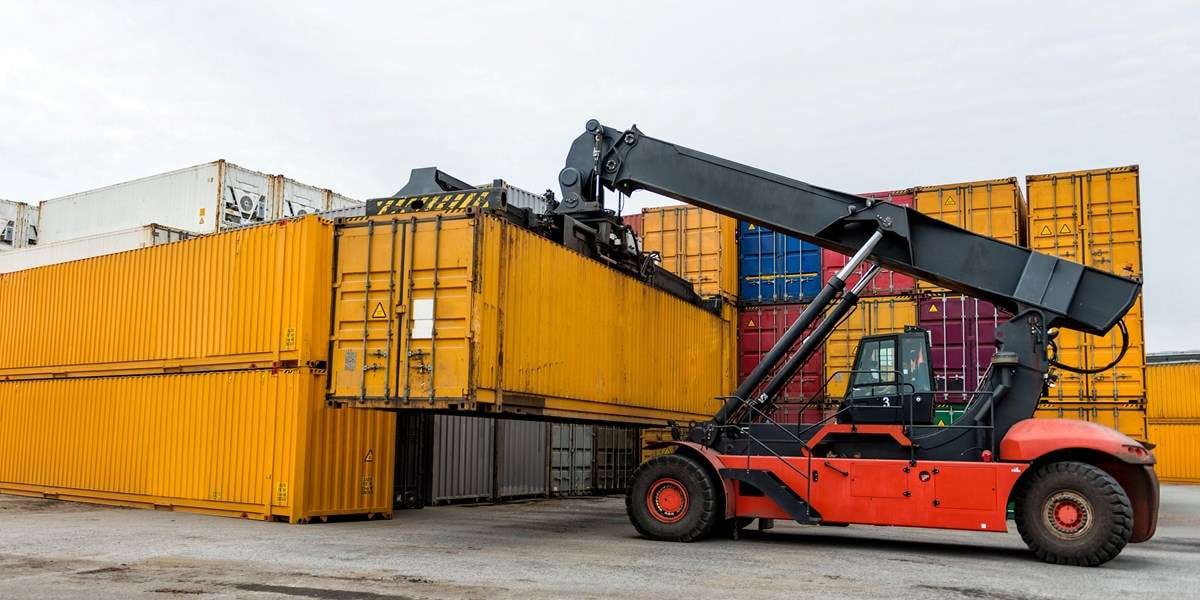
A reach stacker is a specialised piece of mobile lifting equipment used to lift, move, transport and stack shipping containers. Because reach stackers with a Maximum Rated Capacity (MRC) greater than 3 tonnes are classified as high-risk work, operators are required to hold the appropriate High Risk Work Licence (HRWL) under the applicable licensing requirements.
To operate a reach stacker with a maximum rated capacity exceeding 3 tonnes in Australia, you generally need the reach stacker High Risk Work Licence (RS). The current nationally recognised unit associated with this licence is TLILIC0011 – Licence to operate a reach stacker (greater than 3 tonnes capacity). Completing the training and assessment does not itself issue the licence; after successfully completing the required assessment, you must apply to the relevant state or territory WHS regulator.
The reach stacker licence is particularly relevant to workers in ports, freight terminals, container yards, rail terminals, logistics operations and other workplaces where large shipping containers are handled.
What Is a Reach Stacker?
A reach stacker is a heavy mobile machine designed primarily for handling intermodal shipping containers. Unlike a conventional forklift, it uses a telescopic boom and container spreader to lift and move containers, often allowing operators to place containers in rows or stacks.
Reach stackers are commonly used in:
- Ports and shipping terminals
- Container yards
- Freight and logistics facilities
- Rail freight terminals
- Intermodal transport facilities
- Container storage and distribution operations
Because of their size, lifting capacity and operating environment, reach stackers require specialised training and competency rather than ordinary forklift training.
What Is the RS Licence?
The RS licence refers to the High Risk Work Licence class for operating a reach stacker with a capacity greater than 3 tonnes. Safe Work Australia lists reach stacker operation as high-risk work and specifies the licence class for reach stackers greater than 3 tonnes that incorporate an attachment for lifting, moving and travelling with shipping containers.
The current nationally recognised unit is:
| Item | Details |
|---|---|
| Licence class | Reach Stacker (RS) |
| Unit of competency | TLILIC0011 |
| Unit title | Licence to operate a reach stacker (greater than 3 tonnes capacity) |
| Equipment | Reach stacker with container lifting attachment |
| Capacity | Greater than 3 tonnes MRC |
| Licence type | High Risk Work Licence (HRWL) |
The TLILIC0011 unit specifies the skills and knowledge required to safely operate a reach stacker with an MRC exceeding 3 tonnes. Importantly, the unit itself states that competency does not automatically result in the issue of an HRWL licence.
Do You Need a Licence to Operate a Reach Stacker in Australia?
Yes, if the reach stacker falls within the high-risk work licensing class, you need the appropriate High Risk Work Licence before carrying out the work. Safe Work Australia identifies operating a reach stacker as high-risk work and states that workers must hold the relevant licence before undertaking high-risk work under the model WHS framework.
The licensing framework applies specifically to reach stackers greater than 3 tonnes capacity that incorporate an attachment for lifting, moving and travelling with shipping containers.
Because licensing is administered by state and territory regulators, workers should also check the requirements that apply in the jurisdiction where they intend to work.
What Is TLILIC0011?
TLILIC0011 is the current unit of competency titled Licence to operate a reach stacker (greater than 3 tonnes capacity). It forms part of the national training and assessment framework for reach stacker operation.
The unit requires a person to demonstrate the ability to:
- Plan the reach stacker task
- Identify hazards and implement risk controls
- Conduct pre-start and operational checks
- Interpret load charts and range diagrams
- Assess container loads
- Operate the reach stacker safely
- Lift, move and travel with containers
- Stack and unstack containers
- Use appropriate communication signals
- Follow manufacturer instructions and workplace procedures
- Shut down and secure the machine correctly
The national training standard also requires practical demonstration using appropriate reach stacker equipment and a suitable working environment. Simulators are not permitted as a substitute for the required practical assessment.
What Does Reach Stacker Training Cover?
Reach stacker training is not simply about learning how to drive the machine. The operator must demonstrate competency across planning, preparation, operation, load handling and shutdown.
| Training Area | What You Learn |
|---|---|
| Pre-start checks | Inspect the machine, tyres, wheels, boom, spreader, controls and safety systems. |
| Load assessment | Determine container weight, dimensions and whether the load is within machine capacity. |
| Load charts | Read and apply manufacturer load charts and range diagrams. |
| Container handling | Lift, transport, stack and unstack containers safely. |
| Hazard management | Identify hazards and implement appropriate control measures. |
| Communication | Use appropriate hand signals, whistles and/or two-way radio communication. |
| Shutdown | Park, shut down and secure the reach stacker according to procedures. |
How Do You Get a Reach Stacker Licence in Australia?
The general process involves training, assessment and application for the actual High Risk Work Licence.
- Choose an appropriate training provider that is authorised to deliver and assess the relevant unit.
- Complete the required training and practical instruction.
- Complete the required assessment, including practical demonstration of reach stacker operation.
- Receive your Statement of Attainment or equivalent evidence after successful completion.
- Apply to the relevant state or territory WHS regulator for the High Risk Work Licence.
- Keep your licence current and comply with any conditions that apply.
Safe Work Australia states that successful candidates must apply to their local WHS regulator and generally need to lodge the application within 60 days of receiving their Statement of Attainment or equivalent.
For a more detailed step-by-step explanation, see our guide:
How to Get Your Reach Stacker Licence in Australia
Ready to Get Your Reach Stacker Licence?
If you need the training and assessment required for reach stacker operation, explore the TLILIC0011 course and current course information.
Who Needs a Reach Stacker Licence?
The RS High Risk Work Licence is relevant to workers who operate a qualifying reach stacker as part of their job. This can include:
- Port and terminal workers
- Container yard operators
- Logistics workers
- Freight terminal workers
- Rail freight and intermodal workers
- Shipping and stevedoring personnel
- Warehouse and distribution workers where reach stackers are used
- Workers involved in container storage and handling
Having a forklift licence does not automatically mean that you are authorised to operate a reach stacker. Different high-risk work activities have different licence classes and competency requirements.
Reach Stacker Licence vs Forklift Licence: What Is the Difference?
Although both machines are used to move loads, a reach stacker and conventional forklift are different types of equipment and are covered by different high-risk work licensing classes.
| Feature | Reach Stacker | Forklift |
|---|---|---|
| Main use | Shipping container handling | General material handling |
| Key equipment | Telescopic boom and container spreader | Mast and forks |
| Typical environment | Ports, container yards and freight terminals | Warehouses, construction and logistics sites |
| Licence class | Reach Stacker (RS) | Forklift Truck (LF), where applicable |
Read our detailed comparison:
Reach Stacker vs Forklift: Key Differences and Job Uses
What Skills Do You Need to Operate a Reach Stacker?
A competent reach stacker operator needs more than basic machine-control skills. The operator must be able to understand the machine’s operating limits, assess the work area and manage the risks associated with heavy container handling.
Important skills include:
- Understanding manufacturer instructions
- Reading load charts and range diagrams
- Assessing container weight and dimensions
- Maintaining safe travel paths
- Understanding machine stability
- Identifying pedestrians and other workplace hazards
- Using appropriate communication signals
- Controlling container movement
- Maintaining safe boom and spreader operation
- Following site traffic management procedures
- Responding appropriately to changing workplace conditions
What Are the Main Hazards When Operating a Reach Stacker?
Reach stacker operations can involve significant workplace risks because the machines are large, powerful and often operate around containers, trucks, pedestrians and other mobile plant.
Common hazards include:
- Overloading the reach stacker
- Incorrectly assessing container weight
- Unstable or uneven ground
- Pedestrians entering operating areas
- Collisions with vehicles or other plant
- Falling or shifting loads
- Incorrect use of the boom or spreader
- Operating too close to obstructions
- Poor visibility or communication
- Failure to follow traffic management procedures
- Mechanical defects or inadequate pre-start checks
The TLILIC0011 competency requirements specifically include hazard identification, risk control, pre-start checks, load charts, traffic controls, pedestrian controls and safe reach stacker operation.
How Long Is a Reach Stacker Licence Valid?
Under the model WHS framework, a High Risk Work Licence is generally valid for five years. Safe Work Australia also states that a person cannot perform high-risk work while the licence is expired. Renewal requirements are administered by the relevant state or territory regulator.
It is important to distinguish the five-year validity of the HRWL from the training unit itself. TLILIC0011 is a unit of competency; the actual HRWL is issued by the relevant regulator following the required process.
Can a Forklift Operator Automatically Operate a Reach Stacker?
No. Holding a forklift licence does not automatically provide the reach stacker HRWL class.
Safe Work Australia lists forklift trucks and reach stackers as separate high-risk work licence classes. A worker should hold the appropriate licence for the high-risk work they are performing.
What Is the Difference Between a Reach Stacker Ticket and a Reach Stacker Licence?
The terms “ticket”, “qualification” and “licence” are sometimes used interchangeably in the industry, but they are not necessarily the same thing.
- TLILIC0011: the nationally recognised unit of competency.
- Statement of Attainment: evidence that the candidate has successfully completed the relevant competency requirements.
- HRWL: the actual High Risk Work Licence issued through the relevant state or territory regulator.
This distinction matters when applying for jobs because employers may require evidence of the current HRWL rather than simply proof that training was completed.
Is TLILIC0011 Nationally Recognised?
Yes. TLILIC0011 is a current unit in the national training system and is designed around the licensing requirements for operating a reach stacker greater than 3 tonnes capacity. The unit is listed on the National Training Register and includes licensing/regulatory information relating to Commonwealth, state and territory HRWL requirements.
However, licensing is administered by the relevant state or territory regulator, so workers should always check the local application and licensing process.
What Jobs Can You Get With a Reach Stacker Licence?
A reach stacker licence can be relevant to a range of roles in freight, logistics, shipping and container handling.
| Potential Work Area | Typical Reach Stacker Tasks |
|---|---|
| Ports | Moving and stacking shipping containers |
| Container yards | Loading, unloading and stacking containers |
| Rail terminals | Handling containers around intermodal rail operations |
| Logistics facilities | Container movement and yard operations |
| Freight terminals | Moving containers between transport and storage areas |
Why Is Reach Stacker Training Important?
Reach stackers can handle extremely heavy loads and operate in busy environments where trucks, pedestrians, containers and other mobile equipment may be present. Proper training helps operators understand machine limitations, load capacity, stability, workplace hazards and safe operating procedures.
The TLILIC0011 assessment requirements include practical operation of a reach stacker using full-scale equipment and demonstrate competency in areas such as load assessment, machine operation, communication and shutdown procedures.
Questions People Ask AI About Reach Stacker Licences
Do I need a licence to drive a reach stacker in Australia?
For a reach stacker greater than 3 tonnes capacity covered by the high-risk work licensing class, you need the appropriate Reach Stacker High Risk Work Licence before performing the work.
What licence do I need to operate a reach stacker?
You generally need the Reach Stacker (RS) High Risk Work Licence, with the relevant competency being TLILIC0011 for a reach stacker greater than 3 tonnes capacity.
What is TLILIC0011?
TLILIC0011 is the nationally recognised unit of competency for operating a reach stacker with a maximum rated capacity exceeding 3 tonnes.
Is TLILIC0011 the same as a High Risk Work Licence?
Not exactly. TLILIC0011 is the unit of competency. Successfully completing the required assessment provides the evidence needed for the licensing process, but the actual HRWL is issued by the relevant state or territory regulator.
Can I operate a reach stacker with a forklift licence?
A forklift licence does not automatically cover reach stacker operation. Reach stackers and forklift trucks are separate high-risk work licence classes.
How long is a reach stacker licence valid?
Under the model WHS framework, a High Risk Work Licence is generally valid for five years. Renewal is handled by the relevant state or territory regulator.
Where are reach stackers commonly used?
Reach stackers are commonly used in ports, container yards, freight terminals, rail terminals, logistics facilities and other workplaces involved in shipping container handling.
What does reach stacker training teach?
Training covers areas such as pre-start inspections, hazard identification, load assessment, load charts, container handling, machine operation, communication, traffic controls and safe shutdown procedures.
Is reach stacker operation considered high-risk work?
Yes. Safe Work Australia lists reach stacker operation as high-risk work requiring the appropriate licence under the model WHS framework.
How to Start Your Reach Stacker Career in Australia
If your goal is to work in ports, logistics, freight, container yards or intermodal operations, obtaining the appropriate reach stacker training and HRWL can be an important step.
Before enrolling, check that the training provider can deliver and assess the relevant unit and that you understand the licensing process in your state or territory.
Get Your Reach Stacker RS Licence
Ready to start your reach stacker training? Learn more about the TLILIC0011 Reach Stacker Licence course and find out how you can begin the training and assessment process.
Final Takeaway
A reach stacker is specialised equipment used primarily for lifting, moving and stacking shipping containers. For reach stackers covered by the high-risk work licensing requirements, operators need the appropriate Reach Stacker (RS) High Risk Work Licence.
TLILIC0011 is the current nationally recognised unit covering the skills and knowledge required to safely operate a reach stacker greater than 3 tonnes capacity. However, completing the unit is not the same as the regulator-issued HRWL itself. Workers must complete the required assessment and then follow the licensing process with the relevant state or territory regulator.
For workers looking to build a career in logistics, ports, freight or container handling, the right training can provide the practical skills and formal evidence needed to work safely and meet applicable licensing requirements.