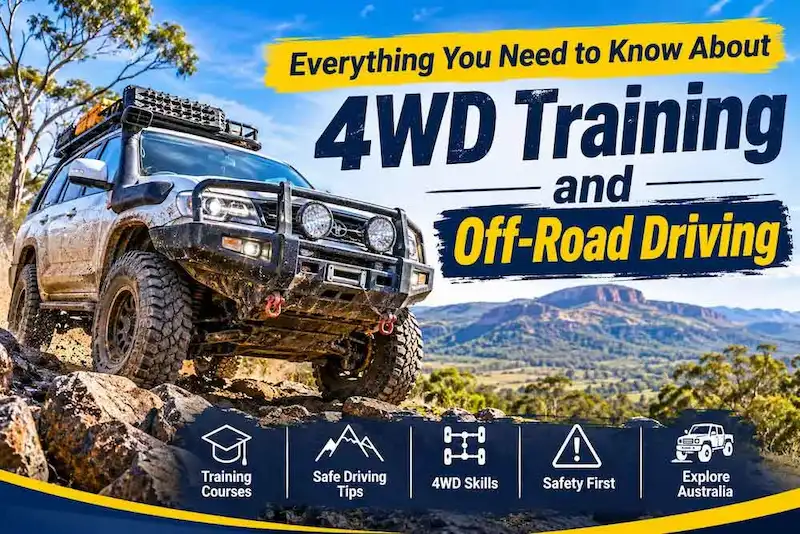
4WD training teaches drivers how to operate four-wheel-drive vehicles safely and confidently across challenging terrain. Whether you are a beginner, a new 4WD owner, an outdoor enthusiast or someone who drives in remote areas for work, understanding off-road driving techniques, vehicle capabilities and recovery procedures is essential.
Quick Answer: What Is 4WD Training?
4WD training is practical instruction that teaches drivers how to operate and manage four-wheel-drive vehicles safely in off-road and challenging environments. It can cover vehicle controls, high-range and low-range driving, terrain assessment, hill driving, sand and mud techniques, vehicle recovery, navigation and environmental awareness.
The purpose is to help drivers understand their vehicle, recognise off-road hazards and make informed decisions before attempting difficult terrain.
Learn to Drive a 4WD With Greater Confidence
Develop practical off-road driving knowledge, understand vehicle capabilities and learn how to manage challenging terrain.
What Is a 4WD Vehicle?
A four-wheel-drive vehicle, commonly called a 4WD or 4×4, is designed to deliver engine power to all four wheels through its drivetrain system. This can improve traction when driving across loose, slippery or uneven surfaces.
Unlike a conventional two-wheel-drive vehicle, which delivers power to either the front or rear wheels, a four-wheel-drive system can distribute driving force across both axles.
This capability can make 4WD vehicles suitable for a range of environments, including:
- Unsealed rural roads.
- Gravel and dirt tracks.
- Beaches and sandy environments where vehicle access is permitted.
- Off-road trails.
- Remote agricultural properties.
- Mining and industrial access roads.
- Steep and uneven terrain.
- Some muddy and slippery surfaces.
However, having a 4WD does not automatically make a vehicle safe in every off-road situation. Ground clearance, tyres, vehicle weight, drivetrain configuration, driver experience and terrain conditions all influence performance.
How Does a Four-Wheel-Drive System Work?
Understanding how a 4WD system works is one of the first steps in learning off-road driving. Drivers need to understand the different drivetrain settings and when they may be appropriate.
Two-Wheel Drive (2WD)
In two-wheel-drive mode, engine power is delivered to either the front or rear wheels, depending on the vehicle design.
Many part-time 4WD vehicles use 2WD for normal sealed-road driving because it can reduce mechanical stress and fuel consumption compared with engaging four-wheel drive unnecessarily.
Four-Wheel Drive High Range (4H)
High-range four-wheel drive distributes driving power across all four wheels while maintaining gearing suitable for higher-speed driving within the vehicle manufacturer’s limits.
It is commonly used on loose gravel, dirt roads and some slippery surfaces where additional traction is useful.
Drivers must understand whether their vehicle has a part-time or full-time four-wheel-drive system. Part-time 4WD systems generally should not be used in high-range mode on high-traction sealed surfaces unless the manufacturer specifically permits it.
Four-Wheel Drive Low Range (4L)
Low-range four-wheel drive provides lower gearing and greater torque at the wheels. It is useful for situations where controlled movement and additional traction are important.
Common applications include:
- Slow-speed rocky terrain.
- Steep hill climbs.
- Controlled descents.
- Some difficult muddy tracks.
- Slow-speed obstacle navigation.
- Specific vehicle recovery situations where appropriate.
Low range is not designed for normal high-speed driving. Drivers should follow the vehicle manufacturer’s instructions when selecting 4L and engaging or disengaging the transfer case.
Differential Locks and Traction Control
Some 4WD vehicles include differential locks and electronic traction control systems.
A differential allows wheels to rotate at different speeds when travelling through corners. However, when traction is lost, some differential configurations can limit the amount of useful driving force delivered to a wheel with grip.
Differential locks help reduce this problem by restricting the difference in rotational speed between connected wheels or axles, depending on the system.
Electronic traction control systems can also help manage wheelspin by using vehicle braking and engine management.
Drivers should understand their vehicle’s systems before attempting challenging terrain because incorrect use of differential locks can affect steering and vehicle handling.
Remember:
Not every 4WD has the same drivetrain configuration. Always consult the vehicle owner’s manual to understand its high-range, low-range, differential lock and traction control systems.
4WD Training: Why Is It Important for Beginners?
Many new 4WD owners assume that driving an off-road vehicle is simply a matter of selecting four-wheel drive and pressing the accelerator. In reality, safe off-road driving requires an understanding of vehicle control, terrain conditions and risk management.
Structured 4WD driver training can help beginners develop the knowledge and practical skills needed to handle different driving environments.
Training can help drivers learn how to:
- Understand the features and capabilities of their 4WD vehicle.
- Select appropriate driving modes and gears.
- Assess terrain before attempting an obstacle.
- Maintain better control on steep, uneven and slippery surfaces.
- Recognise potential vehicle rollover and loss-of-control hazards.
- Understand basic vehicle recovery procedures.
- Use suitable recovery equipment safely.
- Plan trips through remote or unfamiliar locations.
- Reduce unnecessary environmental damage.
Learning these skills in a structured training environment can improve confidence while encouraging safer and more responsible off-road driving habits.

Different Types of Off-Road Terrain and How to Drive on Them
One of the most important parts of 4WD training is understanding how different surfaces affect vehicle traction, steering, braking and stability.
There is no single driving technique suitable for every off-road environment. Drivers must assess the conditions and adapt their approach.
1. Gravel and Dirt Roads
Gravel and dirt roads are common throughout regional Australia. Although they may appear relatively easy to drive on, loose surfaces can reduce tyre grip and increase braking distances.
Important driving considerations include:
- Reduce speed according to visibility and road conditions.
- Maintain a safe following distance.
- Avoid sudden steering and braking inputs.
- Watch for loose gravel, potholes and corrugations.
- Be prepared for dust that can reduce visibility.
- Allow additional space when passing other vehicles.
For more information about Australian dirt roads and off-road conditions, read our detailed guide:
Related guide: Dirt Roads and Dust
Understand the challenges associated with Australian unsealed roads and the importance of appropriate 4WD driving skills.
Read: Dirt Roads and Dust – A Deep Dive into 4WD Training Down Under →
2. Driving on Sand
Sand can be challenging because tyres may lose traction or sink into soft surfaces. Beaches, dunes and sandy tracks require careful assessment before driving.
Important considerations include:
- Check whether vehicle access is permitted.
- Assess the firmness and depth of the sand.
- Understand the manufacturer’s tyre pressure recommendations and any appropriate adjustments for the conditions.
- Avoid abrupt acceleration, braking and steering.
- Maintain controlled momentum where appropriate.
- Watch for soft patches and changes in surface conditions.
- Consider tide conditions when travelling in permitted beach-driving areas.
Lower tyre pressures can sometimes improve flotation and traction in sand, but the correct pressure depends on the vehicle, tyres, load and conditions. Drivers should use an appropriate gauge and reinflate tyres before returning to normal road speeds.
3. Driving Through Mud
Muddy surfaces can cause a rapid loss of traction, especially when the mud is deep or contains hidden obstacles.
Drivers should assess the depth, consistency and likely condition of the track before attempting to cross it.
Important techniques include:
- Inspect the route before entering where it is safe to do so.
- Look for alternative routes if the mud is too deep or dangerous.
- Select an appropriate driving mode.
- Avoid unnecessary wheelspin.
- Maintain controlled movement rather than sudden acceleration.
- Be aware of hidden rocks, holes and other obstacles.
- Never attempt a crossing when the vehicle’s capability is uncertain.
4. Rocky and Uneven Terrain
Rocky tracks require careful wheel placement, suitable ground clearance and controlled vehicle movement.
Drivers may need to use low-range gearing to maintain control at slow speeds.
Key considerations include:
- Assess the obstacle before driving over it.
- Consider ground clearance and underbody protection.
- Avoid unnecessary wheelspin.
- Choose a suitable line through the obstacle.
- Use a spotter where appropriate.
- Watch for damage to tyres, suspension and underbody components.
5. Steep Hill Climbs
Steep uphill driving requires appropriate gear selection, traction management and a clear understanding of the vehicle’s capabilities.
Before attempting a climb, assess the slope, surface, available traction and whether there is a safe route forward.
Drivers should avoid attempting climbs that exceed their experience or vehicle capability. A suitable alternative route may be the safest option.
6. Steep Descents
Descending steep terrain requires careful control because excessive speed or inappropriate braking can result in loss of vehicle control.
Low-range gearing and engine braking may help maintain a controlled descent, depending on the vehicle and conditions.
Drivers should:
- Assess the descent before entering.
- Select an appropriate gear before descending.
- Use controlled speed and smooth inputs.
- Avoid sudden steering or braking.
- Follow vehicle-specific hill descent instructions.
7. Water Crossings
Water crossings are among the most hazardous off-road driving activities. Water depth, current strength, hidden obstacles and changes in the riverbed can make a crossing dangerous.
Before attempting any water crossing:
- Check whether the crossing is necessary and permitted.
- Assess water depth and current conditions from a safe position.
- Never enter floodwater or flowing water when the conditions are uncertain.
- Check the manufacturer’s wading-depth limits.
- Consider the position of the air intake and other vulnerable components.
- Understand the potential effects of water entering the engine or electrical systems.
- Choose an alternative route if the crossing cannot be assessed safely.
Water Crossing Safety Warning
Never assume a water crossing is safe because another vehicle has crossed it. Water depth and current can change rapidly, and floodwater can be dangerous even for four-wheel-drive vehicles.
Essential 4WD Driving Techniques Every Beginner Should Understand
Safe off-road driving involves more than knowing how to select four-wheel drive. Drivers need to develop an understanding of vehicle movement, traction and terrain conditions.
Vehicle Familiarisation
Learn the location and function of 4WD controls, transfer case settings, traction systems and vehicle safety features before entering difficult terrain.
Correct Gear Selection
Understand when high-range and low-range gearing may be appropriate and follow the manufacturer’s instructions.
Controlled Acceleration
Use smooth acceleration to reduce unnecessary wheelspin and help maintain traction on loose surfaces.
Terrain Assessment
Evaluate obstacles, slopes, surface conditions, vehicle clearance and potential hazards before proceeding.
Vehicle Positioning
Choose a suitable driving line and consider wheel placement when travelling across uneven terrain.
Safe Braking
Understand how loose surfaces affect stopping distances and avoid abrupt braking where it could compromise control.
Knowing When to Stop
Recognise when terrain exceeds your experience or vehicle capability. Turning around or choosing another route is often the safest decision.
4WD Vehicle Recovery: What Beginners Need to Know
Vehicle recovery is an important part of off-road driving because a 4WD can become stuck in sand, mud, snow or other challenging environments.
Recovery operations can involve significant forces and serious hazards. Incorrect use of recovery equipment can result in equipment failure, vehicle damage and severe injuries.
Before attempting a recovery, drivers should assess the situation, identify the hazards and select an appropriate recovery method.
Common 4WD Recovery Equipment
| Equipment | Purpose |
|---|---|
| Recovery tracks | Provide additional traction when wheels are stuck in sand or mud. |
| Winch | Can assist in controlled vehicle recovery when correctly rated and anchored. |
| Recovery straps | Designed for specific recovery applications when used with compatible equipment. |
| Rated shackles | Connect compatible recovery components within their rated working limits. |
| Tyre pressure gauge | Helps monitor tyre pressures when adjusting for different terrain. |
| Air compressor | Allows tyres to be reinflated before returning to normal road conditions. |
| Shovel | Can assist with clearing loose material around tyres. |
Important Vehicle Recovery Safety Rules
- Inspect recovery equipment before use.
- Use only equipment suitable for the intended recovery and rated for the loads involved.
- Use designated recovery points, not ordinary tie-down points or unsuitable vehicle components.
- Follow manufacturer instructions for winches, straps and connectors.
- Establish a controlled exclusion area around the recovery operation.
- Keep people away from loaded recovery lines and potential failure paths.
- Never stand in the path of a tensioned strap or cable.
- Avoid shock loading and uncontrolled snatch recoveries.
- Seek experienced assistance if the recovery is beyond your knowledge or equipment capability.
Recovery Safety Reminder
Recovery equipment can store substantial energy under tension. A failed strap, cable or connection can cause catastrophic injury. Training, correct equipment selection and safe recovery procedures are essential.
What Safety Equipment Should You Carry in a 4WD?
Preparation is essential when travelling off-road, particularly in remote parts of Australia where assistance may be limited.
The equipment required depends on the location, vehicle, weather, trip duration and potential hazards.
| Equipment category | Examples |
|---|---|
| Emergency equipment | First aid kit, emergency communication device and emergency supplies. |
| Recovery equipment | Recovery tracks, rated recovery equipment and suitable tools. |
| Tyre equipment | Tyre pressure gauge, air compressor and spare tyre. |
| Navigation | GPS, maps and appropriate backup navigation tools. |
| Communication | UHF radio, satellite communicator or suitable emergency beacon. |
| Fire safety | Suitable vehicle fire extinguisher and other appropriate fire safety equipment. |
| Personal protection | Suitable clothing, footwear, gloves and eye protection. |
| Supplies | Water, food, spare fuel where appropriate and emergency provisions. |
Drivers should also understand how to use the equipment they carry. Having recovery gear, communication devices or a fire extinguisher does not guarantee safety without suitable knowledge and preparation.
For additional information about workplace and vehicle fire safety, explore our Fire Extinguisher Training →.
4WD Trip Planning and Navigation in Australia
Off-road driving often takes place in remote areas where mobile phone coverage, fuel availability and access to emergency assistance may be limited.
Good trip planning helps drivers identify potential hazards before they leave.
Before Starting Your 4WD Trip
- Research the route and check whether vehicle access is permitted.
- Check weather forecasts and road conditions.
- Identify fuel, water and supply locations.
- Inspect the vehicle, tyres, brakes and essential systems.
- Carry appropriate recovery and emergency equipment.
- Check local track closures and restrictions.
- Plan alternative routes where possible.
- Tell someone about your itinerary and expected return time.
- Carry suitable communication equipment for the location.
- Allow sufficient time to complete the trip safely.
Navigation Skills
Drivers should understand how to use navigation tools rather than relying entirely on mobile phone applications.
Depending on the location and trip, useful navigation resources may include:
- GPS navigation devices.
- Offline digital maps.
- Paper topographic maps.
- Compass and basic navigation knowledge.
- Local road and track information.
- Satellite communication systems for remote travel.
Environmental Responsibility and Responsible 4WD Driving
Responsible off-road driving involves protecting the natural environment as well as maintaining vehicle and passenger safety.
Vehicles can damage vegetation, disturb wildlife, contribute to erosion and affect sensitive ecosystems when drivers ignore access restrictions or leave designated tracks.
Responsible 4WD drivers should:
- Stay on authorised tracks and roads.
- Follow local access restrictions and signage.
- Avoid driving through environmentally sensitive areas.
- Respect wildlife and natural habitats.
- Take rubbish away rather than leaving it behind.
- Avoid unnecessary wheelspin and track damage.
- Respect private property and local communities.
- Follow fire restrictions and camping regulations.
Environmental awareness is an important part of professional and recreational 4WD driving, particularly in areas vulnerable to erosion and vegetation damage.
Common 4WD Mistakes Beginners Should Avoid
Many off-road driving incidents occur because drivers underestimate terrain hazards or overestimate their vehicle’s capabilities.
| Common mistake | Why it is dangerous | Better approach |
|---|---|---|
| Driving too fast | Reduces control and increases stopping distances. | Adjust speed to conditions. |
| Incorrect gear selection | Can compromise control and drivetrain performance. | Understand high-range and low-range operation. |
| Ignoring terrain conditions | Can lead to becoming stuck or losing control. | Assess the route before attempting obstacles. |
| Unsafe recovery methods | Can cause equipment failure and serious injury. | Use appropriate equipment and trained procedures. |
| Poor trip preparation | Increases the consequences of breakdowns and emergencies. | Plan routes and carry emergency supplies. |
| Ignoring vehicle limitations | Can result in mechanical damage or dangerous situations. | Understand ground clearance, wading limits and vehicle capability. |
| Driving beyond experience | Can expose drivers and passengers to unnecessary risks. | Build skills progressively through suitable training. |
How to Choose the Right 4WD Training Course
Not every 4WD training course is designed for the same type of driver. Before enrolling, consider your current experience, vehicle type, intended driving environment and learning objectives.
1. Consider Your Current Experience
Beginners should look for a course that introduces fundamental vehicle controls, four-wheel-drive systems, terrain assessment and basic off-road safety.
More experienced drivers may want to develop additional knowledge about recovery procedures, difficult terrain and remote-area driving.
2. Check the Training Content
Before enrolling, check whether the course covers skills relevant to your intended driving activities.
Useful training topics may include:
- Vehicle familiarisation.
- High-range and low-range driving.
- Gear selection and vehicle control.
- Gravel and dirt road driving.
- Sand and muddy terrain.
- Steep hill ascents and descents.
- Terrain assessment and obstacle navigation.
- Basic vehicle recovery techniques.
- Use of recovery equipment.
- Trip planning and navigation.
- Environmental awareness.
3. Look for Practical, Hands-On Training
Reading about 4WD driving is useful, but practical experience is important. Consider training that provides opportunities to practise techniques under appropriate supervision.
Hands-on learning can help drivers understand how their vehicle responds to different surfaces and conditions while receiving feedback from instructors.
4. Consider Your Vehicle Type
Different vehicles have different drivetrain configurations, transmission systems, ground clearance, traction features and recovery points.
Check whether the course is appropriate for your vehicle and whether the techniques can be applied to its particular systems.
5. Consider Where You Plan to Drive
Someone who regularly drives on unsealed rural roads may have different training needs from someone who travels through sand, mud or remote off-road tracks.
Choose training that reflects the environments and hazards you are most likely to encounter.
6. Check the Training Provider
Consider the experience and qualifications of the instructors, the suitability of the training environment and the safety procedures used during practical activities.
A reputable provider should explain the learning objectives, participant requirements, practical activities and relevant safety arrangements before enrolment.
Find the Right 4WD Training Course
Explore training options and discover how structured instruction can help you build your off-road driving knowledge and practical skills.
Who Can Benefit From 4WD Training?
Although 4WD training is particularly useful for beginners, it can benefit a wide range of drivers and workers.
New 4WD Owners
Learn how to use vehicle controls and understand off-road capabilities.
Outdoor Enthusiasts
Develop skills for recreational off-road trips and remote travel.
Agricultural Workers
Understand vehicle operation on rural properties and unsealed roads.
Mining Workers
Develop relevant driving knowledge for remote and challenging access roads.
Remote-Area Drivers
Improve preparation and awareness when travelling away from populated areas.
Businesses and Employers
Support workers who use four-wheel-drive vehicles for operational activities.
Can 4WD Training Improve Employment Opportunities in Australia?
Four-wheel-drive skills can be relevant in several Australian industries where workers need to travel across unsealed roads, remote properties and challenging terrain.
Depending on the role and employer requirements, 4WD knowledge may be useful in areas such as:
- Mining and resources.
- Agriculture and farming.
- Construction and infrastructure.
- Environmental management.
- Tourism and outdoor recreation.
- Land management and conservation.
- Remote-area maintenance and field services.
- Emergency and support services.
However, completing a 4WD training course does not automatically qualify someone for these jobs. Employers may require additional licences, qualifications, industry experience and role-specific competencies.
Explore 4WD-Related Career Opportunities
Find out how 4WD skills may support work in industries that involve remote travel and off-road vehicle operation.
How Can 4WD Training Improve Driving Confidence?
Structured training can help drivers become more familiar with their vehicle and develop a better understanding of off-road conditions.
Confidence should come from knowledge and practical experience rather than from overestimating a vehicle’s capabilities.
A well-prepared driver is more likely to:
- Assess terrain before attempting difficult obstacles.
- Recognise potential hazards.
- Understand vehicle limitations.
- Use suitable driving modes.
- Make better decisions during unexpected situations.
- Recognise when an obstacle should be avoided.
- Prepare for remote travel and emergencies.
Professional training can also help drivers identify unsafe habits and understand why certain driving techniques are appropriate in different environments.
Why Choose Professional 4WD Training?
Professional 4WD training gives beginners the opportunity to develop practical skills in a structured learning environment.
Instead of relying solely on online videos, informal advice or personal experience, participants can learn from instructors and practise relevant techniques under supervision.
A suitable training course can help drivers:
- Understand four-wheel-drive vehicle systems.
- Improve off-road driving knowledge.
- Recognise and assess terrain hazards.
- Understand recovery equipment and safety procedures.
- Develop better trip preparation habits.
- Improve their awareness of environmental responsibilities.
The right course should match the participant’s experience, intended driving activities and vehicle capabilities.
Frequently Asked Questions About 4WD Training
1. What is 4WD training?
4WD training is practical instruction that teaches drivers how to operate four-wheel-drive vehicles safely in off-road environments. It may cover vehicle controls, high-range and low-range driving, terrain assessment, recovery procedures and off-road safety.
2. Do beginners need 4WD training?
4WD training can be particularly beneficial for beginners because it helps them understand vehicle capabilities, driving techniques and off-road hazards before attempting challenging terrain.
3. What do you learn in a 4WD training course?
Training may cover vehicle familiarisation, high-range and low-range operation, gear selection, gravel and sand driving, mud, hill ascents and descents, terrain assessment, recovery equipment, navigation and environmental awareness.
4. What is the difference between 4WD and AWD?
Four-wheel drive generally refers to systems designed to deliver power to all four wheels, often with selectable high-range and low-range settings. All-wheel drive typically distributes power automatically or continuously across the wheels. However, drivetrain designs vary between manufacturers and models.
5. When should you use 4H and 4L?
4H is generally used for higher-speed driving on suitable loose or slippery surfaces, within manufacturer limits. 4L is designed for slower driving where additional torque and controlled movement are required, such as some steep or rocky terrain. Always follow the vehicle manufacturer’s instructions.
6. Can you drive a 4WD on normal sealed roads?
Yes. Many 4WD vehicles are designed for normal road use. However, drivers must understand whether their vehicle uses a part-time or full-time four-wheel-drive system and follow the manufacturer’s instructions regarding drivetrain settings.
7. What equipment do you need for off-road driving?
Depending on the trip, useful equipment may include recovery tracks, suitable recovery gear, a tyre pressure gauge, air compressor, spare tyre, first aid kit, navigation tools, emergency communication equipment and a suitable fire extinguisher.
8. Is 4WD training useful for mining workers?
4WD training can be useful for workers who need to operate vehicles on remote access roads and challenging terrain. Additional site-specific training, licences and employer requirements may also apply.
9. Can 4WD training help with vehicle recovery?
Suitable training can introduce drivers to recovery equipment, recovery hazards and basic recovery procedures. More advanced recovery activities require appropriate knowledge, equipment and experience.
10. Is 4WD training suitable for people who already own a four-wheel-drive vehicle?
Yes. Owning a 4WD does not automatically mean someone understands its drivetrain, recovery points, traction systems or off-road limitations. Training can help existing owners improve their knowledge and driving techniques.
11. What industries use 4WD vehicles in Australia?
Four-wheel-drive vehicles are used in industries including mining, agriculture, construction, environmental management, tourism, land management and remote-area services.
12. Does completing 4WD training guarantee employment?
No. 4WD training can support the development of relevant driving skills, but employment depends on the role, employer requirements, experience and any additional licences or qualifications required.
13. How can I choose the right 4WD training provider?
Compare course content, instructor experience, practical training opportunities, safety procedures, participant requirements and whether the course suits your intended driving activities.
Conclusion: Develop Your Off-Road Driving Skills With 4WD Training
1. What is 4WD training?
4WD training is practical instruction that teaches drivers how to operate four-wheel-drive vehicles safely in off-road environments. It may cover vehicle controls, high-range and low-range driving, terrain assessment, recovery procedures and off-road safety.
2. Do beginners need 4WD training?
4WD training can be particularly beneficial for beginners because it helps them understand vehicle capabilities, driving techniques and off-road hazards before attempting challenging terrain.
3. What do you learn in a 4WD training course?
Training may cover vehicle familiarisation, high-range and low-range operation, gear selection, gravel and sand driving, mud, hill ascents and descents, terrain assessment, recovery equipment, navigation and environmental awareness.
4. What is the difference between 4WD and AWD?
Four-wheel drive generally refers to systems designed to deliver power to all four wheels, often with selectable high-range and low-range settings. All-wheel drive typically distributes power automatically or continuously across the wheels. However, drivetrain designs vary between manufacturers and models.
5. When should you use 4H and 4L?
4H is generally used for higher-speed driving on suitable loose or slippery surfaces, within manufacturer limits. 4L is designed for slower driving where additional torque and controlled movement are required, such as some steep or rocky terrain. Always follow the vehicle manufacturer’s instructions.
6. Can you drive a 4WD on normal sealed roads?
Yes. Many 4WD vehicles are designed for normal road use. However, drivers must understand whether their vehicle uses a part-time or full-time four-wheel-drive system and follow the manufacturer’s instructions regarding drivetrain settings.
7. What equipment do you need for off-road driving?
Depending on the trip, useful equipment may include recovery tracks, suitable recovery gear, a tyre pressure gauge, air compressor, spare tyre, first aid kit, navigation tools, emergency communication equipment and a suitable fire extinguisher.
8. Is 4WD training useful for mining workers?
4WD training can be useful for workers who need to operate vehicles on remote access roads and challenging terrain. Additional site-specific training, licences and employer requirements may also apply.
9. Can 4WD training help with vehicle recovery?
Suitable training can introduce drivers to recovery equipment, recovery hazards and basic recovery procedures. More advanced recovery activities require appropriate knowledge, equipment and experience.
10. Is 4WD training suitable for people who already own a four-wheel-drive vehicle?
Yes. Owning a 4WD does not automatically mean someone understands its drivetrain, recovery points, traction systems or off-road limitations. Training can help existing owners improve their knowledge and driving techniques.
11. What industries use 4WD vehicles in Australia?
Four-wheel-drive vehicles are used in industries including mining, agriculture, construction, environmental management, tourism, land management and remote-area services.
12. Does completing 4WD training guarantee employment?
No. 4WD training can support the development of relevant driving skills, but employment depends on the role, employer requirements, experience and any additional licences or qualifications required.
13. How can I choose the right 4WD training provider?
Compare course content, instructor experience, practical training opportunities, safety procedures, participant requirements and whether the course suits your intended driving activities.
Understanding four-wheel-drive systems, off-road driving techniques, terrain assessment, vehicle recovery and safety procedures is essential for anyone who wants to drive confidently in challenging environments.
From gravel roads and sandy tracks to rocky terrain, steep slopes and remote locations, every off-road environment introduces different challenges that require appropriate knowledge and preparation.
Choosing the right 4WD training course can help beginners and experienced drivers develop practical skills, understand vehicle limitations and make safer decisions when driving off-road.
Whether you are a new 4WD owner, an outdoor enthusiast or someone who needs to operate a four-wheel-drive vehicle for work, structured training can be a valuable step towards becoming a more capable and responsible driver.
Ready to Develop Your 4WD Driving Skills?
Build your knowledge of four-wheel-drive systems, off-road driving techniques, vehicle recovery and safety. Explore 4WD training and take the next step towards more confident and responsible off-road driving.
Explore 4WD Training Courses →
Check course content, participant requirements and training arrangements before enrolling.