Haul trucks are essential pieces of heavy equipment across Australia’s mining, construction, quarrying and civil infrastructure industries. They transport large volumes of materials, including soil, rock, gravel and overburden, helping keep major projects moving efficiently.
Haul Truck Guide
Rigid vs Articulated Haul Trucks: What’s the Difference?
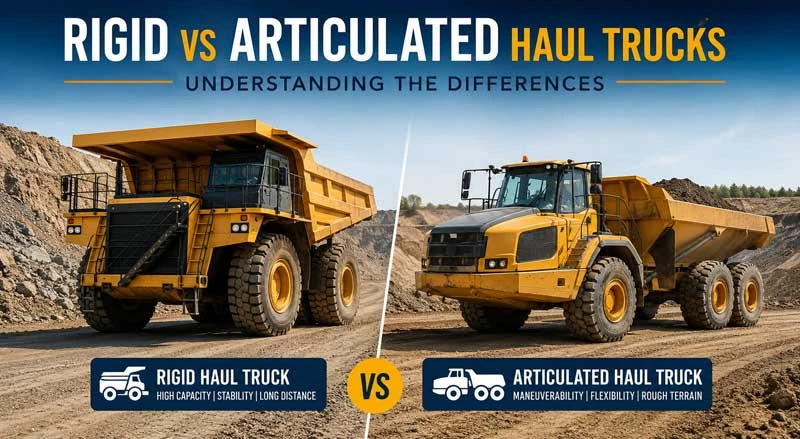
Rigid haul trucks are designed for high-capacity material transport on established haul roads, while articulated haul trucks offer greater manoeuvrability on uneven and challenging terrain. Each machine requires specific operating knowledge and appropriate training.
However, not all haul trucks are designed for the same operating conditions. Two common types are rigid haul trucks and articulated haul trucks. Although both are used to move heavy materials, they have different chassis designs, handling characteristics, payload capabilities and applications.
These differences also matter when choosing operator training. In Australia, two relevant nationally recognised units of competency are:
- RIIMPO338E – Conduct Rigid Haul Truck Operations
- RIIMPO337E – Conduct Articulated Haul Truck Operations
If you’re considering a career in mining or civil construction, understanding the difference between these machines can help you choose training that matches the equipment you intend to operate.
Quick answer: Rigid vs articulated haul trucks
- Rigid haul trucks: Use a single solid chassis and are commonly suited to large mining operations, quarries and established haul roads.
- Articulated haul trucks: Have a pivoting joint between the front and rear sections, making them suitable for uneven ground and challenging site conditions.
- Rigid haul truck training: RIIMPO338E.
- Articulated haul truck training: RIIMPO337E.
What Is a Rigid Haul Truck?
A rigid haul truck is a heavy-duty vehicle with a single, solid chassis connecting the cab and dump body. Unlike articulated models, its front and rear sections do not pivot independently through a central articulation joint.
Rigid haul trucks are engineered to transport substantial loads, particularly in large-scale mining and quarrying environments. Their design makes them well suited to established haul roads and sites where heavy material needs to be moved over repeated routes.
Where Are Rigid Haul Trucks Used?
Common applications include:
- Large open-cut mining operations.
- Quarries and mineral extraction sites.
- Major earthmoving and construction projects.
- Bulk material transport operations.
- Large resource and infrastructure developments.
In large mining operations, rigid haul trucks can move substantial quantities of material between loading and dumping areas. Their payload capacity and suitability for established haul routes make them an important part of many mine production systems.
Key characteristic
A rigid haul truck has a fixed chassis design and is commonly selected for high-volume hauling operations where the site has suitable roads and operating conditions.
What Is an Articulated Haul Truck?
An articulated haul truck is designed with a pivot joint connecting the front tractor section to the rear dump body. This joint allows the two sections to move relative to each other, giving the vehicle greater flexibility when travelling over uneven terrain.
This design makes articulated haul trucks useful on worksites where ground conditions are less predictable or where operators need to manoeuvre through tighter spaces. They are commonly used in civil construction, roadworks and off-road earthmoving projects.
Where Are Articulated Haul Trucks Used?
Typical applications include:
- Road construction and maintenance projects.
- Civil infrastructure developments.
- Earthmoving and site preparation.
- Forestry and land development operations.
- Pipeline construction projects.
- Off-road sites with uneven or challenging ground conditions.
Although articulated haul trucks generally have lower payload capacities than the largest rigid mining trucks, their flexibility and manoeuvrability make them valuable on projects where terrain and site access are important considerations.
Key characteristic
An articulated haul truck uses a pivoting connection between its front and rear sections to improve manoeuvrability over uneven ground and in demanding site conditions.
Rigid vs Articulated Haul Trucks: Key Differences
The main difference between rigid and articulated haul trucks is their chassis design. This affects how each machine handles, the conditions in which it is commonly used and the operating skills required from the driver.
| Feature | Rigid Haul Truck | Articulated Haul Truck |
|---|---|---|
| Chassis design | Single solid chassis | Two sections joined by a pivoting articulation joint |
| Typical applications | Large mining and quarrying operations | Civil construction and off-road earthmoving |
| Payload | Often designed for very high payloads | Generally lower than the largest rigid mining trucks |
| Manoeuvrability | Designed for established haul routes | Greater flexibility on uneven and restricted terrain |
| Common operating environment | Large mines and quarries | Construction sites and off-road projects |
| Relevant competency | RIIMPO338E | RIIMPO337E |
Neither machine is automatically the better option for every project. The right equipment depends on the site’s layout, ground conditions, material volumes, haul distance and the requirements of the operation.
RIIMPO338E – Conduct Rigid Haul Truck Operations
The RIIMPO338E Conduct Rigid Haul Truck Operations course is designed for people who need to develop the skills and knowledge required to operate rigid haul trucks safely in relevant resources and infrastructure environments.
Operating a large rigid haul truck involves more than steering and moving materials. Operators need to understand machine controls, workplace traffic rules, pre-operational checks, load handling and safe dumping procedures.
What Skills Does RIIMPO338E Cover?
Depending on the training and assessment program, relevant skills and knowledge include:
- Preparing for rigid haul truck operations.
- Completing pre-start and operational equipment checks.
- Identifying workplace hazards and applying risk controls.
- Operating the rigid haul truck according to site procedures.
- Travelling safely around loading and dumping areas.
- Loading, transporting and dumping materials.
- Monitoring machine performance and identifying faults.
- Completing shutdown and post-operational procedures.
The competency is relevant to workers seeking rigid haul truck operating roles in mining, quarrying and large-scale earthmoving environments. Training and assessment should be completed in accordance with the unit requirements and the equipment and conditions relevant to the program.
Build Your Operating Skills
Interested in Rigid Haul Truck Training?
Explore RIIMPO338E training information and take the next step towards developing the skills required for rigid haul truck operations.
RIIMPO337E – Conduct Articulated Haul Truck Operations
The RIIMPO337E Conduct Articulated Haul Truck Operations unit focuses on the skills and knowledge needed to operate articulated haul trucks in relevant work environments.
Because articulated trucks have a different chassis design and steering arrangement, operators must understand how the articulation joint affects vehicle movement and handling. This is particularly important when travelling over uneven ground, negotiating turns or working on sloping surfaces.
What Skills Does RIIMPO337E Cover?
Relevant training and assessment may cover:
- Preparing articulated haul trucks for operation.
- Conducting machine inspections and identifying defects.
- Understanding articulated steering and vehicle controls.
- Operating across different ground conditions.
- Manoeuvring safely in work areas and around obstacles.
- Loading, transporting and dumping materials.
- Following site traffic management and communication procedures.
- Completing shutdown and post-operational checks.
This competency is relevant to articulated haul truck operations in civil construction, infrastructure and off-road earthmoving environments. The exact equipment and workplace context used for training and assessment will depend on the training provider and program.
Which Haul Truck Qualification Should You Choose?
The right unit of competency depends on the type of haul truck you intend to operate and the requirements of the job. Before enrolling, consider the equipment used by your current or prospective employer and the competency required for the role.
Rigid Haul Truck
RIIMPO338E
Consider this unit if your intended work involves rigid haul trucks used in mining, quarrying or large-scale material transport.
Articulated Haul Truck
RIIMPO337E
Consider this unit if your intended work involves articulated haul trucks used in civil construction and off-road earthmoving.
Check the required competency with your employer or training provider.
Some employers operate different types of haul trucks across their projects. In those situations, additional competencies may be useful, provided they match the equipment and duties involved in the role.
If you’re considering a career in this field, our guide to rigid haul truck operator jobs in Australia explains more about the types of opportunities available and the skills employers may look for.
Why Is Professional Haul Truck Training Important?
Haul trucks are large, powerful machines that operate in environments where poor decisions can lead to serious injuries, equipment damage and project delays. Operators need practical skills, hazard awareness and a clear understanding of site-specific operating procedures.
Appropriate training and assessment help operators develop the ability to:
- Identify hazards before and during machine operation.
- Complete inspections and recognise equipment defects.
- Follow site traffic management and communication procedures.
- Operate equipment within its designed capabilities.
- Transport and dump materials using safe operating practices.
- Respond appropriately to abnormal operating conditions.
For employers, ensuring workers have the appropriate competency and site-specific instruction is an important part of managing workplace risks. A nationally recognised unit of competency can demonstrate that an individual has been assessed against the relevant training requirements, but employers must still verify the worker’s suitability for the particular machine and worksite.
For a closer look at the importance of RIIMPO338E and safe rigid haul truck operations, read The Crucial RIIMPO338E: Certifying Safe Rigid Haul Truck Operations in Australia.
Frequently Asked Questions About Rigid and Articulated Haul Trucks
1. What is the main difference between a rigid and articulated haul truck?
A rigid haul truck has a single solid chassis connecting the cab and dump body. An articulated haul truck has a pivoting joint between the front and rear sections, allowing greater flexibility over uneven terrain.
2. Which haul truck is commonly used in Australian mining?
Rigid haul trucks are widely used in large Australian mining operations, particularly where high-volume material transport takes place on established haul roads. The choice of equipment depends on the mine layout and operating requirements.
3. What is RIIMPO338E?
RIIMPO338E is the nationally recognised unit of competency titled Conduct Rigid Haul Truck Operations. It covers the skills and knowledge required for the relevant rigid haul truck operating activities.
4. What is RIIMPO337E?
RIIMPO337E is the unit of competency titled Conduct Articulated Haul Truck Operations. It relates to operating articulated haul trucks in relevant work environments.
5. Can a rigid haul truck operator drive an articulated haul truck?
Holding one unit of competency does not automatically demonstrate competency on every type of haul truck. Operators need appropriate training, assessment, familiarisation and workplace authorisation for the specific equipment they will use.
6. Which haul truck has a higher payload capacity?
Rigid haul trucks generally offer much higher payload capacities than typical articulated haul trucks, particularly in large mining applications. Actual capacity varies by manufacturer, model and machine configuration.
7. Are rigid haul trucks only used in mining?
No. Although they are strongly associated with large mining and quarrying operations, rigid haul trucks can also be used in other large-scale earthmoving and material transport applications where the equipment is suitable.
8. Is RIIMPO338E useful for people seeking mining jobs?
RIIMPO338E is relevant to roles involving rigid haul truck operations. It may support an application for suitable mining and quarrying positions, but employers can also require experience, site inductions, medical assessments and additional competencies.
9. Should I complete both RIIMPO338E and RIIMPO337E?
It depends on the equipment used in your intended workplace and the requirements of your employer. Completing both may be useful if your role involves both rigid and articulated haul trucks, but you should confirm the required competencies before enrolling.
Start Your Rigid Haul Truck Training with Safety Australia Training
1. What is the main difference between a rigid and articulated haul truck?
A rigid haul truck has a single solid chassis connecting the cab and dump body. An articulated haul truck has a pivoting joint between the front and rear sections, allowing greater flexibility over uneven terrain.
2. Which haul truck is commonly used in Australian mining?
Rigid haul trucks are widely used in large Australian mining operations, particularly where high-volume material transport takes place on established haul roads. The choice of equipment depends on the mine layout and operating requirements.
3. What is RIIMPO338E?
RIIMPO338E is the nationally recognised unit of competency titled Conduct Rigid Haul Truck Operations. It covers the skills and knowledge required for the relevant rigid haul truck operating activities.
4. What is RIIMPO337E?
RIIMPO337E is the unit of competency titled Conduct Articulated Haul Truck Operations. It relates to operating articulated haul trucks in relevant work environments.
5. Can a rigid haul truck operator drive an articulated haul truck?
Holding one unit of competency does not automatically demonstrate competency on every type of haul truck. Operators need appropriate training, assessment, familiarisation and workplace authorisation for the specific equipment they will use.
6. Which haul truck has a higher payload capacity?
Rigid haul trucks generally offer much higher payload capacities than typical articulated haul trucks, particularly in large mining applications. Actual capacity varies by manufacturer, model and machine configuration.
7. Are rigid haul trucks only used in mining?
No. Although they are strongly associated with large mining and quarrying operations, rigid haul trucks can also be used in other large-scale earthmoving and material transport applications where the equipment is suitable.
8. Is RIIMPO338E useful for people seeking mining jobs?
RIIMPO338E is relevant to roles involving rigid haul truck operations. It may support an application for suitable mining and quarrying positions, but employers can also require experience, site inductions, medical assessments and additional competencies.
9. Should I complete both RIIMPO338E and RIIMPO337E?
It depends on the equipment used in your intended workplace and the requirements of your employer. Completing both may be useful if your role involves both rigid and articulated haul trucks, but you should confirm the required competencies before enrolling.
Choosing between rigid and articulated haul truck training starts with understanding the equipment you want to operate. Rigid haul trucks are commonly associated with large mining and quarrying operations, while articulated models are often used in civil construction and challenging off-road environments.
If your career goal involves operating rigid haul trucks, RIIMPO338E is the relevant unit to investigate. Developing the right skills can help you prepare for the practical demands of heavy equipment operations across Australia’s resources and infrastructure industries.
Your Next Step
Explore RIIMPO338E Rigid Haul Truck Training
Find out more about the training pathway and develop the skills and knowledge required for rigid haul truck operations.