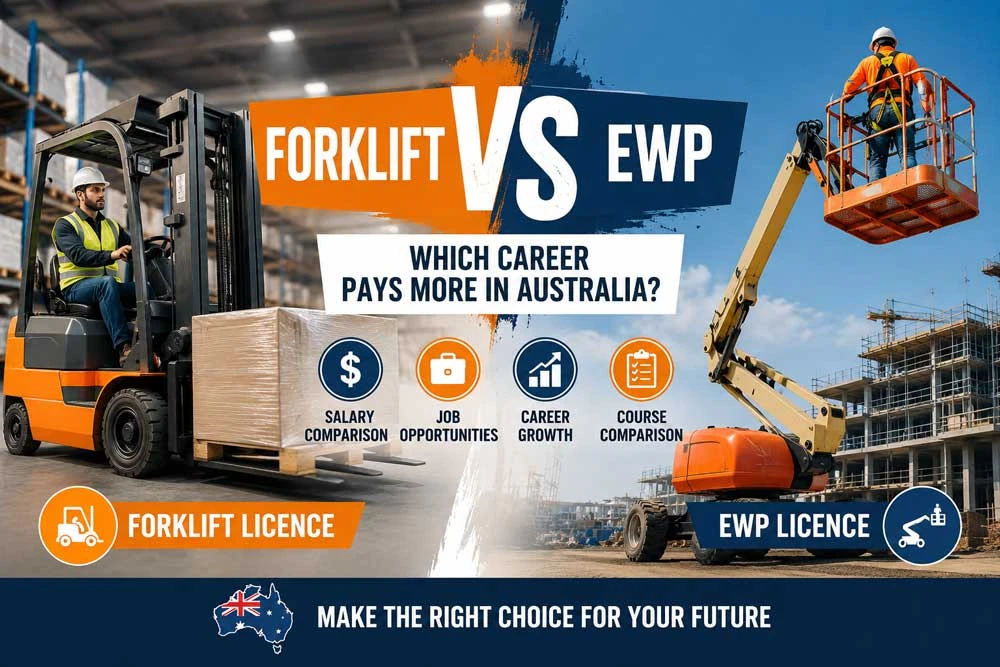
If you’re looking to start a career in Australia’s construction, logistics, or industrial sectors, two of the most popular high-risk qualifications are the Forklift (LF) Licence and the Boom-Type Elevating Work Platform (EWP) Licence over 11 metres. Both licences can open doors to rewarding careers, but they lead to different industries, job responsibilities, earning potential, and long-term career opportunities.
So, which licence is the better investment for your future?
The answer depends on your career goals. In this guide, we’ll compare forklift and EWP licences across salary, job demand, industries, training requirements, and career progression to help you make an informed decision.
What Does a Forklift Operator Do?
Forklift operators are responsible for safely moving materials and products in warehouses, distribution centres, factories, freight terminals, and construction sites.
Typical duties include:
- Loading and unloading trucks
- Moving pallets and heavy materials
- Organising warehouse inventory
- Assisting with stock control
- Following workplace safety procedures
A forklift licence is one of the most widely recognised high-risk licences in Australia because almost every major warehouse, manufacturing facility, and logistics company relies on skilled forklift operators.
What Does an EWP Operator Do?
An Elevating Work Platform (Boom-Type) operator works at height using specialised machinery designed to safely lift workers above 11 metres.
Common industries include:
- Commercial construction
- Civil construction
- Electrical maintenance
- Telecommunications
- Mining
- Infrastructure projects
- Building maintenance
Unlike forklifts, EWPs are designed specifically for working at height rather than moving materials. Australian safety guidance also distinguishes boom-type EWPs from forklifts fitted with work platforms, as forklifts are not intended to replace dedicated EWPs for lifting people.
Salary Comparison
While salaries vary depending on experience, location, overtime, and industry, there are some noticeable trends.
Forklift Operator Salary
Forklift operators commonly work in:
- Warehousing
- Freight
- Manufacturing
- Distribution centres
Experienced operators can increase their earnings through overtime, shift loading, specialised industries, or supervisory roles. Community discussions from Australian workers also suggest experienced operators in specialised environments often earn significantly more than entry-level warehouse positions.
EWP Operator Salary
Boom lift operators often work on higher-risk construction and infrastructure projects where hourly rates are generally higher than standard warehouse roles.
Many employers value workers who combine an EWP licence with other qualifications such as:
- Working at Heights
- Dogging
- Rigging
- Crane licences
- White Card
These combinations can significantly increase earning potential and job opportunities.
Winner: In many construction environments, an EWP licence can lead to higher-paying roles, particularly when combined with additional high-risk licences.
Which Industry Has More Jobs?
Forklift Licence
The forklift industry offers enormous employment opportunities because nearly every supply chain relies on forklift operators.
Common employers include:
- Warehouses
- Retail distribution centres
- Manufacturing plants
- Food processing facilities
- Freight companies
- Transport businesses
Jobs are available across metropolitan and regional Australia.
EWP Licence
EWP operators are in high demand within:
- Commercial construction
- Infrastructure projects
- Electrical contractors
- Maintenance companies
- Mining operations
- Shutdown work
Demand often follows major construction projects, making the licence especially valuable in growing regions.
Winner: Forklift operators generally have access to a broader range of employers, while EWP operators often access more specialised construction roles.
Which Course Is Easier?
Forklift Training
Forklift courses focus on:
- Safe operation
- Load handling
- Stability principles
- Workplace safety
- Practical driving assessment
Many students with little previous experience successfully complete forklift training.
EWP Training
Boom-type EWP training includes:
- Hazard identification
- Safe operation at height
- Emergency procedures
- Risk management
- Harness requirements
- Practical operation
Operating at height introduces additional safety responsibilities, making the course slightly more technical.
Career Progression
Forklift Career Path
A forklift licence can lead to roles such as:
- Warehouse Operator
- Storeperson
- Logistics Coordinator
- Warehouse Supervisor
- Operations Manager
Many experienced operators later move into inventory management or transport coordination.
EWP Career Path
An EWP licence often becomes part of a broader construction career.
Common progression includes:
- Dogging
- Rigging
- Crane operation
- Construction supervision
- Site management
For workers aiming for large commercial or infrastructure projects, an EWP licence is often one step toward higher-paying specialist roles.
Which Licence Is Better for Beginners?
If you’re entering the workforce with little experience, a forklift licence is often the fastest pathway into employment because of the large number of warehouse and logistics jobs available throughout Australia.
However, if your goal is construction, civil works, mining, or infrastructure, obtaining an EWP licence early can position you for specialised roles and future licence upgrades.
Your choice should reflect the industry you ultimately want to work in—not just your first job.
Can You Hold Both Licences?
Absolutely.
Many Australian employers highly value workers who hold multiple high-risk licences. A candidate with both a Forklift Licence and an EWP Licence can perform a wider variety of tasks, making them more versatile on worksites.
Holding both qualifications may also improve employability when applying for construction, maintenance, logistics, or industrial positions.
Which Licence Should You Choose?
Choose a Forklift Licence if you:
- Want to work in warehouses or logistics
- Prefer indoor work
- Want access to a wide range of employers
- Are looking for an accessible entry point into the workforce
Choose an EWP Licence if you:
- Want to work in construction
- Enjoy working outdoors
- Plan to build a career in high-risk construction trades
- Intend to progress into dogging, rigging, or crane operations
For many workers, the best long-term strategy is not choosing one over the other—it is obtaining both licences as your career develops.
Ready to Start Your Career?
Whether you’re planning a future in warehousing or construction, professional training is the first step.
If you’re interested in warehouse and logistics roles, explore our Forklift Licence course:
https://safetyaustraliatraining.com.au/forklift-licence/
If construction and working at heights appeal to you, learn more about our Boom-Type EWP over 11 metres training:
https://safetyaustraliatraining.com.au/perform-ewp-over-11-metres/
For more helpful information, you may also like:
- Why a Forklift Licence Is Essential for Warehouse & Logistics Careers in Australia
https://safetyaustraliatraining.com.au/why-a-forklift-licence-is-essential-for-warehouse-logistics-careers-in-australia/ - EWP Licence Requirements in Australia: What You Must Know
https://safetyaustraliatraining.com.au/ewp-licence-requirements-in-australia-what-you-must-know/