Understanding the Personnel and Materials Hoist (HP) Licence
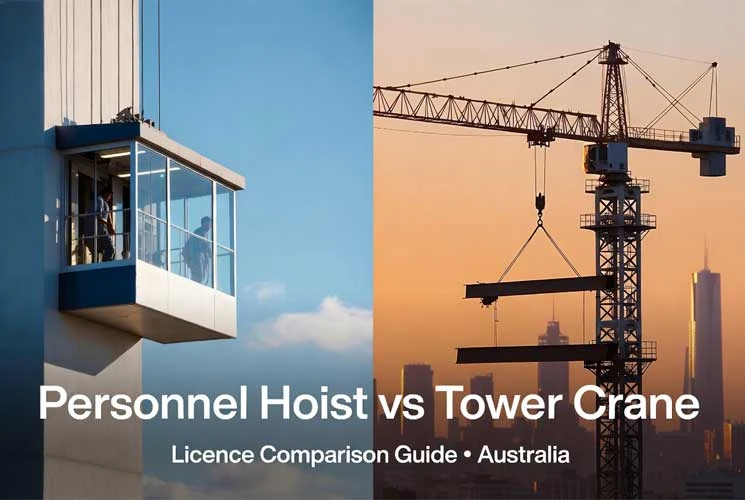
The HP Licence, formally known as CPCCLHS3001 – Licence to operate a personnel and materials hoist, authorises operators to use builder’s hoists for transporting personnel, goods, and materials. These hoists typically feature a car, structure, and associated machinery and can include cantilever, tower, or multiple winch configurations.
Key Responsibilities
- Conducting pre-operational and shutdown checks
- Identifying hazards and implementing controls
- Determining load weights
- Safely raising and lowering loads while respecting manufacturer limitations
- Managing emergency lowering procedures
- Ensuring continuous attendance at controls
Training for the HP Licence generally takes 2–3 days. It combines theory and practical assessments with no formal prerequisites. Upon successful completion, participants receive a nationally recognised Statement of Attainment and a High-Risk Work Licence (Class HP).
HP operators are indispensable on large commercial builds. They keep vertical movement flowing smoothly, transporting workers, tools, concrete, fit-out materials, and equipment across multiple floors.
Discover what makes HP licence holders valuable on large commercial builds
Understanding the Tower Crane (CT) Licence
The Tower Crane Licence, CPCCLTC4001 – Licence to operate a tower crane, covers the operation of jib or boom cranes mounted on tower structures (demountable or permanent), including both horizontal and luffing jib types.
Core Skills
- Comprehensive hazard identification and risk management
- Load calculations and sling selection
- Reading and interpreting load charts
- Pre-start, operational, and post-operational inspections
- Understanding Load Moment Indicators (LMIs)
- Safe load handling using signals and radio communication
The course typically runs for 4–5 days. Graduates obtain a Statement of Attainment and High-Risk Work Licence (Class CT).
Side-by-Side Comparison: HP Licence vs Tower Crane Licence
| Aspect | HP Licence (Personnel & Materials Hoist) | Tower Crane (CT) Licence |
|---|---|---|
| Unit of Competency | CPCCLHS3001 | CPCCLTC4001 |
| Duration | 2–3 days | 4–5 days |
| Focus | Vertical transport of people & materials | Heavy, long-reach lifting across site |
| Equipment Type | Builder’s hoists (cantilever, tower, winch) | Tower cranes (horizontal & luffing jib) |
| Typical Sites | High-rise, commercial builds | Major infrastructure, skyscrapers |
| Complexity | Moderate | High |
Training and Assessment Differences
Both courses emphasise WHS compliance, hazard controls, and safe communication. HP training focuses on repetitive, high-frequency operations and emergency procedures. Tower crane training delves deeper into load dynamics, stability, and complex coordination.
Career Opportunities and Earning Potential
HP Licence holders are highly valued for maintaining daily productivity and site coordination on commercial projects. Many combine it with other tickets for greater versatility.
Tower Crane operators often enjoy premium compensation and work on landmark projects, with strong pathways into supervisory roles.
Which Licence Should You Choose?
- Choose HP for quicker entry and operational logistics roles.
- Choose Tower Crane for technical heavy-lifting specialisation.
- Consider both for maximum career flexibility.
Final Thoughts
Whether you pursue a Personnel Hoist (HP) Licence or a Tower Crane Licence, both represent valuable investments in your construction career. Australia’s construction sector continues to grow, with strong demand for competent, licensed operators who prioritise safety and efficiency.