
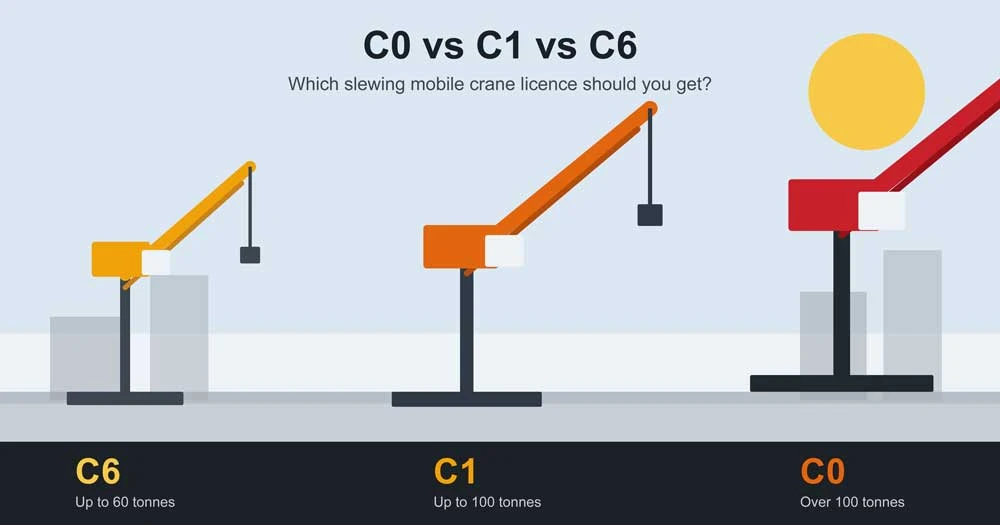
If you’re planning a career operating slewing mobile cranes in Australia, the C6, C1, and C0 licences are the three tickets you’ll come across — and choosing the right one comes down to lifting capacity, the jobs you want, and how much you’re willing to invest upfront. Here’s how the C6, C1, and C0 Slewing Mobile Crane licences compare, and which one makes sense for you.
Quick Answer
All three licences let you operate slewing mobile cranes, non-slewing cranes (like telehandlers and Franna cranes), and vehicle loading cranes (like Hiab and Palfinger units) — the difference is the tonnage cap. C6 covers cranes up to 60 tonnes, C1 covers cranes up to 100 tonnes, and C0 has no upper capacity limit, covering any slewing mobile crane. None of the three have a prerequisite licence, so you can enrol directly in whichever one matches your career goals.
C6 vs C1 vs C0 at a Glance
| Licence | Unit of Competency | Lifting Capacity | Course Duration | Prerequisite |
|---|---|---|---|---|
| C6 | TLILIC0023 | Up to 60 tonnes | 4–5 days (location dependent) | None |
| C1 | TLILIC0021 | Up to 100 tonnes | 5 days | None |
| C0 | TLILIC0020 | Over 100 tonnes (unlimited) | 5 days | None |
C6 Slewing Mobile Crane Licence
The C6 licence covers slewing mobile cranes up to 60 tonnes and is the entry point into slewing crane work. It’s well suited to general construction, warehousing, and logistics roles where lifts rarely exceed mid-range capacity. To enrol, you need to be 18 or over, hold valid photo ID, and pass a basic literacy and numeracy assessment — no prior crane experience is required. The C6 licence is valid for 5 years before renewal.
C1 Slewing Mobile Crane Licence
The C1 licence raises the ceiling to cranes up to 100 tonnes capacity, opening up larger commercial and civil construction lifts. Like the C6, there’s no prerequisite licence — you’ll need to be at least 18, complete an LLN assessment, hold 100 points of photo ID, and be able to obtain a Unique Student Identifier (USI). It’s a solid middle-ground option for operators who expect to work on bigger sites but don’t yet need unlimited capacity.
C0 Slewing Mobile Crane Licence
The C0 licence is the top of the ladder, covering slewing mobile cranes of any capacity over 100 tonnes. It’s the licence most in demand for major infrastructure, mining, and Tier 1 construction projects, where the largest cranes on site are often north of 100 tonnes. Because it has no prerequisite, you can go straight to the C0 course without holding a C6 or C1 first — though some employers prefer operators to build experience on smaller cranes before moving up.
Which One Should You Get?
- Choose C6 if you’re starting out in slewing crane work or expect to mostly operate cranes under 60 tonnes.
- Choose C1 if you want more flexibility for mid-to-large lifts without paying for capacity you may not use straight away.
- Choose C0 if you’re aiming for major construction, mining, or infrastructure projects where the biggest cranes on site are the norm, or if you simply want the broadest licence available so you’re never turned away from a job on tonnage alone.
Because there’s no prerequisite for any of the three, some operators go straight for the C0 to future-proof their career, while others prefer to start on C6 or C1 and step up as their experience and job opportunities grow.
Frequently Asked Questions
Do I need a C6 licence before I can get a C1 or C0?
No. C6, C1, and C0 are all separate, standalone licences with no prerequisite — you can enrol directly in the one that matches the capacity you need.
Can a C0 licence holder operate C6 and C1 cranes?
Yes. Because C0 has no upper capacity limit, C0 licence holders are qualified to operate any slewing mobile crane, including those within the C6 and C1 capacity ranges.
Which crane licence pays the most?
Operators with a C0 licence are generally eligible for the widest range of roles, including large-scale mining and infrastructure projects, which tend to offer the highest pay — particularly FIFO positions in WA and QLD.
Whichever licence you choose, all three are nationally recognised High-Risk Work Licences issued through your state or territory WHS authority once you complete the course and assessment. If you’re unsure which capacity suits your career plans, our team can help you match the right ticket to the jobs you’re targeting.


